

)
From planning lunch to discussing a random thought, Artificial Intelligence (AI) has transformed how people access information. It has also become a valuable resource for individuals seeking health-related information in seconds. With tools like chatbots, virtual health assistants, and medical informatics systems, AI can provide users with information about symptoms, conditions, treatment options, and even lifestyle changes. However, AI should be considered a supplementary tool rather than a replacement for professional medical expertise. It acts as an advanced signal translator, identifying patterns in medical data to assist with diagnosis and treatment planning.
Since AI has become a permanent part of everyone's life, on World Health Day 2026, here are some tips to effectively use AI for health, along with some do's and don'ts, as well as considerations regarding its limitations and potential side effects.
How to use AI for your health and well-being
1. Search for reliable sources
Utilise reputable health platforms and tracking apps that employ AI for personalised insights.
2. Ask specific questions
When using AI tools, be as specific as possible with your questions. This increases the chances of receiving accurate and relevant information.
3. Symptom triage
Chatbots and virtual assistants can help analyse reported symptoms to recommend next steps, such as scheduling a doctor's visit or seeking urgent care.
4. Monitor your health
AI-powered wearables and applications can help track health metrics such as heart rate, sleep patterns, and physical activity, allowing users to gain insights into their health over time.
5. Medical document analysis
AI tools can summarise complex medical records, explain unfamiliar terms in lab reports, and help you prepare questions for your doctor.
Do's and Don'ts
Do's
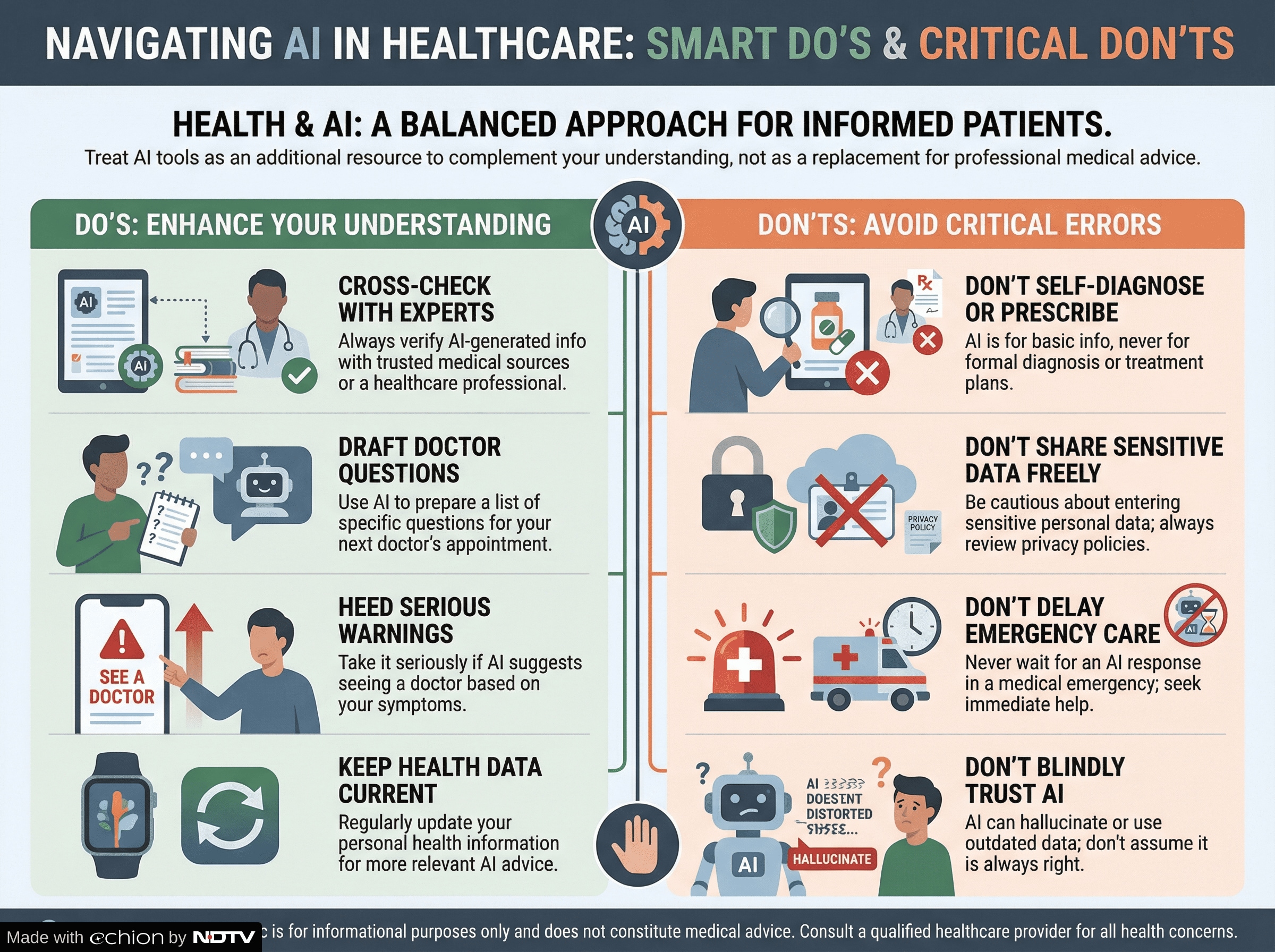
Consider AI tools as an additional resource to complement your understanding of health issues, not as a replacement for professional healthcare advice.
- Use it to understand basic information about a condition or medical term.
- Cross-check the information obtained from AI with trusted medical sources or consult a healthcare professional for confirmation.
- Keeping your personal health information current in your digital health tools can improve the relevance of the advice AI provides.
- Use AI to draft a list of specific questions to ask your doctor.
- If AI suggests seeing a doctor based on your input, take that seriously. It's a red flag that shouldn't be ignored.
Don'ts
- AI can assist with symptom checking, but it should never replace a qualified healthcare professional's diagnosis or treatment plan.
- Be cautious about entering sensitive personal data. Always review the privacy policies of health apps and websites.
- Don't use AI for a formal diagnosis or to prescribe medication.
- Don't assume the AI is always right; it can hallucinate or use outdated data.
- Don't delay emergency care while waiting for an AI response.
Limitations of AI in health
While AI can provide valuable information, it has limitations. Here are some considerations:
- No personalisation: AI lacks the ability to fully consider individual nuances, such as a person's unique health history and conditions. It's mainly based on algorithms and data trends.
- Potential for misinformation: If the AI tool uses flawed algorithms or outdated data, it may lead to incorrect recommendations or insights.
- Understanding context: AI may struggle with understanding the context of a health question or the emotional weight behind it, which is often important in healthcare.
- Contextual inappropriateness: Even correct facts may be dangerous if they ignore your specific allergies or current medication interactions, like suggesting a drug that reacts badly with your existing prescription.
- Mental health risks: Unregulated AI therapy bots may lack boundaries or provide harmful advice that can worsen psychological conditions.
Possible side effects
Using AI for health inquiries can have potential side effects, including:
- Anxiety and confusion: Searching for symptoms online can lead to increased anxiety or hypochondria, as users may misinterpret information or worry excessively about their health.
- Delayed care: Relying too much on AI could lead to delays in seeking necessary medical attention, especially if a serious condition is misdiagnosed or downplayed.
- Inaccurate health decisions: Making health decisions based solely on information from AI without medical oversight can lead to inappropriate self-management of health conditions.
In conclusion, while AI is a powerful tool for addressing health-related questions, it should be used thoughtfully and in conjunction with professional medical advice. Always prioritise your health by consulting with a doctor when in doubt.
Disclaimer: This content including advice provides generic information only. It is in no way a substitute for a qualified medical opinion. Always consult a specialist or your own doctor for more information. NDTV does not claim responsibility for this information.