




- The 5-minute memory test screens for early cognitive changes in adults, especially over 60
- It involves recalling words, drawing a clock, and delayed word recall to assess brain functions
- Scores reflect memory and visual-spatial skills; low scores suggest further medical evaluation
If you have ever forgotten where you left your keys or struggled to recall a name while in the middle of a conversation, you may feel worried about your brain health, especially as you get older. This is because most people know that while occasional forgetfulness is normal, persistent memory lapses can sometimes signal early cognitive decline. The good news is that simple screening tools that you can try at home exist. One such method is a quick, five-minute memory test that doctors often use as an early indicator of changes in thinking and recall. It is not a diagnosis, but it can offer valuable insight into how well your brain is functioning, and tell you whether you need to reach out to a doctor immediately or just take some time to recover and make lifestyle changes. Here is what the results might mean to you.
What is the 5-minute memory test?
According to Harvard Health, globally, over 55 million people are currently living with Alzheimer's disease and other forms of dementia, a figure projected to climb to 78 million by 2030 and reach 139 million by 2050.
A study published in 2024 on PLOS One says that Mini-Cog is a brief, easily accessible screening tool that demonstrates strong sensitivity and specificity for detecting cognitive impairment in older adults across diverse healthcare environments. It combines a brief memory task with a simple drawing exercise. Because it is fast, non-invasive, and easy to perform, it is often used in clinics to flag early cognitive concerns. The test checks multiple brain functions at once, including memory, attention, language and visual-spatial skills.
Read more: World Mental Health Day 2025: Indian Couples Experience Anxiety Differently, See Expert Tips
Who is this test for?
This test is commonly used for adults over 60, but it can also be helpful for anyone noticing changes in memory, focus or thinking speed. It is especially useful when family members observe subtle changes that the person themselves may dismiss. It is important to remember that stress, poor sleep, anxiety, depression and certain medications can all affect test performance. A low score does not automatically mean dementia.
Step-by-step guide to the 5-minute memory test
You can try this test at home, ideally with another person guiding you. Here are some steps to follow.
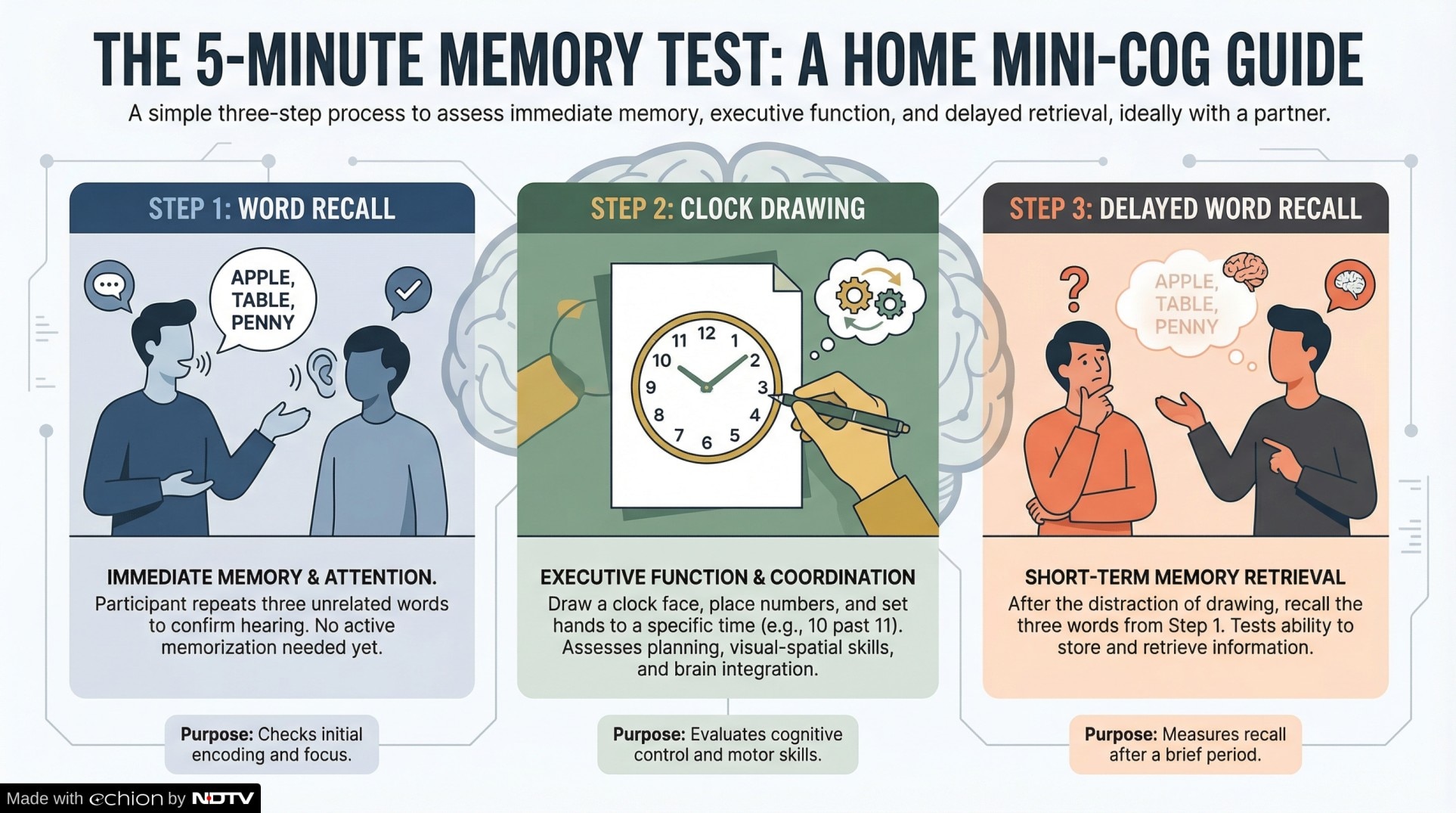
Step 1: Word recall
The person conducting the test says three unrelated words slowly and clearly. For example, apple, table, penny. You are asked to repeat the words to ensure you heard them correctly. This checks immediate memory and attention. Once repeated, move on to the next step without trying to memorise them actively.
Step 2: Clock drawing
You are given a blank sheet of paper and asked to draw a clock face. Place all the numbers where they belong and set the hands to a specific time, such as ten past eleven. This step assesses planning, visual understanding and motor coordination. It also checks how different areas of the brain work together.
Step 3: Delayed word recall
After completing the clock drawing, you are asked to recall the three words from Step 1. This tests short-term memory and the brain's ability to store and retrieve information after a brief distraction.
How is the test scored?
Scoring is simple. You receive points for correctly recalling the words and for drawing an accurate clock. If you remember all three words and draw a correct clock, the result is considered reassuring. Difficulty recalling the words or significant errors in the clock drawing may suggest the need for further assessment. Again, this test is a screening tool, not a final answer.
What can affect your performance?
Many factors unrelated to memory decline can influence results. Poor hearing, vision problems, fatigue or feeling nervous can all interfere.
Education level and cultural background may also play a role, particularly in tasks like clock drawing. That is why healthcare professionals interpret results in context rather than in isolation.
Read more: Early Alzheimer's Detection: New Blood Biomarker Test With Imaging Shows Promise
What to do if the test raises concerns
If you or a loved one struggles with this test, do not panic. The next step is to speak to a healthcare professional. They may recommend a more detailed cognitive assessment, blood tests to rule out vitamin deficiencies, or a review of medications. In some cases, addressing sleep problems, stress or depression can significantly improve memory. Early evaluation is helpful. If there is a problem, identifying it sooner allows for better planning, treatment and support.
Can this test help prevent memory decline?
The test itself does not prevent decline, but awareness does. Spotting early changes encourages people to take proactive steps, like going to a doctor or specialist for immediate support. Also, adding regular physical activity, a balanced diet, social engagement, mental stimulation and good sleep habits all support brain health. Managing blood pressure, diabetes and cholesterol also plays an important role in protecting memory.
Disclaimer: This content, including advice, provides generic information only. It is in no way a substitute for a qualified medical opinion. Always consult a specialist or your own doctor for more information. NDTV does not claim responsibility for this information.
Track Latest News Live on NDTV.com and get news updates from India and around the world

