

)
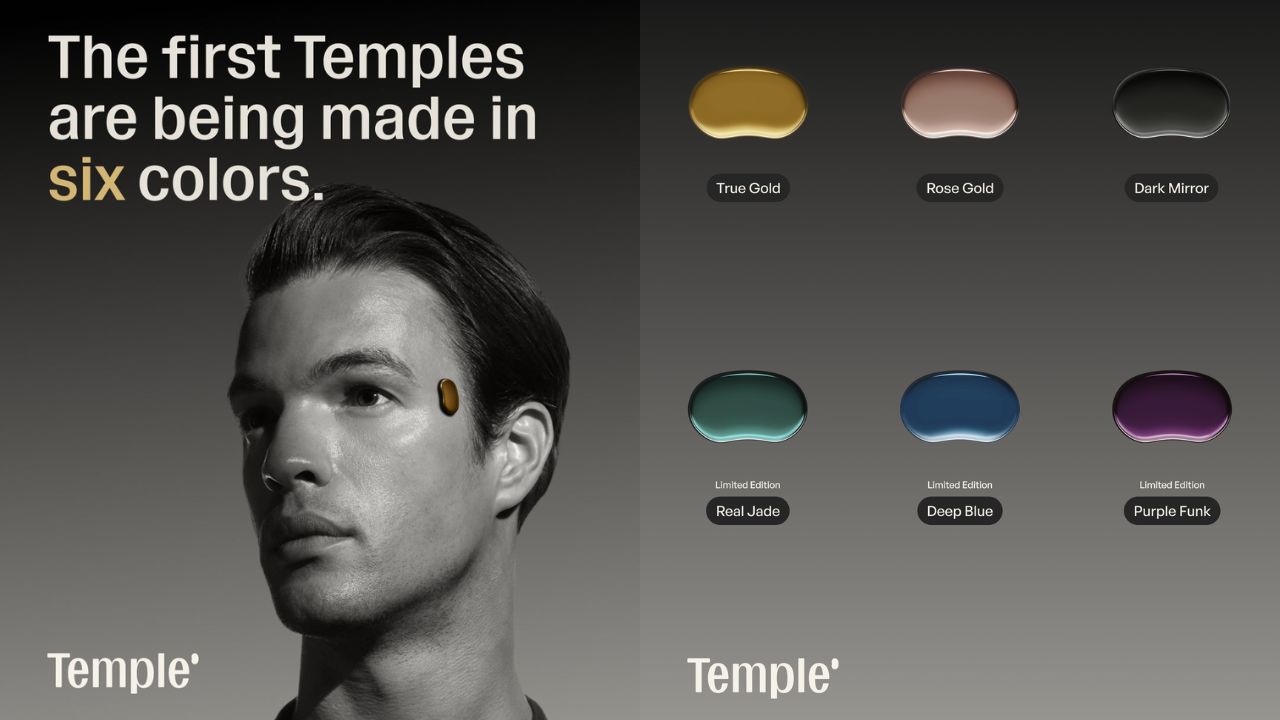
Deepinder Goyal, founder of Zomato and Eternal, in a recent post on X (formerly Twitter) has shared that the Temple wearable will be launched in six colours. The update comes as the device moves closer to its commercial launch. Goyal also said that pre-orders for the coloured-device could open as early as next week. People who have already joined the early-access waitlist are expected to get priority when bookings begin. The launch colours include True Gold, Rose Gold, Black Mirror, Real Jade, Deep Blue and Purple Funk.
The device, Temple, has attracted attention because, unlike smartwatches and fitness bands, it is worn on the side of the head, near the temple. Goyal, in his tweet, wrote, "Six colors for the launch edition of temple. Pre-orders open soon - hopefully next week; just need certainty on a couple more items. Folks on early access waitlist get priority access."
Six colors for the launch edition of @temple
— Deepinder Goyal (@deepigoyal) October 1, 2026
Pre-orders open soon - hopefully next week; just need certainty on a couple more items.
Folks on early access waitlist get priority access. Join the waitlist at https://t.co/hi9q1VXygW
Can't wait to get this 𝗂̶𝗇̶… pic.twitter.com/NVktLJ16yt
The 43-year-old described the latest version as the smallest wearable on the market by volume. In an earlier post, he wrote, "Volumetrically, Temple is now the smallest wearable on the market, and the most 10 powerful. Living and training with Temple is going to change your life." The device is designed to collect information related to brain blood flow and a metric called "Entropy". Goyal says that it reflects the body's metabolic and sympathetic demand. However, doctors have cautioned that such readings should not be treated as a replacement for medical tests or neurological evaluation.
What Does The Temple Device Measure?
1. Brain Blood Flow
One of Temple's main functions is measuring changes related to blood flow to the brain. The technology behind this is called BrainFlow. According to Goyal, the system is designed to continuously monitor these changes through a small wearable placed near the temple. A recent report suggests that BrainFlow showed a stronger relationship with changes in brain blood volume than changes in scalp blood volume, although the findings are still being evaluated.
Does @temple really monitor blood flow to the brain, or just the scalp?
— Deepinder Goyal (@deepigoyal) September 25, 2026
In our second validation study, we tested Temple BrainFlow against time-domain NIRS, one of the few technologies that can separate brain blood volume changes from scalp blood volume changes. We had 60… pic.twitter.com/vEJqxGPiXu
2. Entropy
Temple also shows a metric called Entropy. Goyal describes it as a measure of the body's real-time "cost of being alive". The number changes with factors such as sleep, stress, exercise, caffeine and meditation. This is a parameter which gets updated every second, on "an index from 1 to 250." 1 is the deepest rest that has ever been recorded, and 259 being the highest. The lower number was only seen in "fit, experienced meditators", whereas 250 was recorded in "elite athletes at the peak of their output and flow."
Sharing more about Entropy, Goyal said that "Everything moves Entropy." From sleep and stress to sprinting, coffee, meditation and more, Goyal says that everything impacts "your metabolism, your cost of being alive. And Entropy tracks it, live."
The Temple team has made a breakthrough.
— Deepinder Goyal (@deepigoyal) June 18, 2026
We have discovered (literally discovered) a biomarker, only readable on the temple region, and nowhere else, that measures the real-time cost of you being alive.
We are calling it Entropy™.
It's a live number on Temple's home screen,… pic.twitter.com/wEOu29hVBf
3. Cognitive Load And Stress
The device has also been described as being capable of tracking measures associated with cognitive load, stress and fatigue. The idea is that information collected continuously could help a person understand how the body and brain respond to physical or mental demands.
However, these measurements should not automatically be interpreted as signs of a neurological disease or brain injury. A wearable reading is different from a clinical diagnosis, and abnormal or concerning symptoms still need assessment by a healthcare professional.
How Does Temple Work?
Temple is worn on the side of the head, where it uses light-based sensing technology to collect signals from tissues and blood vessels. Such sensors can detect changes associated with blood flow and oxygenation.
The challenge is that light has to pass through several layers, including the skin, scalp, blood vessels, muscle and skull. Dr Arun L Naik, an AIIMS-trained neurosurgeon, has raised concerns about whether measurements from the temple can accurately represent blood flow in deeper brain arteries. He has stressed that the device should not replace established neurological investigations.
Disclaimer: This content including advice provides generic information only. It is in no way a substitute for a qualified medical opinion. Always consult a specialist or your own doctor for more information. NDTV does not claim responsibility for this information.