

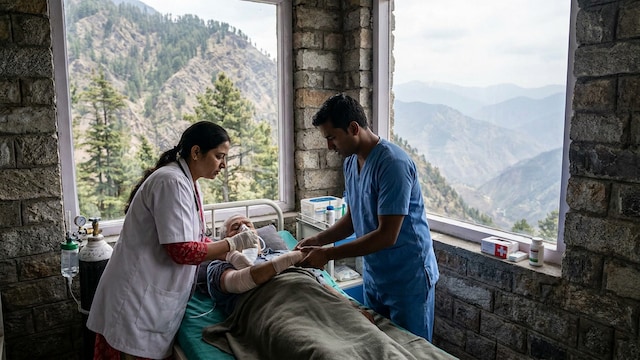
Having served in the Indian Army for 15 years as a medical officer and ENT specialist, I have seen first-hand how challenging healthcare can be in some of the country's most difficult terrains. My postings in Siachen Glacier, Kargil and Dras, along with my experience as a medical doctor during an expedition to Nanda Devi, exposed me to the unique health risks faced by soldiers and people living in high-altitude regions.
These experiences have stayed with me throughout my career. They have also shaped my understanding of why healthcare in the mountains needs a different approach. The combination of low oxygen levels, extreme cold, unpredictable weather and limited access to medical facilities makes both prevention and timely treatment especially important.
It is for this reason that I welcome the Indian Council of Medical Research's (ICMR) initiative to establish a Centre for High Altitude Medicine and Public Health Research in Keylong, Himachal Pradesh. I see this as an important step towards improving our understanding of high-altitude health and finding practical solutions to the challenges faced by people living and working in these regions.
Understanding the Health Challenges of High Altitudes
Living and working at high altitudes puts considerable stress on the human body. Reduced oxygen availability can make it difficult for the body to adjust, particularly when acclimatisation is inadequate. In some cases, this can lead to altitude-related illnesses that require urgent medical attention.
During my years in the Army, I realised that even seemingly minor health problems can become serious in remote locations. Harsh weather, difficult terrain and long distances from medical facilities can delay treatment, making an already challenging situation more complicated.
As an ENT specialist, I have also seen the importance of addressing ear, nose and respiratory problems in such environments. Ear pressure-related discomfort, respiratory complaints and nosebleeds are among the issues that may require medical attention.
For soldiers stationed in remote areas and families living in Himalayan communities, access to timely medical care can make a significant difference. The challenge is not just diagnosing a condition but ensuring that the right treatment reaches the patient when it is needed.
A Step Towards Better High-Altitude Healthcare
ICMR's initiative in Keylong is encouraging because it creates an opportunity to bring scientific research closer to the realities of high-altitude healthcare.
In my view, the real value of such a centre will lie in its ability to translate research into practical solutions. Scientific findings should help doctors make better decisions, enable healthcare workers to identify risks early and equip people living and working in these regions with the knowledge they need to protect their health.
There is considerable scope to improve our understanding of how the human body responds to prolonged exposure to low oxygen levels, extreme temperatures and other environmental stresses. Research in these areas could help refine acclimatisation guidelines, improve the early detection of altitude-related illnesses and strengthen emergency medical preparedness.
The centre could also contribute to better healthcare for Himalayan communities. People living in remote mountain regions face distinct health challenges, and their needs must remain an important part of the conversation around high-altitude medicine.
Lessons From Siachen, Kargil, Dras and Nanda Devi
My experiences in these regions have taught me that preparation is often as important as treatment.
In high-altitude environments, reaching a hospital or arranging medical assistance is not always straightforward. Difficult terrain and changing weather conditions can delay evacuation, while limited medical resources can make emergencies harder to manage.
This is why proper acclimatisation, early recognition of symptoms, trained medical personnel and well-planned emergency response systems are essential.
These measures may seem basic, but in challenging environments, they can make a crucial difference. Medical teams must be prepared for the conditions they are working in, and healthcare protocols must reflect the realities of these regions.
I believe the proposed centre in Keylong can help strengthen this approach by generating evidence that doctors and healthcare teams can use in real-world situations.
Turning Research Into Better Health Outcomes
For me, the success of this initiative will ultimately depend on what it achieves beyond research.
If its work helps prevent altitude-related illnesses, improves acclimatisation practices, strengthens emergency preparedness and makes healthcare more accessible in remote areas, it will have a meaningful impact.
I am particularly hopeful that the benefits will extend to both the armed forces and civilian populations across the Himalayan region.
There is also an opportunity to encourage greater collaboration between researchers, military medical professionals, hospitals and local healthcare providers. Those working on the ground often understand the practical difficulties of delivering care in these environments. Bringing their experience into research can help ensure that the solutions developed are relevant and effective.
The more closely research is connected to actual medical needs, the greater its potential to improve outcomes.
Building India's Expertise in High-Altitude Medicine
One of the biggest lessons I have learnt during my career is that medical preparedness cannot begin when an emergency occurs. It requires planning, training, preventive care and the ability to recognise warning signs before a condition becomes serious.
India has a significant opportunity to strengthen its expertise in high-altitude medicine. Our extensive Himalayan geography, the experience of military medical professionals and our growing research capabilities provide a strong foundation for this work.
The proposed centre in Keylong is an encouraging step in that direction. With sustained research and collaboration, it could help develop better medical protocols, improve emergency response and strengthen healthcare systems in some of the country's most remote regions.
Having worked in these environments, I understand how much difference timely medical care and proper preparation can make. I hope this initiative will help ensure that the lessons learnt through years of experience in the mountains are supported by scientific research and translated into better healthcare practices.
Ultimately, the purpose of medical research is to improve people's lives. Whether it is a soldier stationed in a remote post or a family living in a Himalayan village, everyone deserves access to appropriate and timely medical care.
For me, that is what makes this initiative important: the opportunity to use science, prevention and better healthcare planning to save lives, even in the most challenging terrains.
Disclaimer: The opinions expressed within this article are the personal opinions of the author. NDTV is not responsible for the accuracy, completeness, suitability, or validity of any information on this article. All information is provided on an as-is basis. The information, facts or opinions appearing in the article do not reflect the views of NDTV and NDTV does not assume any responsibility or liability for the same.