

)
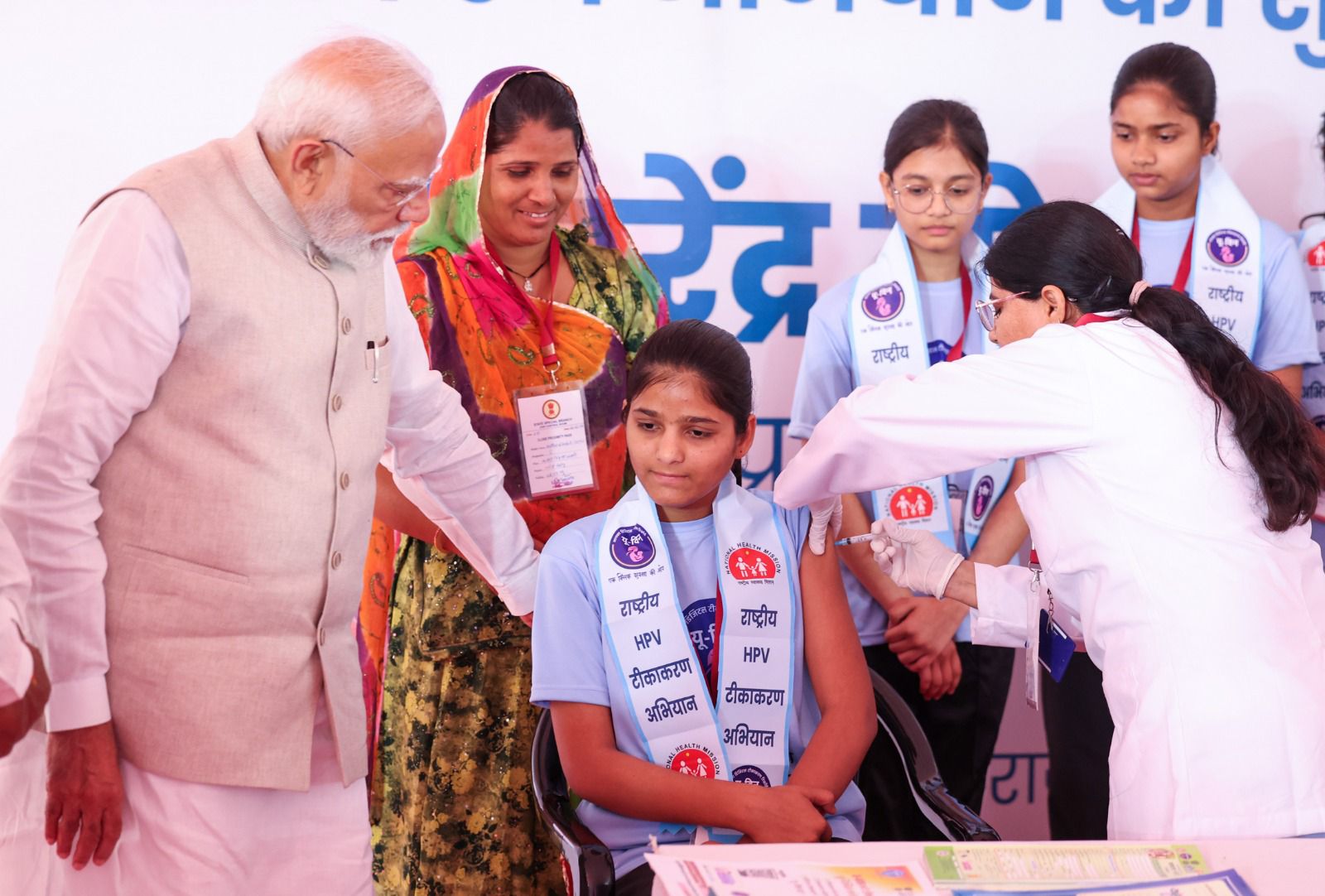
"We all know that when a mother falls ill in the family, the house feels scattered. If the mother is healthy, the family remains capable of facing every crisis," Prime Minister Narendra Modi said on Friday, launching a nationwide drive against cervical cancer while unveiling development projects worth Rs 17,000 crore in Rajasthan.
The Human Papillomavirus (HPV) vaccination rollout, aimed at protecting adolescent girls and women from cervical cancer, was flagged off from Ajmer, marking the start of its implementation across the country.
During the campaign, single-shot Gardasil 4, a quadrivalent HPV vaccine that provides protection against HPV types 16 and 18 which cause cervical cancer as well as types 6 and 11, will be administered. The programme will target approximately 1.15 crore girls aged 14 years every year across all States and Union Territories. The vaccine will be provided free of cost at designated Government health facilities.
The campaign will run in mission mode over a three-month period, during which eligible girls can receive the vaccine daily at designated facilities. Thereafter, the vaccine will continue to be available on routine immunization days. Vaccination will be conducted at Ayushman Arogya Mandirs (Primary Health Centres), Community Health Centres, Sub-District and District Hospitals as well as Government Medical Colleges and Hospitals.
Each session will be supervised by trained Medical Officers, supported by skilled healthcare teams. All sites will have functional Cold Chain Points (CCPs) and will be linked to 24*7 government health facilities to ensure immediate medical support and management of any rare Adverse Events Following Immunization (AEFI).
Also read: Protection At Every Age: Doctor Explains Why The HPV Vaccine Matters
Vaccination will be voluntary and informed consent from parents/guardians will be obtained prior to administration. With the launch of the programme, India will join more than 160 countries that have already introduced HPV vaccinations.
What is HPV?
Human Papillomavirus (HPV) is a common sexually transmitted infection. Almost all sexually active people will be infected at some point in their lives, usually without symptoms, says the World Health Organization (WHO). The infection usually resolves on its own without treatment. However, in some cases, the infection might progress to cause cancer.
Nearly 80% of cervical cancer cases are usually caused by high-risk HPV, particularly types 16 and 18. WHO says cancers from HPV can be prevented with vaccines.
How Essential is Vaccination?
A nationwide Swedish register-based study involving more than 9.26 lakh girls and women published in The British Medical Journal, provides evidence of sustained protection against invasive cervical cancer throughout 18 years of follow-up, with no indication of waning protection.
The study tracks the long-term impact of HPV vaccination, finding that the vaccine significantly reduces the risk of invasive cervical cancer, and that this protection remains strong up to 18 years after immunisation.
The research conducted using national health registers from 2006 to 2023, revealed that just 97 cases of invasive cervical cancer occurred among vaccinated women, compared with 833 cases in those who were not vaccinated over nearly two decades of follow-up.
For those vaccinated before the age of 17, the study observed a 79 per cent lower risk of developing cervical cancer compared with unvaccinated peers, and this sizeable reduction in risk remained virtually unchanged 13-15 years after vaccination.
Also read: PM Modi Launches Nationwide HPV Vaccination Programme For 14-Year-Old Girls
Individuals vaccinated at 17 years or older also saw substantial long-term protections: a 37 per cent lower risk overall, which strengthened to a 77 per cent reduced risk 13-15 years after vaccination compared with those who never received the vaccine.
The analysis further showed that the incidence of invasive cervical cancer has fallen across successive birth cohorts. Women born between 1999 and 2001 had markedly lower cancer rates by age 24 compared with earlier generations, pointing to broader population-level declines as vaccine programmes have expanded.
Disclaimer: This content including advice provides generic information only. It is in no way a substitute for a qualified medical opinion. Always consult a specialist or your own doctor for more information. NDTV does not claim responsibility for this information.