

)
The state of Uttar Pradesh has reported 685 confirmed H1N1 cases, prompting the state government to make H1N1 testing free at government hospitals. The state authorities are remaining vigilant, and the districts of Uttar Pradesh that remain most affected are Noida, Lucknow, Meerut and Ghaziabad. The free testing options for H1N1 in government healthcare facilities have been prioritised, as the 2026 rise in H1N1 cases is much more than the recent years' seasonal cluster outbreak. The need for detecting H1N1 cases is important to avoid severe infection and health complications.
What Is H1N1 And Why Are Cases Rising?
H1N1, or the influenza A virus, can infect the nose, throat, and lungs. The entire respiratory system is involved, and the virus spreads through air droplets. The infection can easily affect multiple people at once, as it can spread quickly through a cough, sneeze, or talking. There is a rise in cases each year as this viral strain becomes seasonally active in the ecosystem.
Current Situation In Uttar Pradesh
Currently, the confirmed cases across 57 districts as of late August 2026 are 551, and 685 confirmed H1N1 cases as per the Central Surveillance Unit, Integrated Disease Surveillance Programme (IDSP), NCDC. But the complete statewide updated tally of cases hasn't been reported yet.
What Are The Symptoms Of H1N1?
As per the Influenza and Respiratory Viruses Journal, H1N1 could present with symptoms of the common seasonal flu, but some patients may also show serious digestive symptoms and severe respiratory system complications. These symptoms could be:
- Fever
- Cough
- Sore throat
- Runny nose
- Body aches
- Headache
- Fatigue
The exact effect of each of these symptoms in those who are positive for H1N1 could vary. A review suggests that the exact figures could look something like this:
- Cough (84.9%)
- Fever (84.7%)
- Headache (66.5%)
- Runny nose (60.1%)
- Muscle aches/body pain (58.1%)
Emergency Warning Signs
The warning signs that can turn into a medical emergency could be:
- Difficulty breathing
- Persistent chest pain
- Confusion
- Severe dehydration
Who Should Get Tested For H1N1?
The tests for H1N1 are mandatory for those who show symptoms and those who fall under the high-risk category, as H1N1 could turn into a medical emergency. The rise in secondary infections is higher among those who already have a weak immune system. Complications could result in hospitalisations and even cause death.
Where Can You Get Free H1N1 Tests In India?
Free H1N1 tests are available at government medical colleges, district hospitals, community health centres, primary health centres and other state-run government health facilities.
Alongside free medical tests for H1N1, the state has instructed the medical facilities to maintain other medical facilities that may be needed to manage the rise in cases.
These include:
- Flu outpatient department and separate flu counters to deal with the influx of patients.
- Special sample collection facilities that could easily collect the samples and provide results quicker.
- Standardised testing such as RT-PCR testing arrangements to provide clear results.
- Isolation wards and beds for patients who have severe H1N1 so ample medical facilities are available.
- A stock of antiviral medicines such as oseltamivir to effectively treat positive H1N1 cases.
Integrated Disease Surveillance Programme (IDSP) Network
The National Centre for Disease Control (NCDC), Ministry of Health and Family Welfare, has established an Integrated Disease Surveillance Programme (IDSP) Network to collect and analyse data of positive H1N1 cases to assess how many people are actually positive within a state.
ICMR-Approved Public Health Labs
The Indian Council of Medical Research (ICMR) has a Virus Research and Diagnostic Laboratory (VRDL) Network that monitors cases of H1N1 through diagnostics, surveillance, and testing, as it is an infectious disease that needs to be tracked for preparing to handle the fallout.
State Health Department Facilities
The state health department facilities that have free H1N1 tests available are as follows:
- KGMU, Lucknow
- Dr Ram Manohar Lohia Institute of Medical Sciences, Lucknow
- Government Institute of Medical Sciences (GIMS), Greater Noida
There may be more district hospitals that could also offer this service, as they fall under the state government's H1N1 testing and surveillance arrangement, as Uttar Pradesh Chief Minister Yogi Adityanath indicated in a meeting.
The availability of teleconsultation services is also to be ensured, as a state helpline needs to address the concerns of the public.
The referral process for testing could be provided to those who may be confused as they present with symptoms.
Government H1N1 testing is needed, as private healthcare facilities have varying pricing for necessary tests, causing hindrances for those who need it urgently.
How Is H1N1 Diagnosed?
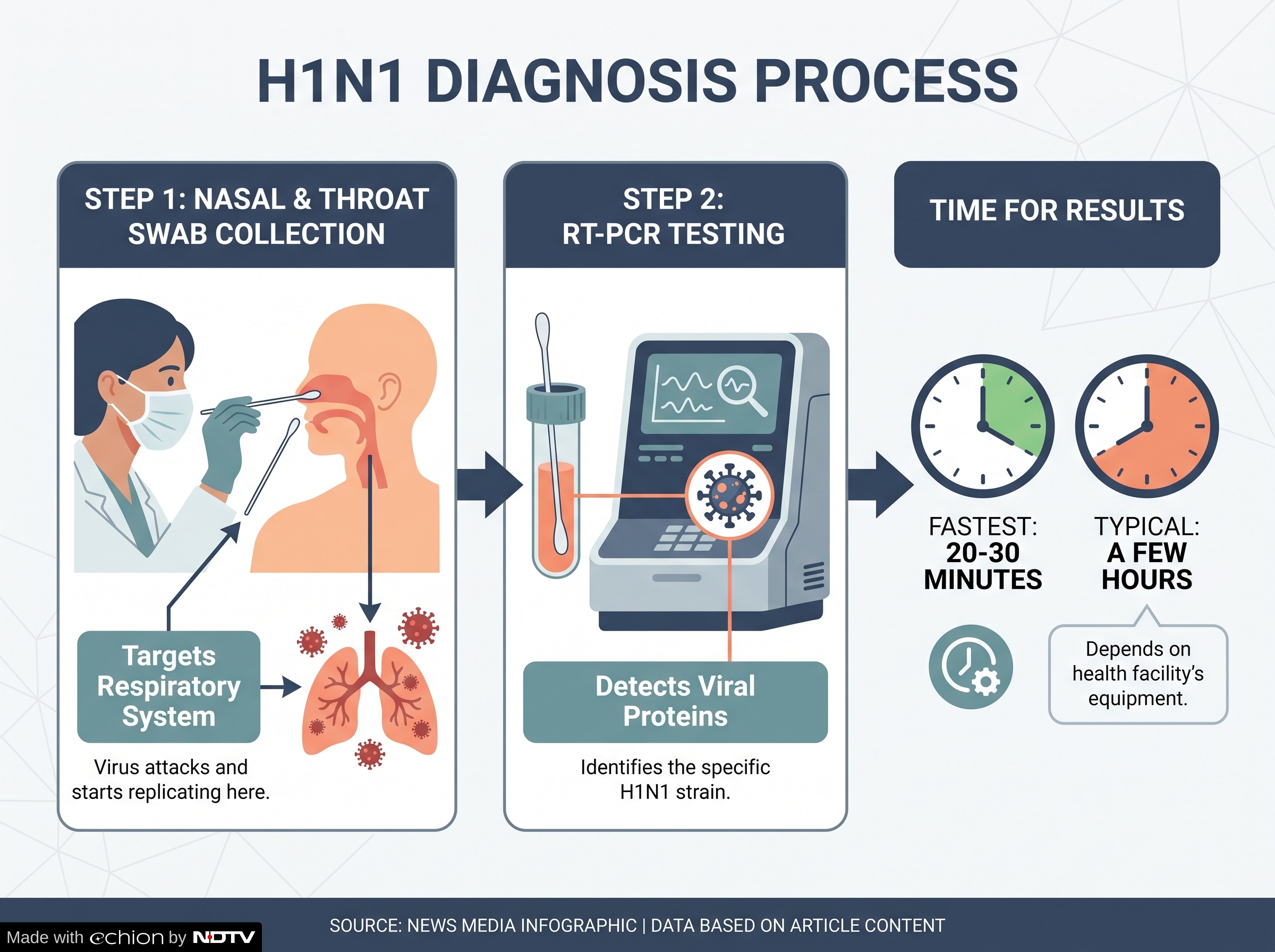
The diagnosis for H1N1 depends on detecting the strain in the respiratory system as per these steps:
- RT-PCR testing is used to detect the presence of the viral proteins of the strain.
- Nasal and throat swab collection is also necessary, as the disease attacks the respiratory system and starts replicating.
- Time required for results depends on the strain, which could be detected in 20-30 minutes but also takes a few hours depending on the health facilities' equipment.
- Accuracy of H1N1 testing as per the Centre for Disease Control (CDC) is around 90-95%.
Treatment Options For H1N1
The treatment options for H1N1 currently involve making use of effective medications within 48 hours of the infection. The onset of symptoms needs to be medically addressed by using oseltamivir, as it offers protection from severe infection.
Home Care Measures
At-home care for H1N1 involves isolating to contain its spread and focusing on:
- Hydration
- Rest
How To Protect Yourself During An H1N1 Surge
To protect yourself during an H1N1 surge, you need to focus on these kinds of preventive strategies:
- Hand hygiene is necessary to avoid transmission of the infection.
- Do not touch your eyes, mouth, or nose to stop the transfer of germs.
- Mask use when symptomatic is necessary to avoid community spread.
- Avoid crowded spaces if sick, as it could spread.
- Annual flu vaccination to avoid serious health complications.
When Should You Seek Immediate Medical Help?
People who have H1N1 should seek medical help when they experience any of these signs, as the infection has turned into a medical emergency:
- Breathlessness
- Oxygen drop
- Persistent high fever
- Severe weakness
- Worsening symptoms in high-risk groups
H1N1 free tests in Uttar Pradesh have made it possible for the general public to get tested when they experience the symptoms of the infection.
Also Read: Why H1N1 Is Hitting Some Indian Cities Harder Than Others This Year
Disclaimer: This content including advice provides generic information only. It is in no way a substitute for a qualified medical opinion. Always consult a specialist or your own doctor for more information. NDTV does not claim responsibility for this information.