


Harry Potter actor Daniel Radcliffe has been open about his struggles with mental health and alcohol abuse during his time as a child actor. In an interview with Bustle, Daniel Radcliffe said that he agrees with singer-actor Ariana Grande that therapy should be accessible on set for all young performers. "Being a child actor is a thing like... whether you not or make it out with a good frame of mind is so much luck. I was so lucky with the parents I have, but also with so many people on set who looked after me, being surrounded by the right people at the right time is so important. But I definitely think there have been some really, really tragic stories in the last few years," he said.
He emphasised that therapy should be normalised for child actors.
"There was a very young man who took his life, who was a young actor... And in talking to people about why that happened, I have seen that thing mentioned is that he was somebody, as I have been through, viewed by people that 'you've got it all', 'you're actor', 'you're so young, you've got money', so you feel like you don't have right to complain. That atmosphere is so hard to get past that, actually, some sort of mandated therapy would probably be a really, really great thing. Normalise it. Start therapy before you need it."
Child actors often face a unique set of psychological pressures that differ significantly from a typical childhood. Mental health advocates and former child stars, such as Daniel Radcliffe and Noah Schnapp, have increasingly called for mandatory therapy to manage these challenges.
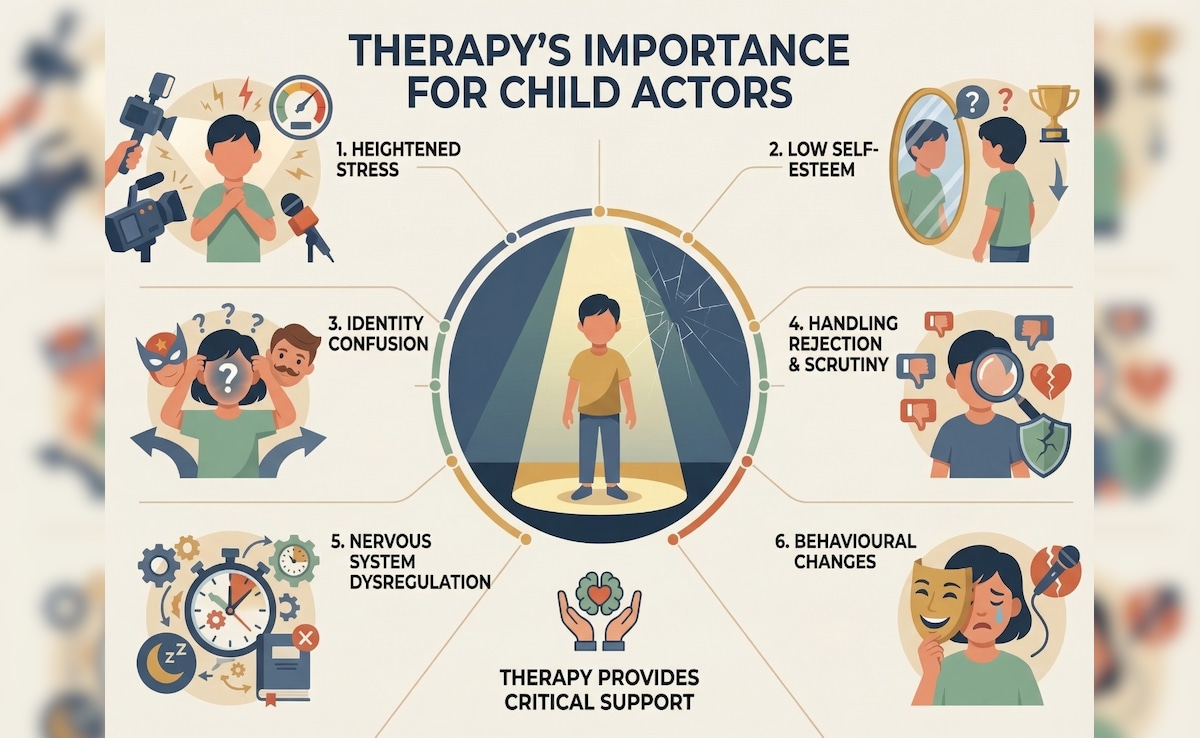
Understanding the importance of therapy for child actors
NDTV spoke to multiple mental health experts to understand why therapy is essential for child actors.
1. Hightened stress
"Unlike regular children, child actors are exposed to fame and public scrutiny at a very early age and being constantly in the spotlight can become overwhelming. The pressure to perform, public attention, and expectations from audiences and the industry can gradually lead to stress and anxiety," said Dr. Krithishree Somanna, Consultant Physiatrist, KMC Hospital, Mangalore.
2. Low self-esteem
"For child actors, the visibility aspect of how they are performing becomes much larger. In that aspect, the anxiety, the fear of failure, the kind of attention, praise, appreciation, all of that, that a child gets at a young age for their performances, they tend to internalise and can affect their ability to develop their sense of self-belief, their self-worth, all of that, that tends to depend upon their success," explained Mimansa Singh Tanwar, Clinical Psychologist, Head Fortis School Mental Health Program, Adayu Mindfulness.
3. Identity confusion
Growing up in the public eye makes it difficult for children to discover who they are outside of their roles or public personas. They are often expected to behave with adult-like perfection while they are still developing.
"At a young age where the child is still developing their sense of identity, and it is a critical stage where they're forming their sense of self, this widely recognized aspect of public persona can sometimes make it very difficult for them to navigate this challenge of what they are portraying the world to be in their different ways and shapes," Ms Tanwar added.
4. Handling rejection and public scrutiny
Unlike most children, young performers face professional rejection and public judgment for their mistakes.
"Scrutiny can certainly exacerbate their mental health challenges, specifically if they're going through a difficult time period or if they don't have a strong buffer in the form of parental support or support even in terms of a mentor to be able to help them deal with these things," Ms Tanwar said.
5. Nervous system dysregulation
The unpredictable nature of the entertainment industry, including inconsistent schedules, high-pressure environments, and intense workloads, can disrupt a child's need for routine and stability. "Disruption in sleep cycle and academics, along with the constant pressure to perform, can lead to chronic stress in the long run," said Dr. Pretty Duggar Gupta, Consultant - Psychiatrist, Aster Whitefield Hospital
6. Behavioural changes
According to Dr. Somanna, children who appear confident on stage or in front of a camera may still struggle emotionally. Being able to handle a large crowd or hold a microphone on stage does not necessarily mean a child can cope with personal criticism or negative feedback. In many cases, the emotional burden becomes visible through behavioural changes.
How to support child actors
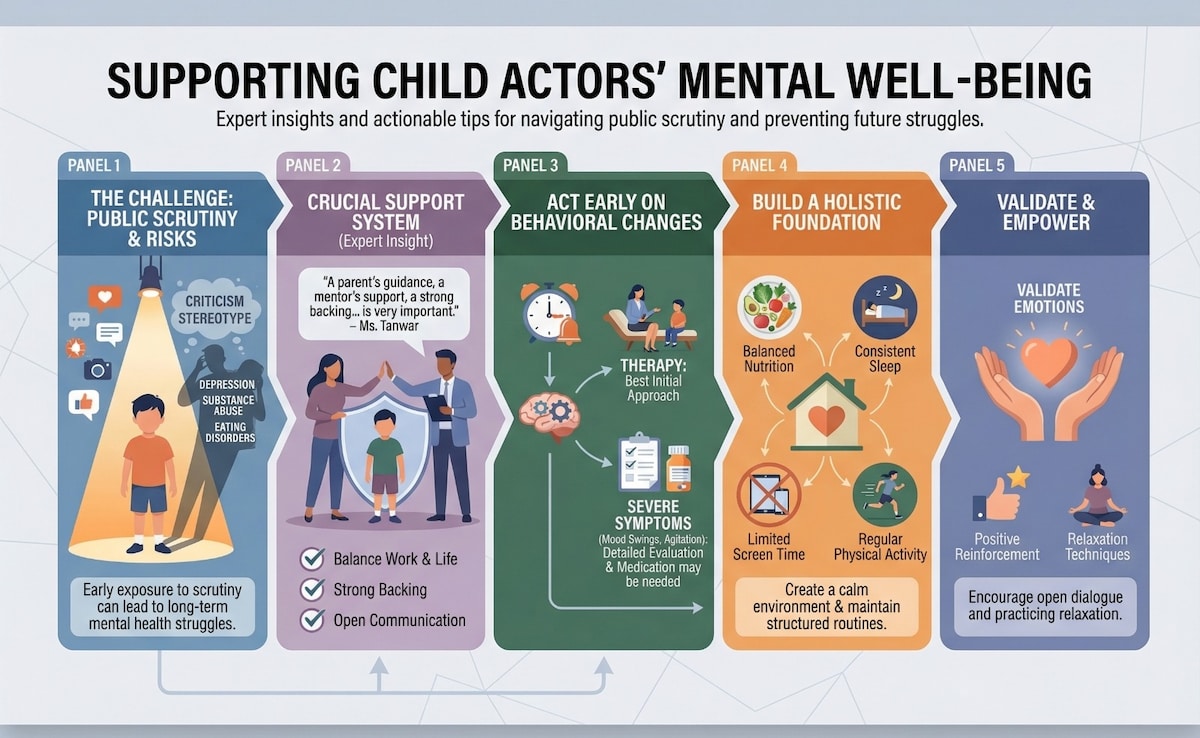
Early intervention through therapy can help prevent future struggles with depression, substance abuse, and eating disorders that have historically affected former child stars.
"It's important to understand that acting as a profession in itself for a young child is not harmful, but the kind of public scrutiny, which is more widely done in today's age of social media and the kind of criticism and conversations around stereotype, perceptions, negativity that a child tends to get, that's where a parent's guidance, a mentor's support, a strong backing and at the same time helping them to balance their work life, is very important," Ms Tanwar highlighted.
The expert further shared the following tips:
- When caregivers, family members, or teachers notice behavioural changes, it is important to act early. Therapy is often the best initial approach. If the condition progresses to severe mood swings, agitation, or refusal to follow rules, a detailed evaluation may be required, and medications may be advised.
- Parents can support children by creating a calm environment, maintaining structured routines, encouraging open communication, and validating the child's emotions.
- Positive reinforcement, relaxation techniques, balanced nutrition, limited screen time, regular physical activity, and consistent sleep schedules can also help.
"Child actors are at a higher risk of developing anxiety issues, depression, burnout, hypochondriasis, sleep issues, body image issues and sometimes even substance issues. Therapy provides a safe space where the child actors can separate their personal identity from the characters they play and the constant pressure they deal with," Dr. Duggar concluded.
Disclaimer: This content including advice provides generic information only. It is in no way a substitute for a qualified medical opinion. Always consult a specialist or your own doctor for more information. NDTV does not claim responsibility for this information.