

)
For many patients living with joint pain, the biggest fear isn't the surgery itself, it's what comes after. The long recovery, the pain, and the uncertainty of whether they will walk comfortably again. Orthopedic surgery is slowly rewriting the story, with the help of robotic technology.
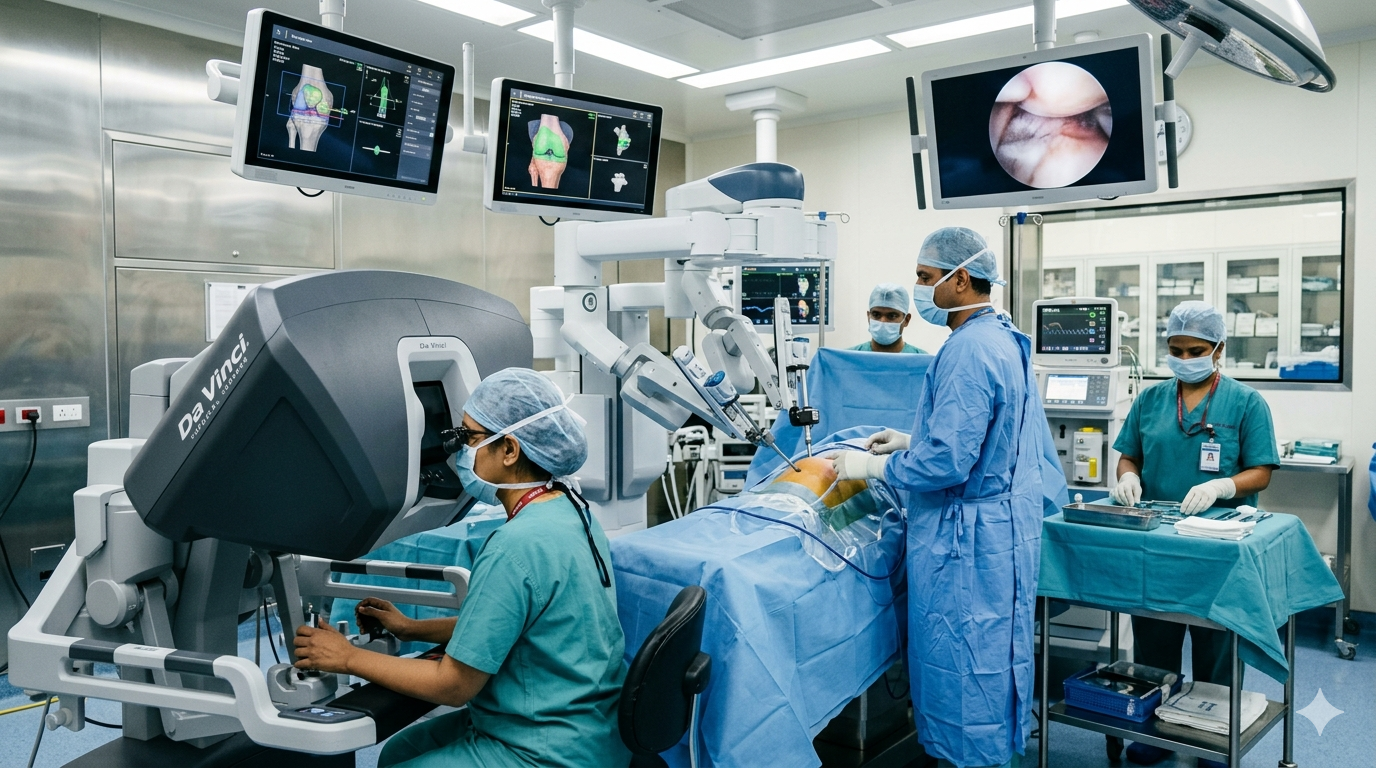
Robot-assisted orthopedic surgery enables surgeons to plan surgeries with a level of accuracy that had been difficult before. Each incision, each angle, and each placement of the implant is charted on the patient's body, making it possible for surgeons to work with a high degree of accuracy while doing as little damage as possible to the tissue. This means that patients can expect less bleeding, smaller incisions, less pain, and a quicker recovery time.
As this advancement played out across three very different patients at Manipal Hospitals, where we conducted one hip replacement and two knee replacement surgeries using three different robotic platforms, all in one day. Each of these surgeries presented its own set of challenges, and each of them illustrates how robotics is assisting surgeons in personalizing treatment, as opposed to standardizing it.
A Young Man in Severe Pain
The first patient was a 40-year-old man who had been dealing with intense hip pain caused by avascular necrosis, a condition where reduced blood supply causes the hip joint to collapse over time. What made his case particularly concerning was his age. Joint replacement at 40 raises important questions about durability and long-term movement.
With robotic assistance, Dr. Kini conducted a total hip replacement surgery, which offers the precise placement of the implant so as to avoid impingement and dislocation. This was crucial in restoring proper tension in the patient's hip and ensuring the operated leg length matched the opposite side.
A Knee Replacement Without Removing an Old Rod
The second surgery was much more complicated. In the case of a 67-year-old woman who had been suffering from arthritis and deformity of her knees for almost five years. As her pain was excruciating that even the simplest of tasks had become difficult for her. To add to her problems, she also had a metal rod in her thigh due to a previous injury.
In conventional surgery techniques, this rod would have to be removed, which in itself is a procedure. However, with the robotic system, the surgical team was able to do a total knee replacement without having to touch the existing implant.
The surgery was carried out using robotic support, allowing precise planning around the rod. At the patient's request, titanium niobium nitride, coated implants were used, an important choice for patients who are sensitive or allergic to nickel. The result was a safer surgery and a smoother post-operative course.
Choosing Robotics the Second Time Around
The final patient of the day was a 70-year-old man who had already experienced knee replacement surgery on one knee using conventional methods. When it came time to operate on his other knee, he chose a robotic-assisted approach, hoping for less pain and a quicker recovery.
This time, the surgery was done with robotic support, allowing better soft tissue balance and using oxinium implants. For patients who have experienced both approaches, the difference in recovery is often noticeable within the first few weeks.
More Than Technology: Better Patient Experience
It is not only about efficiency when it comes to performing three complex joint replacement surgeries in a day. It is a sign that robotic assistance is helping surgeons work smarter, not harder.
For patients, the actual implications are in:
- Lesser risk of complications
- Less pain after the surgery
- Lesser requirement for painkillers or analgesics
- Speedy return to mobility
- Early discharge
- More feel of a natural knee
- Better alignment and long-term outcome
It is not about replacing the orthopedic surgeon. It is about enhancing surgical skills with precision so that patients can heal faster and gain their independence sooner.
With the advancement of technology, one thing that has not changed is the aim of assisting people in walking without pain and living without limitations.
(By Dr. Sunil G Kini, HOD & Consultant - Orthopedic & Robotic Joint Replacement Surgery, Manipal Hospitals, Old Airport Road)
Disclaimer: The opinions expressed within this article are the personal opinions of the author. NDTV is not responsible for the accuracy, completeness, suitability, or validity of any information on this article. All information is provided on an as-is basis. The information, facts or opinions appearing in the article do not reflect the views of NDTV and NDTV does not assume any responsibility or liability for the same.