





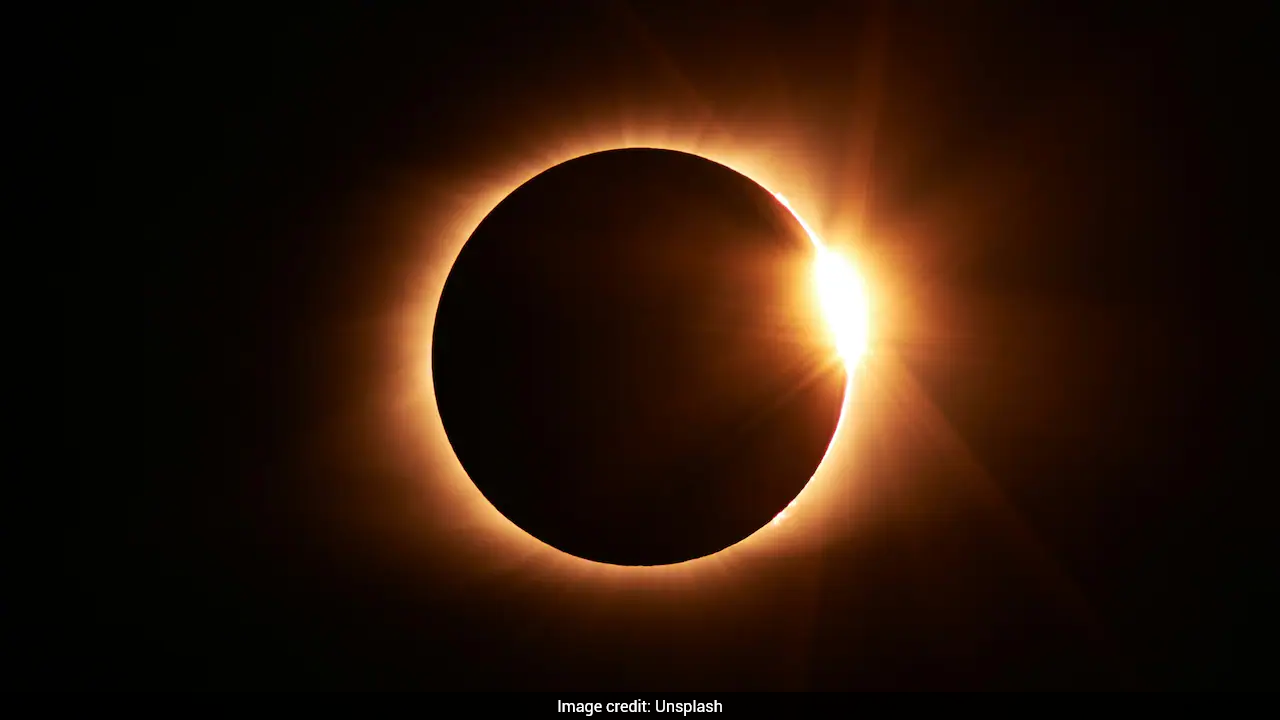
Total Solar Eclipse 2026: Sky watchers are gearing up for the total solar eclipse this year as NASA confirmed that the cosmic event will sweep across parts of Europe on August 12, 2026. A total solar eclipse happens when the Moon slips in front of the Sun, casting its shadow on those in the centre of the Moon's shadow. As the topic starts to buzz on social media, many users have begun asking details of the event, especially about the places from which it will be visible.
"A total solar eclipse is one of those rare moments when millions of people can look up together and feel both wonder and curiosity," Carole Mundell, the ESA's director of science, said in a statement. "It is a shared moment that connects us to the Universe and reminds us that the desire to explore and understand is one of humanity's greatest strengths."
Also read | Scientists Finally Detect Wind Streaming From Milky Way's Central Supermassive Black Hole
Total solar eclipse: When and where to see it
The Moon will pass directly between the Sun and Earth, casting a narrow path of totality across parts of the North Atlantic and Europe. Totality, when the Sun is completely blocked, will be visible in eastern Greenland, western Iceland, northern Spain, and a small corner of northeastern Portugal.
According to NASA, for most of Europe, northern North America, and northwestern Africa, only a partial eclipse will be visible, with part of the Sun still showing.
The space agency further mentioned that for many along the western part of the eclipse path (in mainland Europe and Africa), the Sun will set while it's still partially eclipsed, which would create an opportunity to see a sunset eclipse.
The eclipse won't be visible from India.
Also read | NASA Astronaut Shares Aurora Show From Space Station; Says "A Lot Going On Right Now"
Total solar eclipse: How long does it last
Duration varies by location. NASA confirmed that for most in the path of totality, the Sun will be fully eclipsed for less than two minutes. For anyone near the very centre of the eclipse path in Greenland, Russia, or the North Atlantic, totality will last a little longer, but still less than two and a half minutes.
Total solar eclipse: What you'll see
During totality, the Sun's outer atmosphere, or corona, becomes visible to the naked eye as a faint glow around the dark Moon. Temperature drops slightly, and planets may appear bright in the darkened sky.
Total solar eclipse: Safety reminder
Never look directly at the Sun without certified solar eclipse glasses, even during a partial phase. Eye damage can occur instantly. Only remove protection during the brief moments of totality.
"Before and after totality, everyone observing the Sun must use eye protection to view the partial phases of the eclipse, when the Moon is covering only part of the Sun's disk. Observers can use solar viewing glasses (often called "eclipse glasses"), handheld solar viewers, or other safe solar filters that block out most of the Sun's light and prevent eye damage," NASA wrote.
Track Latest News Live on NDTV.com and get news updates from India and around the world

