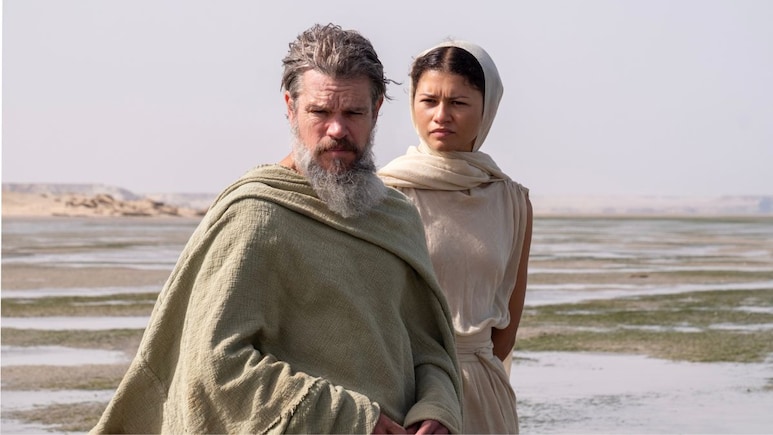
Around 725-675 BCE, Homer first sang of Odysseus's long, punishing journey home from Troy. Nearly 300 centuries later, Christopher Nolan has attempted his own crossing -- and true to form, he arrives with a cinematic epic that is less interested in Olympus than in the man standing beneath it.
The Odyssey, starring Matt Damon as the wandering king of Ithaca, is Nolan's first true venture into myth. And from the opening scene -- 'In the time of apparent magic '-- it's clear he has made a choice that will define and divide opinion about the movie: the gods are almost entirely gone.
-

-
 NDTV World Summit 2026: What To Watch Out For | PM Modi, Jaishankar, AI And Global Power Shifts
 -
 Andrew Ng On AI At Scale: Building The Intelligence Economy | NDTV World Summit 2026
 -
 NDTV World Summit 2026: Behind The Scenes As Ayush And Vedika Preview Two-Day Mega Event
 -
 Who Is Rajiv Mehta? Lilavati Hospital Trustee To Speak At NDTV World Summit 2026
 -
 Ex-CIA Director To Decode 'War In Times Of AI' At NDTV World Summit
 -
 From Call Centre To Billion-Dollar Disruptor: Nikhil Kamath At NDTV World Summit
 -
 Alain Ebobisse, Africa50 CEO, To Attend NDTV World Summit 2026. All About Him
 -
 Kriti Sanon At NDTV World Summit: A Look At Her Career And Business Ventures
 -
 Ex-CIA Director To Decode 'War In Times Of AI' At NDTV World Summit
 -
 Who Is Vikram Rai, CEO, South Asia GE Aerospace, Set To Attend The NDTV World Summit 2026
Homer's Gods
As an English major, Homer's Iliad and Odyssey were my introduction to Greek mythology. In the epics, the gods are not mere mise-en-scene but the central propeller. The Trojan War -- the source of Odysseus's apparent guilt in Nolan's retelling -- didn't begin with Helen's infidelity. It began with an invitation for the wedding of sea-nymph Thetis to the mortal king Peleus, a union so significant that nearly every god and goddess on Olympus was invited, along with plenty of mortal royalty.
The one name that wasn't on the guest list was Eris, the goddess of strife and discord. The other gods, unsurprisingly, didn't want the personification of chaos ruining a wedding, so they didn't invite her.
Unsurprisingly, Eris did not take it well. She showed up anyway, uninvited, and set in motion a chain of events that led to ten years of war before the fall of Troy and, eventually, to the fall of the order of the gods and the Bronze Age.
Then in Odysseus's decade-long journey home, half the plot is driven by Poseidon's fury and the other half by Athena's intervention, disguises, protections, and manipulation. All this while Zeus arbitrates from Olympus like a weary judge presiding over squabbling relatives.
The Odyssey is, at its core, a story about what humans owe capricious, petty, magnificent gods and what happens when a mortal's cleverness lets him slip past their notice.
Nolan's Adaptation
In his retelling, Nolan doesn't strip the epic entirely of its mysticism. He keeps the monsters intact in the Cyclops, Circe, and the Sirens to make a hero out of Odysseus. But the deities themselves are reduced to distant presences in the form of a storm that might be Poseidon's wrath or simply the sea, a vision of Athena that could be divine guidance or personification of the hero's guilt and consciousness.
The adaptation felt like a version of Olympus recast in a quieter, more monotheistic register, where a single, remote moral authority stood in for the loud, quarreling pantheon Homer wrote.
Homer's gods aren't just plot devices. They're the moral weather of the entire poem. Nolan's directorial choice to strip them down to ambiguous flicker made Odysseus's sufferings less cosmic and more bad luck.
Heroification Of Flaws
Homer's Odysseus is a magnificent, exhausting contradiction. He's brilliant but vain, loyal but reckless, a devoted husband who can't stop testing his own cunning even when silence would save his men. His hubris, or pride, in his refusal to leave the Cyclops's island without one last taunt, unable to resist announcing his own name, is precisely what prolongs his suffering. The poem never lets him off the hook for it.
On his voyage home, he encountered the Lotus-Eaters early on, a peaceful people whose fruit made anyone who tasted it forget home entirely. Several of his men ate it and lost all desire to leave. But Odysseus refused to touch it himself and instead dragged his drugged crew back to the ships by force, tying them down until the craving passed.
Later, on Circe's island, the sorceress turned his men into pigs, but rather than fighting her, Odysseus became her lover and stayed on her island for a full year before his men urged him to continue home.
Even longer was his stay with the nymph Calypso, who kept him on her island as her lover for seven years, offering him immortality if he stayed forever. She only fully lets him go after Zeus' intervention.
Nolan almost erases these flaws. His Odysseus is closer to Emily Wilson's now-famous rendering of him as "a complicated man" than to the trickster-hero of older translations. He's a soldier still carrying the scars of war in his soul.
The source of his suffering is less divine punishment for hubris and more a man psychologically unmade by what he did and saw at Troy, slowly reassembling his own memory and identity across the voyage.
It's less about the gods punishing him for his arrogance and more about a traumatised man punishing himself when the gods may or may not be watching.
That's a very Nolan-esque reframing, where trauma stands in for divine retribution, the way time dilation once stood in for grief in Interstellar. This makes the film's Odysseus much gentler and more sympathetic a figure than Homer's. The poem's Odysseus is a survivor you admire and at times wince at. Nolan's hero is easier to root for.
A Visual Masterpiece
Visually, this could arguably be one of Nolan's most awe-inspiring stories, with IMAX-scaled seascapes, a genuinely upsetting Circe sequence, and a Trojan Horse set piece that earns its hype.
Ludwig Goransson's score does a lot of the film's emotional heavy lifting, especially in places where the script, stripped of divine stakes, occasionally goes quiet on meaning. The casting of Anne Hathaway as grieving Penelope and Tom Holland as lost Telemachus felt apt. Robert Pattinson as Penelope's scheming suitor Antinous delivers one of his career-best performances. Zendaya's Athena had a unidirectional arc as Odysseus's guardian angel, but she shines in the limited screentime.
But what's undeniable is that this is not Homer's Odyssey transcribed to film. It's Nolan's argument with Homer, staged on an enormous scale.
Also Read | Casting To Costume Backlash: 5 Biggest Controversies Surrounding Christopher Nolan's The Odyssey
