





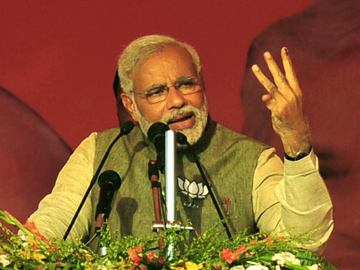
Indian Bharatiya Janata Party (BJP) Prime Ministeral candidate Narendra Modi addresses an election rally in support of local candidates in Allahabad on May 4, 2014.
New Delhi:
As voting for India's national election ended today, clearing the way for exit polls, the first analysis came from BJP's prime ministerial candidate Narendra Modi.
In a series of tweets, Mr Modi exulted in the increased voter turnout, slammed the Congress and also appeared to reach out to potential allies.
"Usually ruling Party sets agenda of the election but in this campaign ruling party was neither proactive nor responsive,it remained reactive," Mr Modi, 63, tweeted.
He added that due to social media, "lies and false promises of several leaders could not go beyond the podiums of their rallies! More power to social media."
India has posted a record turnout in this election, which analysts see as a sign of change.
The BJP, led by Mr Modi, is widely expected to win the maximum number of seats but it is not yet clear whether the party will land a clear majority with its existing allies.
Mr Modi tweeted a link to his blog which appears to address politicians who have sparred with him repeatedly during the bitterly fought campaign. (Narendra Modi blogs on the conclusion of 2014 Lok Sabha Elections)
"Yes, as political parties and candidates we have differing ideologies but our goal is one- to work for India and to fulfill the aspirations of our youth," he says in his blog.
"Let's place people over politics, hope over despair, healing over hurting, inclusion over exclusion and development over divisiveness. It is natural for the spirit of bi-partisanship to get temporarily lost in the midst of an election campaign but now is the time to resurrect it."
Mr Modi also commented on the results of the Andhra Pradesh municipal or local body elections, which held good news for a key ally of the BJP, Chandrababu Naidu. (read: In Andhra Pradesh, results of an important election)
"This is curtain raiser for 16th May. Both states will give massive mandate for the TDP-BJP alliance in Parliament & Assembly elections (sic)," Mr Modi tweeted.
Mr Modi's critics, however, said the analysis was wrong; the civic polls were held on March 30, long before the BJP and TDP sealed their alliance.
In a series of tweets, Mr Modi exulted in the increased voter turnout, slammed the Congress and also appeared to reach out to potential allies.
"Usually ruling Party sets agenda of the election but in this campaign ruling party was neither proactive nor responsive,it remained reactive," Mr Modi, 63, tweeted.
He added that due to social media, "lies and false promises of several leaders could not go beyond the podiums of their rallies! More power to social media."
India has posted a record turnout in this election, which analysts see as a sign of change.
The BJP, led by Mr Modi, is widely expected to win the maximum number of seats but it is not yet clear whether the party will land a clear majority with its existing allies.
Mr Modi tweeted a link to his blog which appears to address politicians who have sparred with him repeatedly during the bitterly fought campaign. (Narendra Modi blogs on the conclusion of 2014 Lok Sabha Elections)
"Yes, as political parties and candidates we have differing ideologies but our goal is one- to work for India and to fulfill the aspirations of our youth," he says in his blog.
"Let's place people over politics, hope over despair, healing over hurting, inclusion over exclusion and development over divisiveness. It is natural for the spirit of bi-partisanship to get temporarily lost in the midst of an election campaign but now is the time to resurrect it."
Mr Modi also commented on the results of the Andhra Pradesh municipal or local body elections, which held good news for a key ally of the BJP, Chandrababu Naidu. (read: In Andhra Pradesh, results of an important election)
"This is curtain raiser for 16th May. Both states will give massive mandate for the TDP-BJP alliance in Parliament & Assembly elections (sic)," Mr Modi tweeted.
Mr Modi's critics, however, said the analysis was wrong; the civic polls were held on March 30, long before the BJP and TDP sealed their alliance.
How may i help you today
Show full article
Track Latest News Live on NDTV.com and get news updates from India and around the world

