





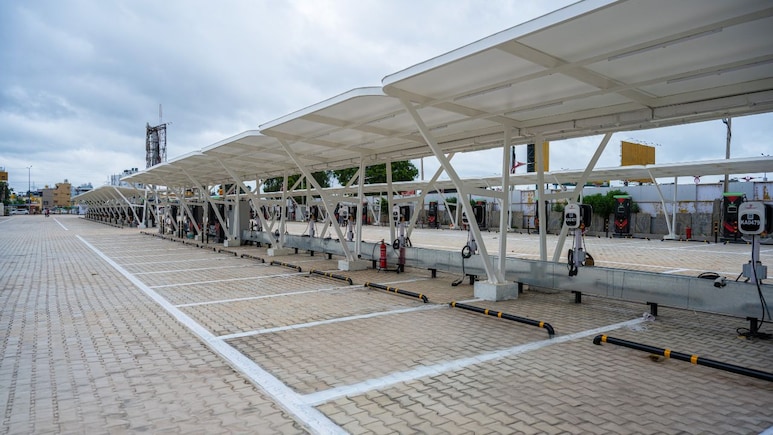
As Delhi races toward its 2026 clean air goals, electric mobility has emerged as one of the city's biggest bets. The Delhi Action Plan and the NCR Plan for 2026, now submitted to the Commission for Air Quality Management (CAQM), outline a clear direction: reduce the capital's annual AQI by at least 15% by shifting more of its transport system toward electric vehicles and expanding a fleet of battery electric buses.
Vehicular emissions have long been among Delhi's top pollution sources, and the transition to EVs is positioned as a crucial solution. But beneath the optimism lies a harder question: Is Delhi actually building enough charging infrastructure to support widespread EV adoption?
The EV Plan vs the EV Reality
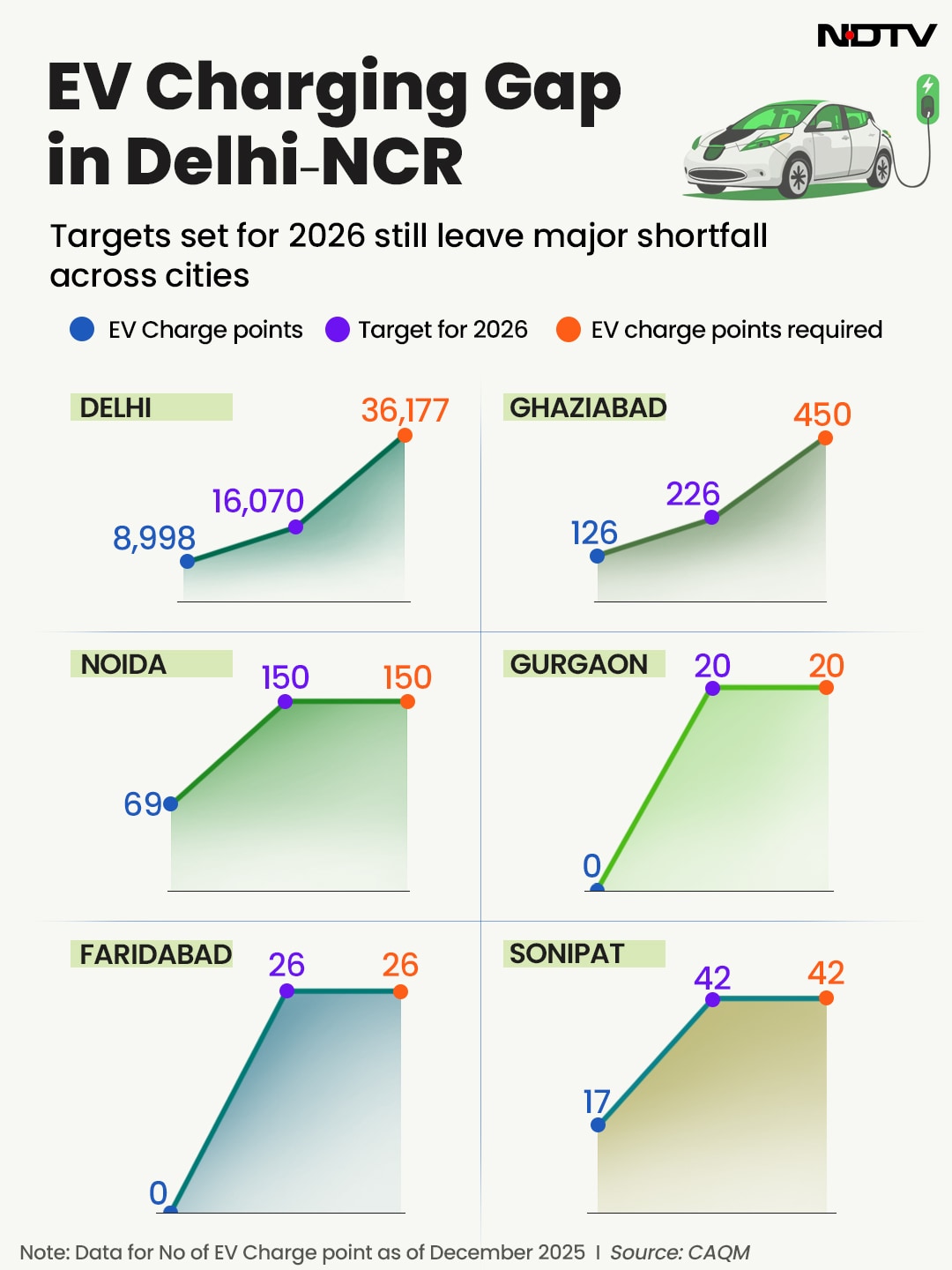
According to the CAQM 2026 action plan, Delhi-NCR has mapped out the current number of charging points, the total required capacity, and individual city targets. The findings show a worrying imbalance.
Currently, Delhi has only around one-fourth of the charging points it needs. Even if the capital meets its 2026 installation target, more than half the required network will still be missing. This gap could significantly hinder mass EV usage, especially for private buyers who rely on confidence that charging will be accessible.
Add image caption here
Ghaziabad also struggles with limited coverage. Even after achieving its 2026 target, the city will reach barely half of its projected requirement, raising doubts about whether public and private commuters will find charging convenient enough to switch to EVs.
However, other NCR cities like Noida and Sonipat appear far more prepared, mostly because their requirements are reasonable. Gurgaon and Faridabad have even more modest needs, each targeting only 20 EV charging points.
India's National EV Charging Landscape
The gaps seen in Delhi mirror a national trend. As of December 16, 2025, data from the Ministry of Heavy Industries shows 29,151 EV charging stations were installed across India in the past five years. Of these, 8,805 are fast charging stations and 20,346 are slow charging ones.
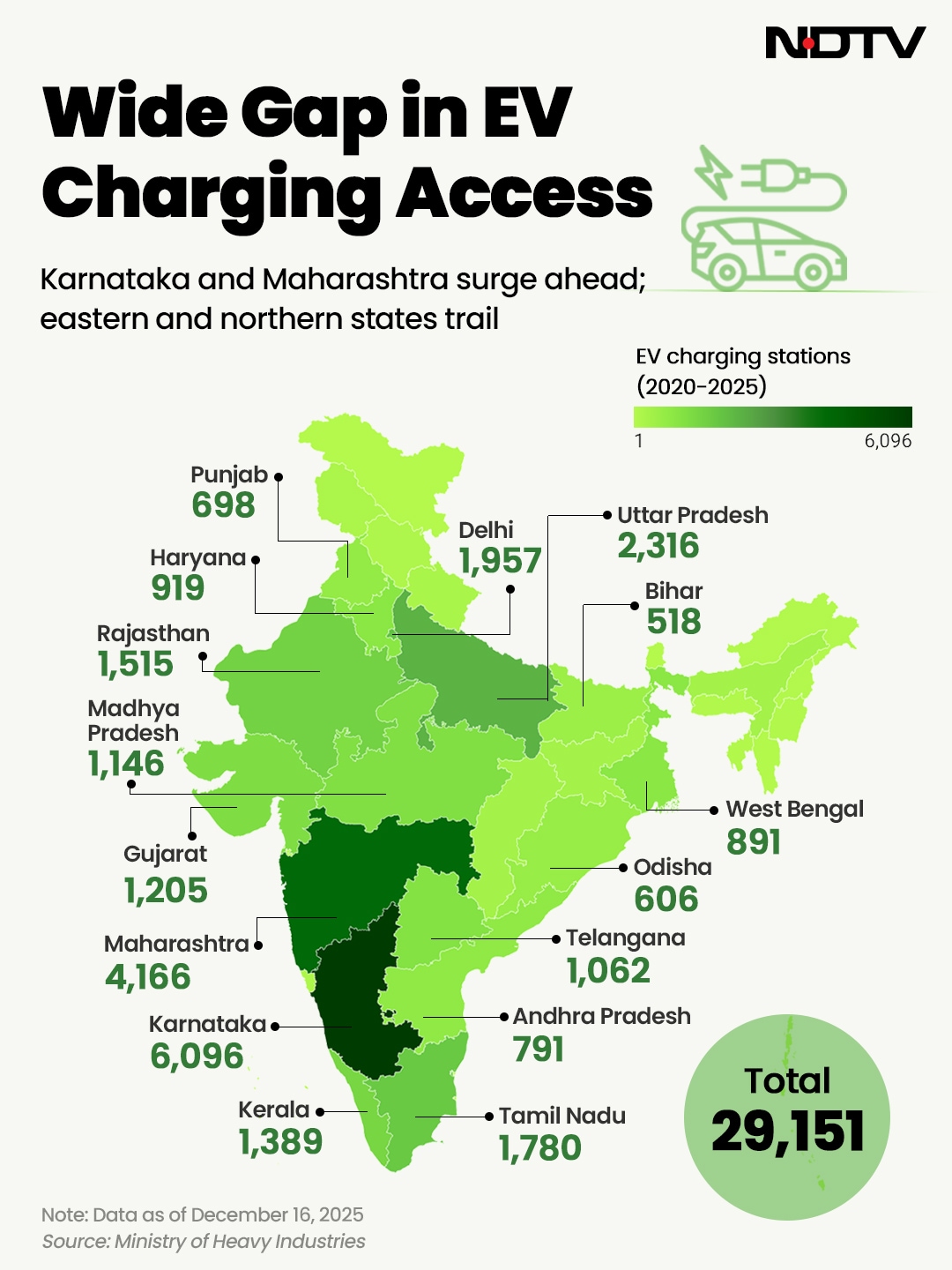
However, coverage remains highly uneven across states. Karnataka and Maharashtra have surged ahead with large, dense charging networks, helped by strong EV policies, booming auto manufacturing hubs, and high urban demand. Other big states like Uttar Pradesh, Tamil Nadu and Rajasthan are catching up, while most others have a long way to go. Adoption in hill states is low for now because most people are still unsure of the reliability of EVs in these regions.
EV Sales Are Rising
Despite infrastructure gaps, EV sales in India are accelerating:
Passenger EVs have nearly doubled in a year, reflecting growing consumer confidence and expanding model availability.
Three-wheelers and commercial EV fleets continue to grow steadily, driven by cost efficiency and last-mile logistics demand.
Two-wheelers remain the highest-selling EV category, posting consistent year-on-year growth and forming the backbone of India's electric mobility shift.
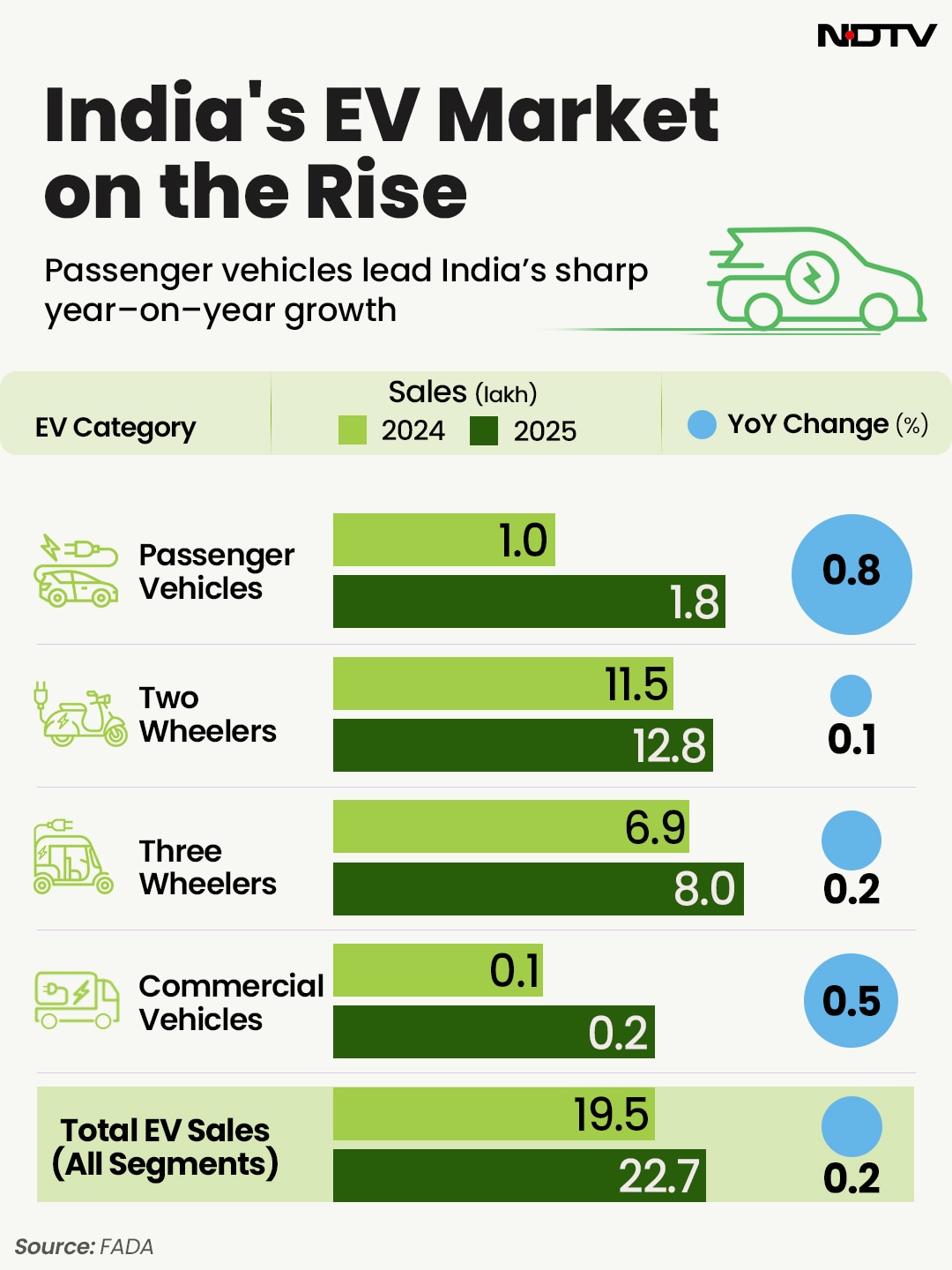
Overall, the market is expanding across all segments, indicating rising acceptance but also increasing pressure on the charging ecosystem to keep up.
Is the Government Serious About EVs? The Budget Says Yes
The Union Budget makes the government's priorities clear as the PM E-Drive scheme gets a significant push. The scheme has received a sharp increase in funding for 2025-26, with allocations rising further in 2026-27 to Rs 1,500 crore, reflecting a national focus on EV manufacturing, charging networks, clean public transport, and domestic supply chain development.
The PM e-Bus Sewa programme has also seen a major boost. Funding for the electric-bus scheme rose sharply from almost Rs 5 crore in FY25 to Rs 510 crore in FY26. However, in the current year, the allocation has dropped to just Rs 12 crore.
Track Latest News Live on NDTV.com and get news updates from India and around the world

