




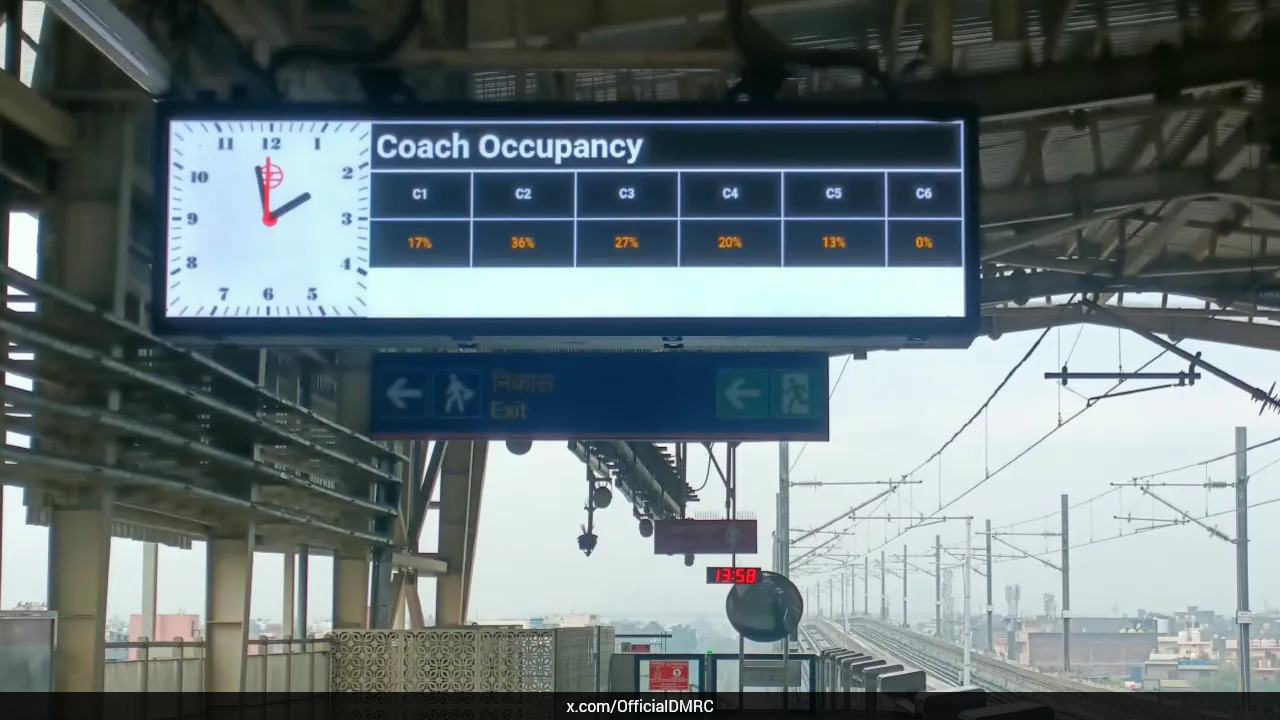
The Delhi Metro Rail Corporation (DMRC) has introduced a real-time coach occupancy display system on the Pink Line, allowing passengers to check how crowded each coach is before their train arrives. The facility, already available on the Magenta Line since 2022, aims to help commuters choose less crowded coaches and make their journeys more comfortable, particularly during peak hours.
Announcing the development in a post on X, DMRC said, "Building on the successful implementation of real-time car occupancy information on the Magenta Line, the Delhi Metro Rail Corporation (DMRC) has now extended the display of coach-wise occupancy status of arriving trains to stations of the Pink Line."
How Does the System Work?
The system uses load sensors installed in metro coaches to measure their weight and compare it with their empty weight. Based on this information, the approximate passenger occupancy percentage is calculated.
The occupancy levels of six coaches, marked C1 to C6, are displayed on Passenger Information Display System (PIDS) screens shortly before a train arrives.
According to DMRC, implementing the system on the Pink Line, also known as Line 7, was challenging because of its circular route and complex data interlinking requirements.
DELHI METRO EXTENDS REAL-TIME CAR OCCUPANCY STATUS DISPLAY TO PINK LINE Building on the successful implementation of real-time car occupancy information on the Magenta Line, the Delhi Metro Rail Corporation (DMRC) has now extended the display of coach-wise occupancy status of arriving trains to stations of the Pink Line (i.e, Line-7 from Majlis Park – Shiv Vihar/Maujpur- Babarpur (Circular Line)). The Passenger Information Display System (PIDS) on Magenta Line (i.e Line-8 from Botanical Garden to Janakpuri West) platforms has been showing real-time occupancy levels of individual coaches since 2022. The system has helped passengers make informed boarding decisions and has contributed to better distribution of passenger load across coaches. Encouraged by the positive response, DMRC has now operationalised the same feature on the Pink Line. The system uses load sensors fitted in the coaches to measure the current weight of each coach and compare it with the empty weight. Based on this data, the approximate passenger load percentage of each coach (displayed as C1, C2, C3, C4, C5 and C6) is calculated and shown on the platform PIDS screens shortly before the train arrives. Implementing data interlinking on Line 7 was challenging, as it is a circular line The real-time car occupancy display offers following advantages to passengers: Informed boarding decisions: Passengers can identify less crowded coaches in advance and move towards them on the platform, reducing the need to stand in densely packed coaches. Better distribution of passenger load: Encourages more balanced occupancy across coaches, improving overall comfort and reducing local overcrowding. Enhanced travel experience during peak hours: Particularly useful during morning and evening rush i.e peak hour rush, when certain coaches tend to fill up faster than others. Improved safety and efficiency: More even weight distribution across the train contributes to smoother operations and better utilisation of available capacity. Time-saving and reduced stress: Commuters no longer need to guess or walk the full length of the platform after the train has arrived to find space. DMRC remains committed to continuously upgrading passenger information systems and introducing technology-driven solutions that make metro travel more convenient, comfortable and efficient. The extension of this feature to the Pink Line marks another step in providing a uniform, passenger-centric experience across major corridors of the network.
— Delhi Metro Rail Corporation (@OfficialDMRC) October 30, 2026
How Will Passengers Benefit?
The facility will help passengers identify less crowded coaches and position themselves accordingly on platforms before boarding.
Highlighting its benefits, DMRC stated in its X post, "Passengers can identify less crowded coaches in advance and move towards them on the platform, reducing the need to stand in densely packed coaches."
The system is expected to improve passenger distribution, reduce overcrowding and save time during morning and evening rush hours.
DMRC first introduced the technology on the Magenta Line, connecting Botanical Garden and Janakpuri West, in 2022. Following its positive response, the corporation has expanded the facility to the Pink Line.
The initiative is part of DMRC's efforts to improve passenger convenience through technology and provide a smoother travel experience across its network.
Track Latest News Live on NDTV.com and get news updates from India and around the world

