





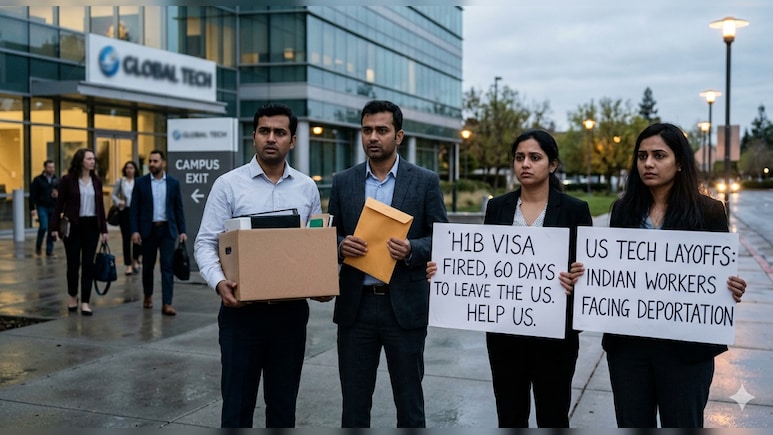
The recent layoff has Meta has hit Indian techies with H-1B visa the most. For years, Indian engineers and software developers helped build America's biggest tech companies. They wrote code, led teams, bought homes, raised families, and settled into what many believed was a stable life overseas.
Now, for thousands of them, one email is changing everything.
The latest wave of layoffs across the US tech industry is doing more than cutting jobs. It is reopening an old fear among Indian professionals in America -- the fear that losing a job could also mean losing the right to stay in the country.
Also Read | Layoffs Are Rising In Tech, But These Skills Are Helping People Unlock Better Pay
Companies across Silicon Valley have once again entered cost-cutting mode. Meta has cut about 8,000 jobs as it aggressively shifts resources toward artificial intelligence. Amazon continues to trim teams after multiple rounds of cuts. LinkedIn, too, has reduced roles in recent months as the tech industry restructures itself around AI and automation.
The layoffs are not just numbers on a spreadsheet for Indian workers. For many, the stakes are deeply personal. A job loss in the US can quickly become a countdown.
Clock Is Ticking For Indian Employees
Most Indian tech professionals in America work on H-1B visas, which are tied directly to their employers. Once they lose their jobs, the clock starts ticking. Under US immigration rules, they usually get just 60 days to find another employer willing to sponsor their visa. If they fail, they are expected to leave the country.
That pressure changes everything.
A layoff suddenly becomes more than a professional setback. It becomes a race against time involving immigration paperwork, mortgage payments, school admissions, healthcare, and family decisions.
Many Indians working in the US have spent years waiting for green cards trapped in enormous backlogs. Some have children born in America. Others have bought homes assuming they would continue living there long-term. Losing a job throws all those plans into uncertainty almost overnight.
According to media reports, many laid-off Indian workers are now trying temporary alternatives to stay in the US longer. One of the most common routes is switching to a B-2 visitor visa, which can allow a person to remain in the country for a few additional months while searching for another employer.
What Is The 60-Day H-1B Rule?
Under rules set by the US Citizenship and Immigration Services (USCIS), laid-off H-1B workers usually get a 60-day grace period -- or until their I-94 status expires, whichever comes first -- to figure out their next move. During this window, they can look for another employer willing to sponsor their visa, apply for a different visa category, or prepare to leave the US.
Importantly, the 60-day period generally begins from the employee's last working day, not when the final salary hits the bank account.
The rule was introduced to give skilled foreign workers some breathing room after sudden layoffs. But in reality, two months can disappear very quickly, especially when the tech industry itself is slowing hiring.
Finding a new sponsor is often not easy. Job interviews take time, visa transfers involve paperwork, and companies are becoming more cautious about hiring amid economic uncertainty and AI-led restructuring.
Because of this, many immigration lawyers have traditionally advised laid-off workers to temporarily switch to a B-1 or B-2 visitor visa by filing Form I-539. In the past, USCIS guidance indicated that people on visitor status could attend interviews and search for jobs, as long as they were not actively employed.
That option is still legally available. However, recent reports suggest US authorities are now scrutinising such applications far more closely than before. Immigration lawyers have pointed to rising requests for additional documents and tougher questioning around change-of-status filings.
The fear among workers is growing that even backup plans may no longer provide enough breathing room. The anxiety is being amplified by the scale of layoffs sweeping across the tech industry.
Widespread Layoff In Silicon Valley
According to Layoffs.fyi, more than 110,000 employees across tech companies have lost jobs this year alone. A significant portion of them are believed to be foreign workers, especially Indians, who remain the largest beneficiaries of the H-1B visa programme.
US government data for FY25 showed Indians accounted for the overwhelming majority of approved H-1B petitions. That dependence on the system is now becoming a vulnerability.
The uncertainty is also changing how many Indians view the American dream itself.
For decades, the US represented career growth, higher salaries, and global exposure. But frequent layoffs, visa dependency, political rhetoric around immigration, and the rise of AI-driven restructuring are forcing many professionals to rethink their future.
A recent Blind poll suggested that nearly half of Indian professionals in the US would consider returning to India if they lost their jobs. Others are looking at Canada and Europe as alternatives.
The employees fired by Meta receive severance package amounting to 16 weeks in base pay, plus two weeks for every year of continuous employment, Business Insider reported. Apart from that, workers will also get 18 months of healthcare coverage for them and their families.
However, for many, the calculation is no longer only financial.
The emotional strain of living under visa uncertainty is becoming harder to ignore. Workers often cannot take career breaks freely, switch jobs casually, or remain unemployed for long periods. One layoff can disrupt an entire family's life.
And unlike American employees, foreign workers carry an additional burden -- immigration status.
The situation is different for Indians in the US who are not dependent on H-1B visas. Those with green cards or permanent residency status can remain in the country even after losing jobs. They may still face financial stress and employment uncertainty, but they do not face the immediate risk of having to leave the US within weeks.
Similarly, Indians working on dependent visas, student visas, or citizenship pathways may have more flexibility depending on their status. But for H-1B workers, the consequences are sharper and far more immediate.
The AI Disruption
The latest layoffs are also arriving at a time when AI is rapidly changing hiring patterns across the tech industry. Companies are restructuring teams, flattening management layers, and investing billions into AI products and automation tools.
Meta alone is expected to spend over $100 billion this year on AI-related investments, according to Bloomberg. Reports also suggest the company reassigned thousands of employees internally toward AI-focused roles even as layoffs continued elsewhere.
That shift is creating a new fear among workers -- that the slowdown may not be temporary.
Many professionals now worry that AI could permanently reduce hiring demand across some tech functions, especially for routine engineering and support roles.
For Indian workers in the US, that creates a difficult reality. The challenge is no longer just finding the next job. It is finding one fast enough to keep an entire life from collapsing.
Track Latest News Live on NDTV.com and get news updates from India and around the world

