





- Nithin Kamath warns of multiple economic risks hitting India simultaneously in 2026
- Rising crude oil prices and Strait of Hormuz disruptions increase fuel costs sharply
- A possible strong El Niño threatens below-normal monsoon rainfall and crop yields
"It's still May."
That's how billionaire entrepreneur Nithin Kamath summed up what may be India's biggest economic worry right now.
His latest post on X was not another social media hot take. It was a warning built on multiple risks colliding at the same time --rising crude oil prices, a possible super El Nino, extreme heat, weak rainfall forecasts, food inflation and pressure on economic growth.
Individually, India has handled each of these before. Together, they can become dangerous.
The concerns is multi-dimensional. India's economy still depends heavily on affordable energy, a stable monsoon and rural demand. All three are under pressure at once.
"If history is any guide, we may have a terrible year ahead," wrote Kamath in his post.
The First Shock Is Already Here: Energy
India entered 2026 dealing with an external shock it cannot control.
The closure and disruption around the Strait of Hormuz -- one of the world's most critical oil shipping routes -- has pushed up crude prices sharply. Nearly 20 per cent of global oil and LNG trade moves through this narrow channel.
India is especially vulnerable because it imports nearly 85 per cent of its crude oil requirement and roughly half of its gas demand.
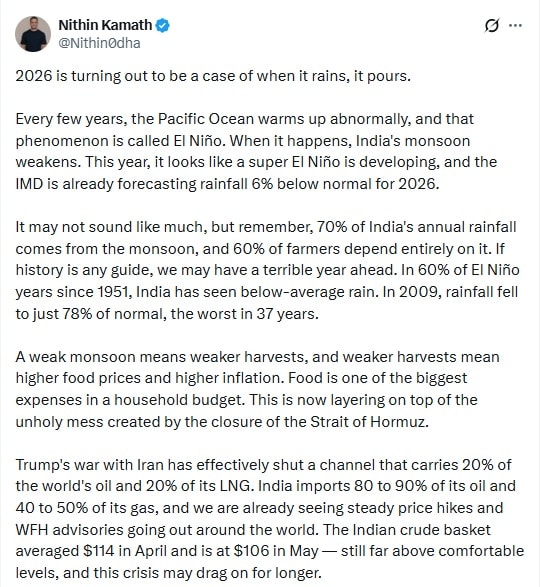
Kamath pointed out that the Indian crude basket averaged around $114 per barrel in April and stayed above $100 levels in May -- far above comfort levels for an oil-importing country like India.
The impact is already visible.
Fuel prices have been raised repeatedly in recent weeks. Transport costs are climbing. Companies are beginning to worry about logistics expenses. Airlines are exposed. Manufacturers are exposed. Delivery businesses are exposed.
For households, it starts with petrol and diesel. But it never stops there. Costlier fuel raises freight expenses. Freight raises food prices. Food inflation squeezes household budgets. Families cut discretionary spending. Consequently, demand weakens.
This ripple effect travels across the economy. According to India Ratings and Research, every $10 increase in crude oil prices can shave nearly 44 basis points off India's GDP growth.
Another Economic Shock On The Horizon: A Super El Niño
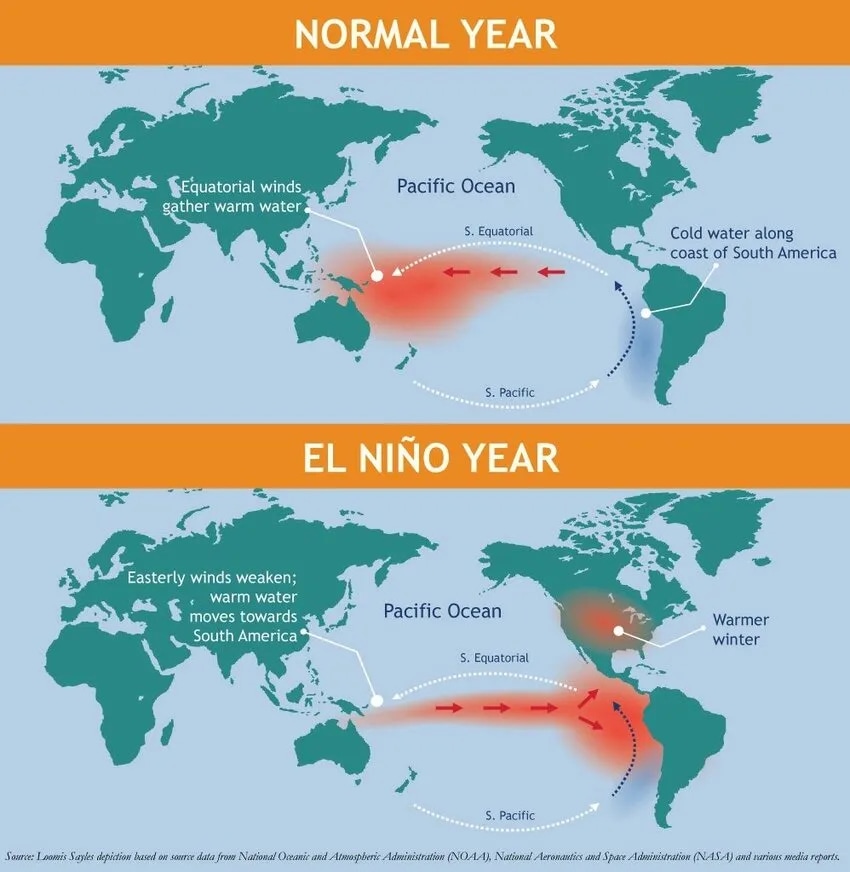
Every few years, Pacific Ocean temperatures warm abnormally. This weather phenomenon is called El Nino.
For India, it usually means trouble. A strong El Nino weakens the southwest monsoon -- the rain system that supplies nearly 70 per cent of India's annual rainfall. Follow Live Updates
This matters because agriculture in India still depends heavily on rainfall. Nearly 60 per cent of Indian farmers remain dependent on monsoon rains. And early signs are worrying.
The India Meteorological Department (IMD) has forecast rainfall around 6 per cent below normal for 2026. On paper, that may not sound catastrophic. But India's agricultural system is extremely sensitive to rainfall distribution and timing.
Even a modest rainfall deficiency can damage crop yields if rains arrive late, stop abruptly or remain uneven across states.
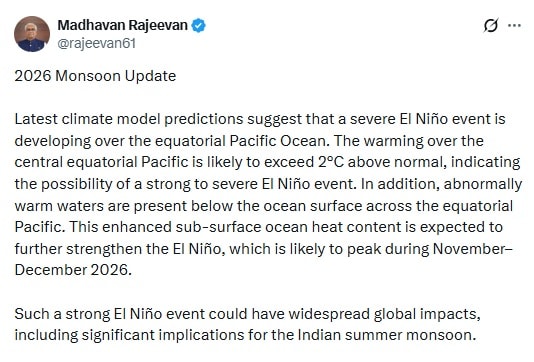
Former Secretary of the Ministry of Earth Sciences, Madhavan Rajeevan, in a post on X, recently warned that climate models are pointing towards a severe El Nino event developing over the equatorial Pacific.
According to him, warming in the central Pacific could exceed 2 degrees Celsius above normal -- a sign associated with strong or even severe El Niño conditions.
Historically, that has rarely been good news for India.
In 60 per cent of El Nino years since 1951, India recorded below-average rainfall. In 2009, one of the worst drought years, monsoon rainfall fell to just 78 per cent of the long-period average.
The consequences were immediate: lower farm output, rising food prices and weaker rural demand.
Why A Weak Monsoon Hits Much More Than Farmers
The monsoon is not just an agriculture story in India. It is an economy story. A weak monsoon affects food production first. Lower crop output pushes up prices of vegetables, pulses, cereals and edible oils.
India has already seen how quickly food inflation can become politically and economically sensitive. Tomato prices, onion prices and cereal inflation have repeatedly disrupted household budgets over the past few years.
Now imagine that pressure returning while fuel prices are already rising. Milk prices are already moving higher. Both Amul and Mother Dairy recently raised prices by Rs 2 per litre.
"With rising fuel and transportation costs, prices of eggs, chicken, and other essential protein products are witnessing frequent fluctuations across the agriculture and allied sectors. Higher diesel prices are pushing up the cost of transporting feed ingredients, poultry products, and other agri commodities, adding pressure across the supply chain. Since feed contributes nearly 60-70 percent of production costs in poultry and aquaculture, even small increases in logistics expenses have a direct impact on farmer margins and consumer prices," said Divya Kumar Gulati, Chairman, CLFMA of India.
If rainfall weakens further, economists fear broader food inflation could follow. That's where the second-order impact begins.
Significantly, when rural incomes weaken, consumption slows. Farmers buy fewer tractors. Rural families delay motorcycle purchases. FMCG demand softens. Entry-level consumer products see slower sales.
India has seen this pattern repeatedly during drought years.
A large part of India's consumption economy still depends on rural spending power. "At a time when farmers and agri businesses are already dealing with volatility in raw material prices and global supply chain challenges, continued fuel price hikes are making it harder to keep essential food products affordable and competitive in both domestic and export markets. Higher transportation costs are putting additional pressure on the entire value chain - from feed manufacturers to poultry and aquaculture farmers," added Gulati.
Rural India accounts for a major share of demand for two-wheelers, affordable housing materials, fertilisers, tractors and packaged consumer goods. Weak rains can therefore travel quickly from farms to corporate earnings.
Heatwaves Are Becoming An Economic Problem
But this year, there is another layer to the crisis: extreme heat. India is not just dealing with hotter days anymore. It is dealing with hotter nights too.
Several parts of the country have reported unusually high night-time temperatures, limiting the body's ability to recover from daytime heat stress.
That has serious economic implications.
According to the Council on Energy, Environment and Water (CEEW), nearly 57 per cent of Indian districts -- home to almost three-fourths of the population -- are already at high to very high heat risk.
Vishwas Chitale, Fellow at CEEW, describes extreme heat as a "structural economic risk" rather than a seasonal weather event.
The distinction matters.
Heat reduces labour productivity. Construction slows down. Outdoor work becomes dangerous. Logistics operations become inefficient. Warehousing costs rise because cooling demand increases. And electricity demand surges.
Factories face higher operating costs. Urban households spend more on cooling. Governments spend more on power management and healthcare responses.
The effect compounds across sectors.
According to Siddharth Maurya of Vibhavangal Anukulkara, prolonged heat stress costs India an estimated $150 billion in lost economic output, especially in labour-intensive sectors. This is particularly worrying for a country where millions still work outdoors in construction, agriculture, transport and delivery services.
India's growth story depends heavily on labour-intensive sectors. Extreme heat directly attacks that productivity engine.
Inflation Could Force RBI Into A Corner
The worst-case scenario for any central bank is when food inflation and fuel inflation rise together. That is exactly the risk India may now face.
If crude oil remains elevated and food prices spike because of weak rainfall, the Reserve Bank of India could come under pressure to tighten monetary policy again.
Higher interest rates slow borrowing and spending. Home loans become expensive. Auto loans become expensive. Business investments slow. Consumer demand weakens.
Kamath warned that "when food and energy prices rise together, the RBI cannot stay quiet."
That concern is not theoretical.
Last week, India Ratings projected India's growth to slow to 6.7 per cent in FY27 from 7.6 per cent because of high oil prices, weak monsoon risks and inflationary pressures. The agency also warned that weaker capital inflows, currency pressure and softer government spending could amplify the slowdown.
India Is More Resilient Than Before - But Not Immune
There is one important caveat. India today is far more resilient to monsoon shocks than it was two decades ago.
The economy is now more services-driven. Irrigation coverage has improved. Agricultural practices are better. Food grain stocks are larger.
Even Former Secretary Rajeevan noted that the overall macroeconomic impact of weak monsoons may now be more limited than in earlier decades. But "limited" does not mean harmless.
Agriculture and water resources remain deeply vulnerable. And when climate shocks combine with geopolitical shocks, resilience alone may not fully protect growth.
That is what makes the current moment worrying. India is not staring at one crisis. It is staring at multiple stress points feeding into each other.
Costlier oil raises inflation. Weak rainfall raises food prices. Heatwaves reduce productivity. Rural demand weakens. Interest rates stay elevated longer. Together, they can create a broad economic drag.
And the worrying part is that all of this is unfolding before the monsoon has even properly begun. Which is perhaps why Kamath's closing line resonated so strongly online.
"It's still May."
Track Latest News Live on NDTV.com and get news updates from India and around the world

