






For mutual fund investors, the temptation is simple: look at the return table and pick the category at the top. But that can be a costly mistake.
A fund category that has delivered the best return over the past year may not necessarily be the best fit for the next five years. Flexi-cap, mid-cap and multi-asset funds are built differently. They carry different risks and can behave very differently when markets turn volatile.
So, Where Should Investors Put Fresh Money?
Ajay Kumar Yadav, CFPCM, Group CEO & CIO, Wise Finserv, says the answer should not begin with returns alone. An investor's goal, risk appetite and investment horizon should come first.
Also Read | Layoffs Are Rising In Tech, But These Skills Are Helping People Unlock Better Pay
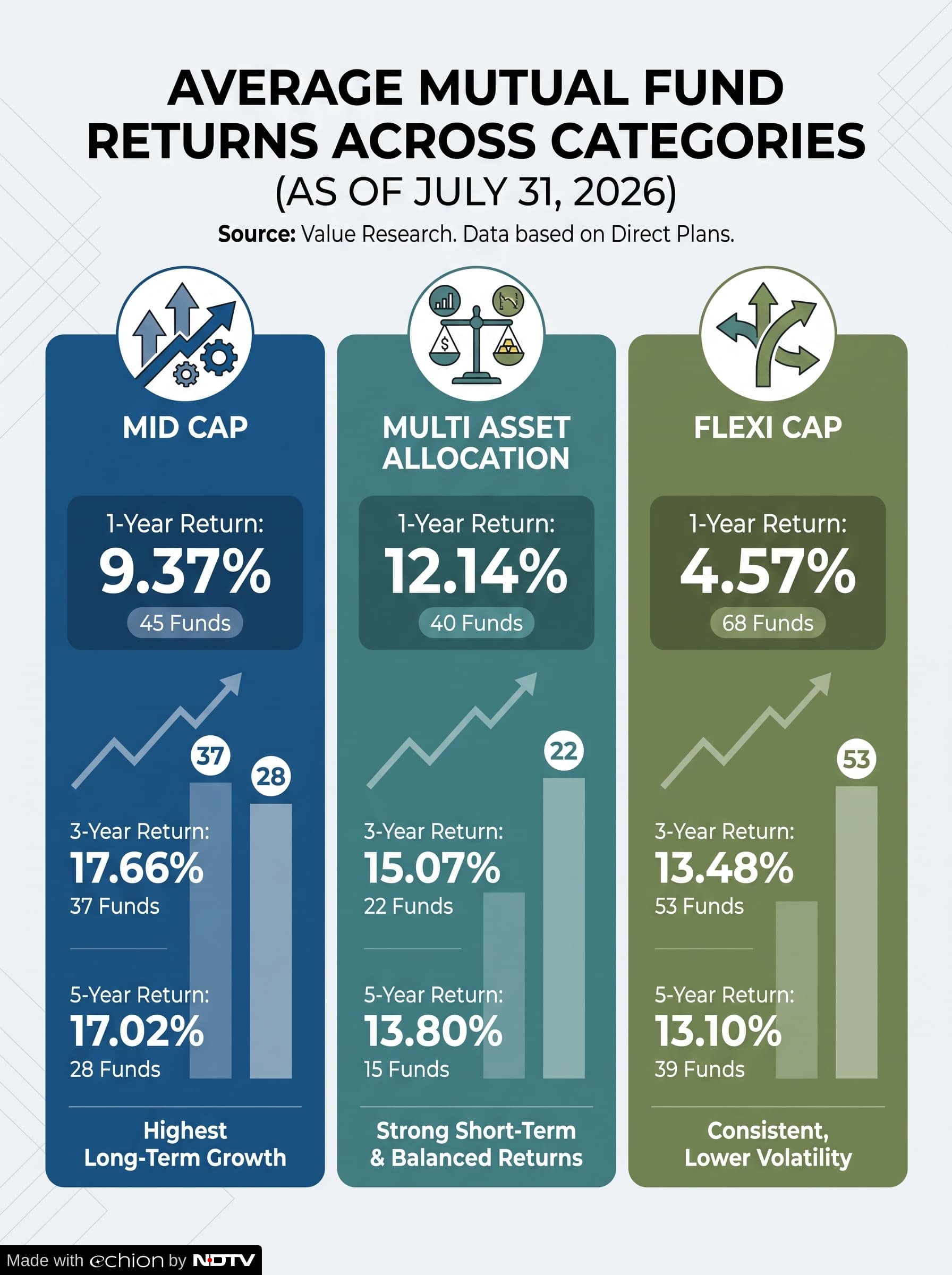
The numbers make the point. Over one year, multi-asset funds led the pack with an average return of 12.14 per cent. Mid-cap funds followed at 9.37 per cent, while flexi-cap funds delivered 4.57 per cent.
Stretch the investment period to three years and the picture changes. Mid-cap funds took the lead with an average return of 17.66 per cent, followed by multi-asset funds at 15.07 per cent and flexi-cap funds at 13.48 per cent.
Over five years, mid-cap funds again led with 17.02 per cent. Multi-asset funds returned 13.80 per cent, while flexi-cap funds delivered 13.10 per cent.
At first glance, mid-cap funds look like the clear winner. But Yadav cautions against reading the numbers in isolation.
Mid-Cap Funds: Higher Growth, Higher Bumps
Mid-cap funds invest predominantly in mid-sized companies. Under SEBI's framework, these funds must keep at least 65 per cent of their assets in mid-cap stocks.
The attraction is obvious. Mid-sized companies often have room to expand. They can enter new markets, add capacity and grow their earnings faster than more mature businesses.
That can translate into stronger returns. But there is a catch.
The same stocks can fall sharply when valuations become stretched or market sentiment weakens. Investors therefore need the stomach to sit through steep corrections. "Mid-cap funds may offer stronger growth potential, but they can also test an investor's patience during market corrections," Yadav points out.
That makes the category better suited to investors with a long horizon and a high tolerance for volatility. For most investors, mid-cap exposure should be a part of the equity portfolio rather than the entire portfolio.
Flexi-Cap Funds: Let The Fund Manager Switch Gears
Flexi-cap funds take a different route. They can invest across large-cap, mid-cap and small-cap companies. SEBI requires them to invest at least 65 per cent of total assets in equity and equity-related instruments.
This gives the fund manager greater freedom. When large companies look attractive, the portfolio can lean towards them. When opportunities shift towards mid- or small-caps, the fund manager can increase exposure there.
For an investor, this means there is no need to constantly decide which market-cap segment to favour. That flexibility makes flexi-cap funds an option for investors looking for broad equity exposure over the long term.
However, Yadav's return data shows why investors should not assume that flexibility automatically means the highest returns. Flexi-cap funds delivered 13.48 per cent over three years and 13.10 per cent over five years in the data cited.
The appeal here is more about flexibility and diversification within equities than chasing the top-performing category every year.
Multi-Asset Funds: The Diversification Play
Multi-asset funds work differently again. Instead of depending largely on equities, they spread investments across different asset classes. These can include equity, debt and commodities such as gold or silver. AMFI describes multi-asset funds as offering exposure to a broad mix of asset classes, which can help balance risk and reward.
This diversification can matter when markets become unpredictable. The recent numbers offer a good example.
Multi-asset funds delivered the highest one-year return among the three categories at 12.14 per cent. But over three and five years, they trailed mid-cap funds.
That is the trade-off. A diversified portfolio may provide more balance when one asset class struggles. But it may not match the returns of a pure equity category during a powerful equity rally. For investors who want growth but do not want their entire portfolio tied to equities, multi-asset funds can therefore be worth considering.
So, Which One Should You Choose?
Well, there is no single winner. It depends on what are your goals, and how much time are you willing to spend in the market.
Explaining the three categories, Rohan Goyal - Investment Research Analyst - MIRA Money, told NDTV, "Flexi caps are built for stability. Flexi caps adapt to market cycles rather than being confined in one market cap segment and this is what makes them a solid core portfolio holding. Ideal for investors who want equity exposure without constantly tracking which segment is in favour. Meanwhile, mid cap funds consist of companies that have passed the small cap stage by haven't matured enough to be called large caps yet. They generally deliver stronger earnings growth than their large caps peers. Although, the catch here is volatility. Mid caps fall harder and faster during corrections and when they miss their earnings estimates. Ideal for investors looking for higher growth and returns and are ok with the additional volatility that they come with."
Goyal adds, "Lastly, multi asset funds have a different approach than flexi and mid caps. This is ideal for investors who prioritize stability and smoother returns while having some equity exposure, rather than chasing the highest return."
Track Latest News Live on NDTV.com and get news updates from India and around the world

