





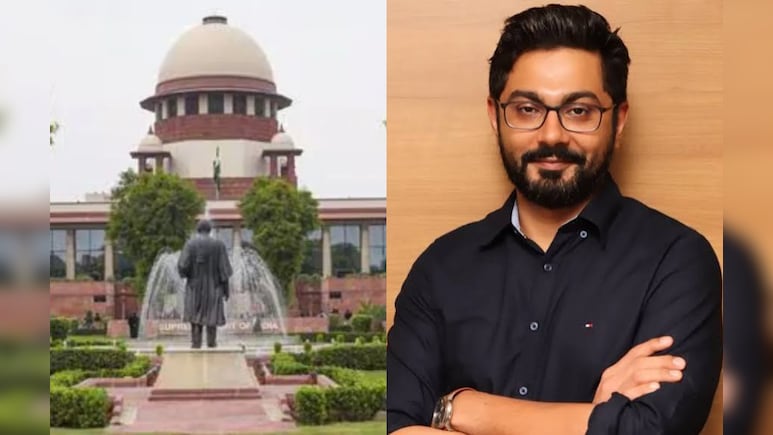
Days after the Supreme Court extended the mandatory third-party motor insurance cover for new vehicles, Acko founder Varun Dua has published a detailed critique of the order on LinkedIn.
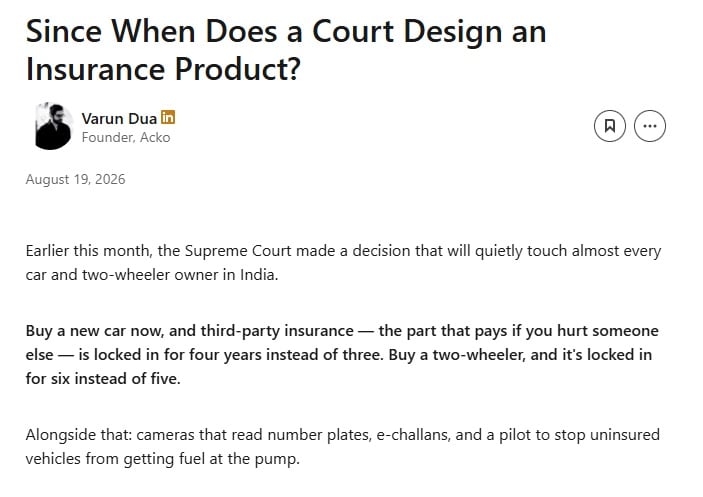
In a post titled "Since When Does a Court Design an Insurance Product?", Dua questioned the decision to increase the mandatory third-party insurance tenure for new vehicles. He also raised questions about whether the move addresses the actual reasons why millions of vehicles remain uninsured.
What Did The Supreme Court Order Say?
On August 4, the Supreme Court directed that third-party insurance for new cars should be purchased for four years, instead of the existing three years. For new two-wheelers, the mandatory period was increased from five years to six years.
Also Read | Layoffs Are Rising In Tech, But These Skills Are Helping People Unlock Better Pay
The court noted that despite its 2018 direction introducing three-year third-party cover for new cars and five-year cover for new two-wheelers, a large number of vehicles continued to remain uninsured.
The order cited a figure of nearly 56 per cent of vehicles on Indian roads being uninsured. In absolute terms, it referred to 16.54 crore uninsured vehicles out of 30.48 crore vehicles.
The court also directed the insurance regulator to issue necessary directions for the longer cover. Separately, it asked authorities to work on measures such as using number-plate recognition systems to identify uninsured vehicles and conducting a pilot project linking fuel supply with valid insurance.
Varun Dua's Critique
Dua's central argument is that increasing the insurance tenure may not address the problem that led to the court's intervention.
He points to the experience of the 2018 mandate. According to Dua, third-party cover was moved to a long-term cycle while own-damage cover continued to require annual renewal.
Citing the Insurance Information Bureau's FY25 data, Dua says 99.2 per cent of long-term car policies and 97.5 per cent of long-term two-wheeler policies are structured this way. His argument is that this split can leave vehicle owners with third-party insurance still active while their own-damage cover has already expired.
Dua also questions whether extending the mandatory tenure targets the vehicles that are actually driving the insurance compliance gap. According to the figures cited by him from the IIB's FY25 report, 87 per cent of private car owners renew their insurance on schedule. For two-wheelers, however, Dua says 79 per cent do not renew after the long-term cover expires.
He argues that the longer mandatory period, therefore, puts an additional lock-in on a group that already has a relatively high renewal rate, while the renewal problem among two-wheelers remains.
He also highlights commercial vehicles. According to Dua, they account for more than 40 per cent of claims and more than a third of road deaths, but were not covered by either the 2018 mandate or the latest extension. Dua wrote that "The people actually causing it don't feel this rule at all."
Dua's Concern Over Pricing Structure
Another part of his critique relates to the long-term pricing of third-party insurance.
Dua says the premium is fixed when the policy is purchased, while the cost of claims can rise during the policy period. Citing IIB data, he says the average payout for injury claims rose 17 per cent in FY25, while the average payout for death claims increased 10 per cent.
He also points to the claims backlog. According to the figures cited in his post, outstanding third-party claims rose 4 per cent to 9.73 lakh. He says 84 per cent of payouts made in FY25 related to accidents from earlier years.
His point is that extending the insurance period does not, by itself, address the time taken to settle claims.
Dua also raised the issue of vehicle ownership transfers. He points to cases where the formal transfer of ownership does not happen quickly, while liability can continue to be attached to the person whose name remains on the vehicle records.
He also questions the treatment of unused third-party insurance when a vehicle is sold before the long-term cover expires. According to his post, refunds for unused third-party premium are limited to situations such as theft or the vehicle being written off.
Why Is Dua Questioning Court's Role?
This is the sharpest part of the post. Dua asks why the design of an insurance product should be determined through a court order rather than by the insurance regulator. He argues that questions such as policy tenure, pricing and product structure require extensive industry and claims data.
He also notes that the Insurance Regulatory and Development Authority of India had, along with the General Insurance Council, recommended against increasing the tenure. The Supreme Court order records that position before deciding to increase the period by one year.
Dua also brings dealer commissions into the discussion. He says some car-dealer-linked brokers charge commissions as high as 53 per cent of the premium and argues that a longer policy period could reduce the frequency with which customers get an opportunity to compare prices and switch insurers.
Dua Bats For Stronger Enforcement
Rather than simply extending the insurance period, Dua argues for stronger enforcement of the rules that already exist. He calls for the insurance claims backlog to be cleared, the vehicle ownership transfer process to be fixed and insurance pricing to reflect the cost of claims.
He also argues that customers who comply with the rules should not bear the cost of non-compliance by others. The Supreme Court's order was aimed at addressing the large number of uninsured vehicles and the difficulties faced by accident victims in obtaining compensation. The court specifically linked the lack of insurance to prolonged litigation for victims and their families.
Dua's LinkedIn post, meanwhile, questions whether extending the mandatory tenure is the most effective way to address that problem.
Track Latest News Live on NDTV.com and get news updates from India and around the world

