





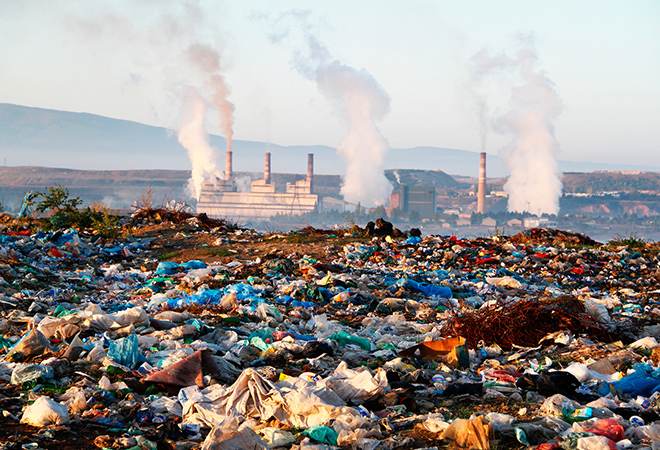
Expressing concern over the high volume of solid waste generated and the lack of civic sense in society, the Supreme Court has issued a slew of directions for its management and disposal, saying the infrastructure for the purpose needs to be scaled up to meet the standards of the Solid Waste Management (SWM) Rules, 2026.
A bench of Justices SVN Bhatti and NV Anjaria said it is regrettable that across society, the general feeling is "I am entitled to generate but not to cooperate and control the impact of solid waste management at the threshold".
It said, "The volume and complexity of such waste, i.e., biodegradable, non-biodegradable, hazardous, electronic and construction, have outgrown what any single class of workers can be expected to absorb or handle. The infrastructure needs a complete audit and upgradation to meet the extant standards of the SWM Rules, 2026." The bench was hearing appeals arising from orders of the National Green Tribunal concerning environmental compliance by the municipal corporation under the SWM rules.
The Bhopal Municipal Corporation challenged the proceedings relating to its obligations in handling municipal solid waste. Looking at the enormity of the problem, the top court later expanded the scope nationwide.
Flagging the absence of a sense of compliance with the SMW rules, the bench said, "This is clearly lacking among individuals and institutions, including schools and colleges, students, the educated and the illiterate, the employed and the unemployed, and finally, professionals and businessmen." Lauding the Centre for putting in place statutory committees for implementation and enforcement of the SWM rules, which came into force on April 1, the bench in its order passed on Tuesday said these initiatives were steps in the right direction.
"However, the larger and perennial hazards arising from the non-observance of the SWM Rules, 2026, by the stakeholders are not addressed by merely putting in place committees and enforcement agencies," it said, adding that the mounds of garbage posed a problem demanding everyone's attention.
It said the Supreme Court Monitoring Committee (SCMC) was constituted pursuant to the top court's earlier direction and it includes several secretaries of the Union government and the secretary of the Central Pollution Control Board (CPCB).
The bench directed the district collectors to identify all bulk waste generators in their respective jurisdictions, in cooperation with local bodies, within six weeks.
"The SCMC, through the Chief Secretary(ies) of the State(s) directs the district collector(s) to communicate to all the bulk waste generators/BWGs the consequences of non-compliance with SWM Rules, 2026 which consequence would include temporary disconnection of power or water supply until the waste generated by the bulk waste generators conforms to the SWM Rules," it said.
The top court said every person, household and institution (without exception) generates solid waste as an inevitable by-product of life and activity and the prevailing assumption that solid waste is a problem for sanitary workers alone, while the rest of the population remains passive generators, is neither legally correct nor practically sustainable, and is constitutionally unethical.
"Continued complacency will lead to pandemic and endemic situations. With this in mind, Rule 4 of the SWM Rules, 2026 casts the duty of segregation, safe storage and hand-over on every waste generator, a term covering every individual, household, institution and establishment," it said.
Directing the SCMC to focus on water pollution from municipal solid waste/material to rivers and place before the court data for further directions, the bench said it is a statutory duty reinforced by Article 51A(g) of the Constitution and inseparable from the right to a clean and healthy environment under Article 21 of the Constitution.
"The court is enforcing SWM Rules, 2026 through continuous mandamus, to prevent pollution from solid waste to the environment including rivers," it said, adding that law can secure cooperation only by prescribing rules and consequences but it cannot, by itself, generate civic behaviour.
Compliance is achieved only when the individual and institutional generators internalise the obligation, the bench said while pointing out that the real problem lies in the unorganised sector of residential, commercial and business establishments.
It directed that bulk waste generators are required to set up facilities in place and to report online compliance to local bodies for inspection and forward the report to the district collector(s).
The bench asked the district collectors to enhance the participation of the elected representatives of the wards of gram panchayats, municipalities and the corporations in the implementation of the SMW rules.
"The ULBs/MLBs/RLBs (civic bodies) are directed to notify the waste generated, accounted for and unaccounted for, and the steps taken to achieve 100 per cent basic participation by the stakeholders referred," it said.
The bench said the slow approach of the education department in the matter was slightly unintelligible and troubling the court and the department of school and higher education shall, with immediate effect, integrate both theoretical and practical knowledge on solid waste management for students to train their family members, and also prepare teachers as trainers.
(This story has not been edited by NDTV staff and is auto-generated from a syndicated feed.)
Track Latest News Live on NDTV.com and get news updates from India and around the world

