





I was seventeen the night I left Kashmir. It was January 19, 1990.
That night everything changed for us.
The loudspeakers began blaring slogans against Kashmiri Pandits. Overnight, the place we had always called home no longer felt like home. Families who had lived in the Valley for generations suddenly found themselves confronting questions they had never imagined they would have to ask.
Could we stay? Were we safe? What came next?
In the days that followed, people began leaving quietly. Neighbours disappeared. Relatives left. One family would go, then another. Soon it was our turn.
There was no time to grieve the house, or the streets, or the only life I had ever known. There was only the decision that Pandit family after Pandit family was making in those days: leave now, while you still can.
My father woke me at three in the morning. I can still feel that hand on my shoulder in the cold. He did not explain much. There was nothing to explain that we both did not already know. He put me on his scooter and drove me out through the empty, curfewed streets. No sound but the engine and our own breathing. His government curfew pass was the only reason we could move at all. I held on to him in the dark, and somewhere on that ride I understood, without either of us saying it, that I did not know when I would see him again.He took me to the bus stand at Lal Chowk. Two buses were leaving Kashmir that morning, and an entire community was trying to fold its whole life onto them. The only one I could take was a KMD bus, already packed. There was no seat for me anywhere inside. So I climbed up and sat on the bonnet at the front, the metal cover over the engine.
It was the dead of a Kashmiri winter and my face was numb with cold. But the bonnet was hot. The engine ran beneath it the whole way down, and the heat came up through the metal and through my clothes, until I was freezing and burning at the same time. My father handed me over to the driver, asked him to take care of me, and let go.
Then I was moving. Alone.
Many of you reading this know that night without me describing it. You have your own version. A different bus, a different house, a different hand let go of in the dark. We do not need to compare notes. The cold is the same cold. We carry it in the same place.
What I want to write about is not the leaving. We have grieved the leaving for thirty-six years, and we are entitled to. I want to write about what came after, because that is the part I think we have been too modest about.
We came down to Jammu in numbers no city could have been fully prepared for. We arrived faster than homes could be found and faster than supplies could be organised. Yet Jammu opened its doors.
I have never forgotten that.
A city was asked to absorb a flood of frightened strangers almost overnight, and most of its people met us with warmth, sharing what little there was even as our own numbers strained it past breaking.
When you have lost everything, you do not forget who made room for you.
My parents and my family live in Jammu to this day. It became home in the truest sense, and a part of me will always belong to it.
It was not all gentle, and I would be dishonest to my own people if I pretended it was. When supplies run short, some will profiteer. That is true in every place, and it was true there too. There were also fringe voices that taunted us, asking why Kashmiri Pandits had not stayed back and fought.
Those words cut in a way the cold never could.
But fringe elements exist in every society, and they were never the face of Jammu. The face of Jammu was the family that quietly made space for six other families in its own home.
We paid for our survival in small daily losses of dignity, and we paid them without complaint. Put that many people into one or two rooms and the hardest thing is not sleeping. It is privacy.
The makeshift bathrooms were often little more than tarpaulin stretched over a frame. It was the women and young girls who bore the worst of that loss of dignity, guarding their modesty against prying eyes with nothing but their own composure.
They never made a performance of their suffering.
They simply endured it and carried on.
I think of them now whenever I hear the word resilience used too casually.
And inside those crowded rooms, something quietly remarkable happened. I remember a house that became a refuge for six families at once. By any practical measure, six families under one roof should have meant one shared kitchen, one stove and one arrangement.
That is not what happened.
Each family kept its own kitchen.
Not because there was space. There wasn't.
Because there was self-respect.
Sharing a roof was survival.
Sharing a kitchen would have meant dependence.
A Kashmiri Pandit household does not surrender its dignity that easily.
Those separate little stoves, burning in the same crowded house, were not stubbornness. They were a statement.
We have lost the valley. We have not lost ourselves.
Looking back thirty-six years later, I think that may be the greatest achievement of the Kashmiri Pandit community.
I think about those kitchens often. They explain our story better than any speech ever could.
We are a people who were stripped of place and refused to be stripped of self. We sent our children to school from refugee tents and they topped the exams. We rebuilt careers from zero in cities that did not know our names. We did not become bitter so much as we became precise about what is worth keeping and what the world can take from you without you losing anything that matters.
That is a particular kind of strength, and it is ours.
I spent the years after that bus doing what so many Kashmiri families did. Building again. Starting over. Trying to make something meaningful out of what remained.
Over time I built a career that took me into leadership roles and boardrooms I could never have imagined as a seventeen-year-old sitting on that bus. But the lesson that shaped me came much earlier.
Loss can take away your past. It cannot decide your future.
Somewhere along the way I understood something that I have now put into a book.
Every peak you reach only shows you the next mountain you did not know was there.
The book is called The Next Mountain. In many ways, it is the most Kashmiri thing I have ever written. Not because it is about Kashmir, but because it is about the thing Kashmir taught me before it taught me anything else.

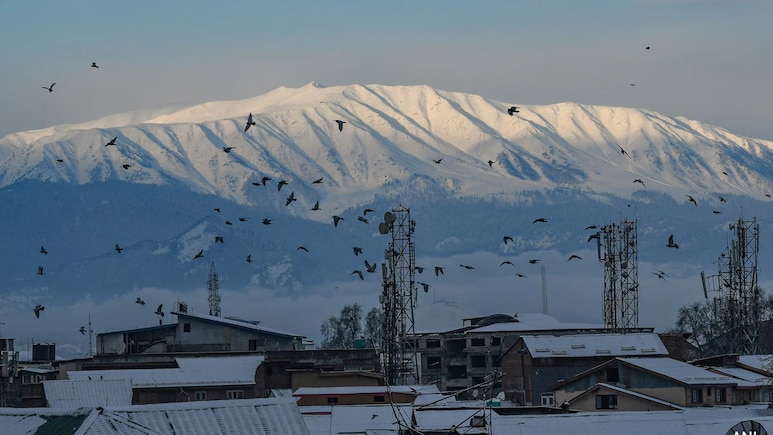
I grew up surrounded by mountains. They were simply part of everyday life. You saw them every morning. You measured distance by them. And you learned very early that nothing worth reaching came easily.
The hardest part of our story is not that we were forced down one mountain.
It is that life rarely allows you to climb the same one again.
The Kashmir I left at seventeen is not a place I can simply return to and resume where I stopped. None of us can.
But I have learned something over the years.
The mountain that is taken from you and the mountain you choose are not the same thing.
The second one belongs entirely to you.
A week ago, I went back. I stood once again on the steps of the house I had left as a frightened seventeen-year-old. Thirty-six years had passed. The first time I walked down those stairs, I had no choice. Leaving was about survival. This time was different. Nobody was forcing me to go anywhere. I had come back to stand for a moment in a place that had shaped me, and to close a circle before the next chapter begins.
And standing there, I realised something. A life spent only surviving is not enough. At some point, survival has to become purpose. Otherwise, what was all that surviving for? That is the question at the heart of this book. As a community, we have already proved that we can endure. We proved that decades ago. The question now is different.
What will we choose to build?
What will we choose to become?
Hard times do not last forever.
What they turn you into often does.
Something permanent was forged in those crowded rooms and around those separate stoves. I wanted to write it down before we forgot. If any part of this feels familiar, then perhaps this book belongs to you as much as it belongs to me. I would be honoured to have you read it.
Avinash Kaul's book, The Next Mountain: Notes on Resilience, Leadership and Purpose (HarperBusiness, with Priya Kumar), releases on 3 July 2026. It can be pre-ordered here.
Disclaimer: These are the personal opinions of the author
Track Latest News Live on NDTV.com and get news updates from India and around the world

