





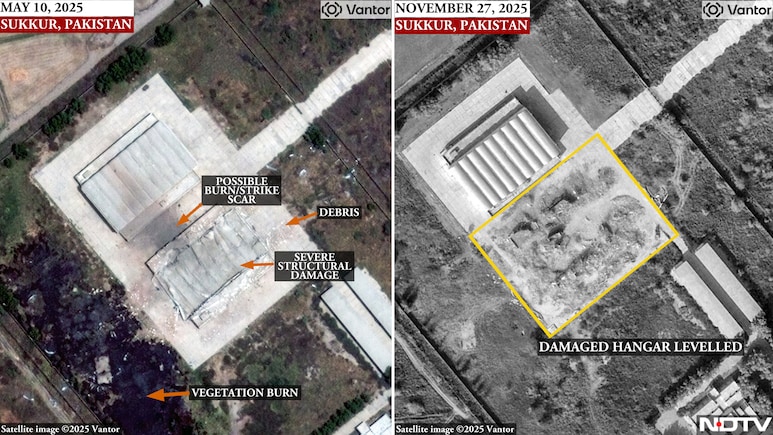
Operation Sindoor, the 88-hour 'mini-war' between India and Pakistan in May last year, came to redefine modern aerial conflict in ways that are now evident in the ongoing war being fought in the Middle East.
While my recently published book, The Sky Warriors: Operation Sindoor Redefined, focuses on first-person accounts of the Indian Air Force's (IAF) war fighters between May 7 and May 10 last year, the conflict itself can be seen through the prism of five key templates that this article lists, along with small excerpts from the book.
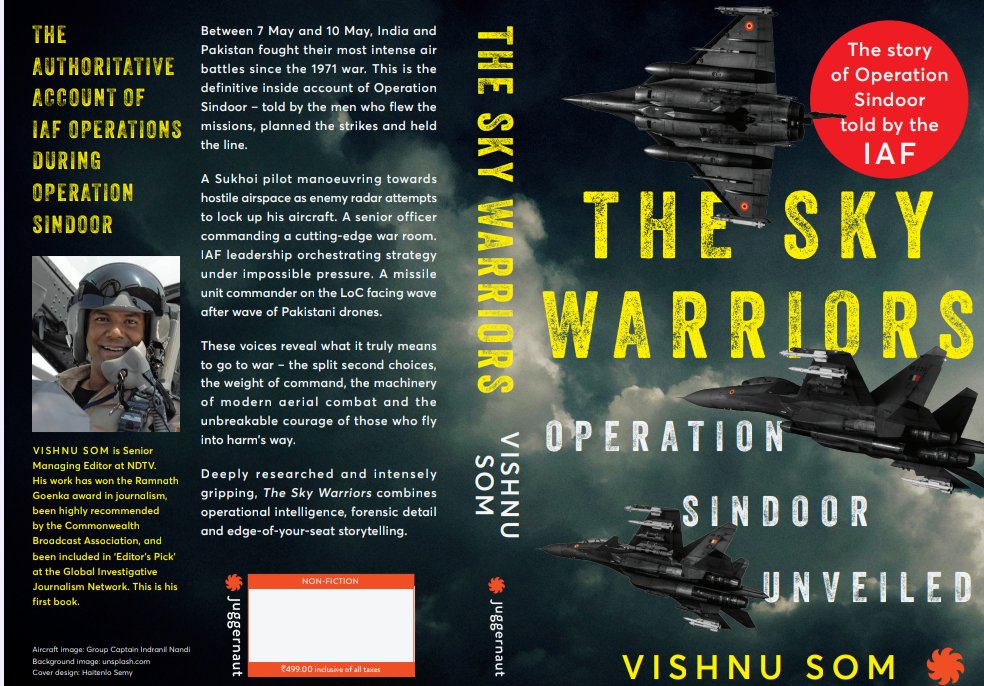
The cover of Vishnu Som's book Sky Warriors. (Courtesy: Juggernaut)
1. Superiority of Long-Range "No-Escape" Zones
Air combat fought between fighter jets or by surface-to-air missile systems targeting fighters is increasingly premised on ultra-long-range weapons. Air-to-air or surface-to-air engagements, which could reliably take place at ranges no more than 100 km in the last decade, are now being fought at ranges beyond 400 km. During Op Sindoor, Russian-built S-400 surface-to-air missile systems operated by the IAF from Adampur proved to be decisive in engaging Pakistani airborne targets, in the process swinging the conflict decisively in India's favour.
On October 7, shortly after the IAF and Indian Army struck terror camps in Pakistan and Pakistan-occupied Kashmir, Group Captain Animesh Patni, who went on to be honoured with a Vir Chakra, helmed one of the firing units of the S-400.
"With missiles flying across the international border, Patni knew he could be called into action in minutes. He was. Patni was ordered to fire. Weapons free, engage targets. It was a scenario that he had trained for time and time again, but always with his formidable weapons system in safe mode - the missiles would not leave their launchers. The radars and systems would simulate incoming threats. And kills would not be real. But this was the real deal."
In The Sky Warriors, I describe just how Patni and the officers and men under his command ended up bringing down a PAF Airborne Early Warning or Electronic Warning aircraft at a range of more than 314 km. No Air Force is believed to have shot down an enemy aircraft at this range.
2. The Vital Role of Integrated Electronic Warfare (EW)
Operation Sindoor demonstrated that modern air warfare is all about managing the electromagnetic spectrum - the strategic control of radio, radar, and infrared waves to ensure your own communications and sensors work while simultaneously blinding, jamming, or ''listening'' to those of the adversary. Aircraft equipped with advanced internal EW suites, such as the Rafale's SPECTRA system, were able to operate within highly contested "bubbles" by jamming enemy fire-control radars and spoofing incoming missiles.
In the book, I write in detail about the role of SPECTRA in protecting IAF Rafales from enemy air-to-air and surface-to-air missiles.
Group Captain Ranjeet Singh Sidhu, the Commanding Officer of a Rafale squadron who was awarded the Vir Chakra, played a key role in the IAF's attack missions.
"SPECTRA is one of the world's most advanced electronic warning suites. It ended up being a huge advantage, Pakistani radars and missiles tried to lock onto Rafales, but SPECTRA defeated them repeatedly. Yes, the adversary fired a lot of missiles, but they were defeated successfully. [It] was giving us indications [of inbound Pakistani missiles]."
The basic point: electronic warfare, in all its forms, is no longer a support function. It is a primary survival tool.
3. Sensor Fusion and Data Link Resiliency
One of the most significant technical takeaways of Operation Sindoor was the success of Sensor Fusion. Pilots who could see a unified "god's eye view" compiled from their own radar, IRST (Infra-Red Search and Track), and off-board data from Airborne Warning and ground-based sensors are likely to have performed significantly better under pressure. In a dense combat environment, processed, fused intelligence is a massive enabler, an asset, one that saves lives.
The Sky Warriors delves deeply into the Indian Air Force's Integrated Air Command and Control Systems (IACCS) nodes, which coordinated the entire battle. Located underground in multiple locations, IACCS node commanders had a 360-degree view of the air battles that unfolded last May.
A senior officer handling one of the IAF's most critical nodes delved deeply into the role of the nodes in waging the battle:
"Have you seen the movie Apollo 13? The operations room seems to be a replica of Mission Control in Apollo 13. We used to keep joking that we are the Houston of the Indian Air Force. It's a fairly big room, and we have a data wall - a big screen in front. The Air Battle Manager (ABM) and the Sector Director sit at a vantage point along with another key officer so that they get better visibility of the screen as well as what is happening below, where several controllers worked on individual consoles. In the Node Commander's Ops Room, the IACCS node, the RAP [Rectified Air Picture] glowed on the huge data wall; officers watched it like lifeguards watching a crowded sea. The node received continuous inputs from multiple radars, civil aviation sensors, observation posts and, when airborne, airborne early warning and control (EW&C) system planes. Algorithms reconciled conflicting tracks, tagged every blip with identity and intent and handed a common picture to fighters, surface-to-air missile units and counter-drone systems."
4. Precision at Standoff Ranges
By May 10, the IAF was clearly on the ascendency in Op Sindoor. Not only had IAF jets struck at least 10 Pakistani air bases, but Indian fighters were in the air to carry out further strikes when they were told to abort their missions because Pakistan had shown a willingness to come to the ceasefire table.
India's ability to strike Pakistani airbases - almost at will - can largely be attributed to a range of new-generation precision guided weaponry, including SCALP, Rampage, BrahMos, Crystal Maze and Hammer missiles/smart bombs. The precision strikes of the IAF, which ensured no collateral damage was done, are a clear indicator of the "iron bomb" era being effectively over in high-threat environments.
There are detailed accounts of the deployment of these weapons in The Sky Warriors.
Group Captain Manav Bhatia was the Commanding Officer of a Sukhoi-30 MKI squadron during Operation Sindoor:
"The BrahMos is a beautiful weapon when it leaves your aircraft. It's like a sunrise in the middle of the night. When I was pressing the trigger, in my heart I prayed in my heart, Bas, bulls eye mar de yarr, please let the launch and hit be perfect. 'And then - gayi! She's gone! On the intercom, I said, "Very nice" [to the young pilot in the front cockpit]. 'And then that thing lights up on our head-up display screen (HUD) because it's the boost phase, and the youngster starts handling the aircraft like Maverick in Top Gun - and we are now doing our post-launch manoeuvres."
5. Transition to "Non-Contact" Attrition - Drone Warfare
Operation Sindoor marked a transition from using drones merely as "eyes in the sky" reconnaissance platforms to making them the centrepiece of kinetic action. For the IAF and the Army, the operation demonstrated that high-end, expensive platforms are not always the answer to high-volume threats. Pakistan extensively used drones - several hundred between May 7 and May 10, from Siachen in the North to Gujarat in the South - across the entire field of operations. The goal was very clear: to attempt to overwhelm India's defences, trigger surface-to-air missile launches by the IAF, in the process depleting IAF stocks of expensive weapons. The use of drones highlighted a major cost asymmetry. Using a multi-million dollar missile to down a "thousand-dollar" drone is economically unsustainable in a long-drawn conflict.
Air Marshal AK Bharti, then the Director General of Air Operations, had a birds-eye view of how Pakistan infiltrated Indian airspace using drones:
"It was very clear that the Pakistani military had deliberately made itself a legitimate target for the Indian Armed Forces. So when they attempted to saturate us [with drones on the evening of 7 May and into the early hours of 8 May], we were prepared for it. They started sending in hordes of drones. We had to see where they were headed. We dealt with the intruding drones by analysing where they were headed, with the ones heading to civil population centres being accorded high priority. We used a combination of weapons [to engage the drones], in some cases surface-to-air missiles. In some cases, we used our close-in weapons systems - guns, hard-kill [missiles] and soft-kill options where you try and jam their frequencies. It was a layered defence which ensured that we did not have any damage."
Operation Sindoor, though brief at just 88 hours, stands as a watershed in contemporary aerial warfare. It demonstrated how rapidly evolving technologies - ultra-long-range missiles, advanced electronic warfare suites, resilient data links, precision standoff munitions, and massed drone operations - can compress decision cycles, amplify lethality, and force adversaries to the negotiating table before escalation spirals uncontrollably.
What emerged from those four days in May 2025 was India's ability to impose calibrated but overwhelming costs - degrading terrorist infrastructure, crippling airbases, and neutralising airborne threats - while maintaining strategic restraint. Pakistan's attempts at saturation and retaliation were blunted, leading to a ceasefire on May 10, with India clearly holding the upper hand in the air domain.
As conflicts in the Middle East continue to unfold with eerily similar signatures - extended-range engagements, drone-heavy attrition, and electromagnetic battles - the echoes of Operation Sindoor grow louder. The mini-war was not merely a bilateral flare-up; it previewed how future air campaigns will be waged: faster, farther, more fused, and increasingly remote from the pilot's cockpit.
In my book, The Sky Warriors: Operation Sindoor Redefined, these accounts from the cockpit, the underground nodes, and the SAM batteries capture the human element behind the hardware - the courage, split-second decisions, and quiet professionalism - that turned doctrine into dominance.
(The author is Senior Managing Editor, NDTV)
Disclaimer: These are the personal opinions of the author
Track Latest News Live on NDTV.com and get news updates from India and around the world

