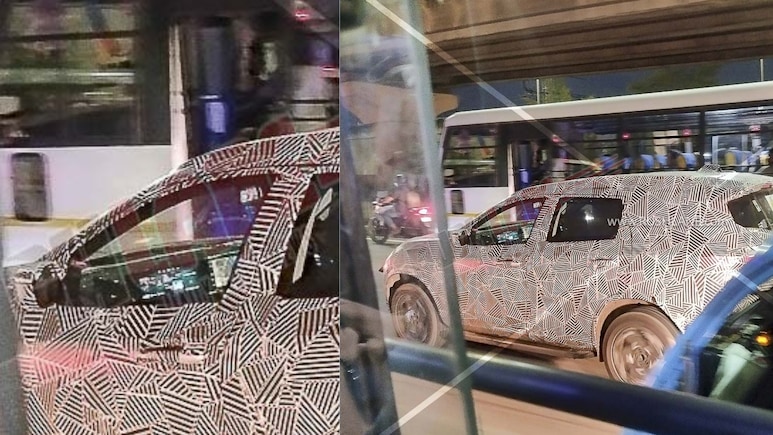
Tata Motors' upcoming Safari EV is set to adopt the triple-screen dashboard layout first introduced on the Sierra EV. The update comes from the new spy shots of a test mule. The images show an illuminated passenger-side display alongside the central touchscreen and digital instrument cluster, confirming earlier reports about a significant cabin upgrade for Tata's upcoming flagship electric SUV.
Triple-Screen Cabin And Feature Set
The Sierra became the first Tata car to feature a triple-screen setup earlier in 2026. The Safari EV will now bring the same configuration to a three-row SUV, distinguishing it from the Harrier EV's two-screen arrangement. This additional screen is expected to offer dedicated infotainment or navigation views for the front passenger, enhancing the premium feel of the cabin.
Also Read: Mahindra Thar 3-Door Set For Another Facelift, Teased Ahead Of Launch
Beyond the passenger display, the Safari EV is likely to borrow several features from the Harrier EV. These may include a digital IRVM with integrated dashcam functionality, a 540-degree camera system, ventilated front seats, a JBL audio system, Level-2 ADAS, and auto park assist. Vehicle-to-load (V2L) and vehicle-to-vehicle (V2V) power-sharing capabilities are also anticipated, aligning the Safari EV with current expectations for connected electric SUVs.
The heavily camouflaged prototype retains the familiar Safari silhouette, with an upright rear section, roof rails and a roof-mounted spoiler. The triple-screen dashboard, however, represents the most visible interior evolution over the current combustion-engine Safari.
Also Read: New Hero Impulse Spotted Undisguised, Launch Imminent
Batteries, Range And Performance
The Safari EV is expected to share the Harrier EV's battery and drivetrain options. Two packs are likely: a 65 kWh unit and a larger 75 kWh pack, offered with rear-wheel-drive (RWD) and dual-motor QWD (all-wheel-drive) configurations. The Harrier EV's certified ranges stand at 538 km for the 65 kWh version, 627 km for the 75 kWh RWD and 622 km for the 75 kWh QWD. The Safari EV could deliver broadly similar figures, though its additional weight from the third row may slightly reduce the final certified range.
Also Read: MG Cyberster, M9 EV Now Available As BaaS - Check Price, Battery Rental
In terms of performance, the Harrier EV's QWD variant produces 504 Nm of torque, and its 75 kWh battery supports a claimed 20-80 per cent charge in around 25 minutes on a suitable 120 kW DC fast charger. These numbers provide a useful benchmark for the Safari EV's expected capabilities in real-world use.
Pricing, Positioning And Launch Timeline
The Harrier EV is currently priced between Rs 21.79 lakh and Rs 30.54 lakh (ex-showroom, Mumbai). Given the Safari's traditional premium over the Harrier in the internal-combustion range, where price gaps vary from Rs 40,000 to Rs 80,000, the Safari EV is estimated to start around Rs 22-23 lakh and reach up to Rs 31-32 lakh for higher variants.
The Safari EV will directly rival the Mahindra XEV 9S, which reportedly sells around 3,000-4,000 units a month, indicating healthy demand for three-row electric SUVs. Tata is expected to officially unveil the Safari EV at the Bharat Mobility Auto Expo 2027, with market launch likely in late 2026 or early 2027, depending on final production scheduling.
Track Latest News Live on NDTV.com and get news updates from India and around the world
