Driving through the Garhwal Himalayas isn't just about scenic views; it is a brutal test of mechanical sympathy and driver skill. Landour, with its notoriously steep, tight hairpins heading up towards Lal Tibba, often turns up as a proving ground. A recent viral video highlights exactly how quickly things can go south when you lose momentum on these sharp inclines, and why modern safety tech like 'Hill-Hold Assist' is an absolute lifesaver.
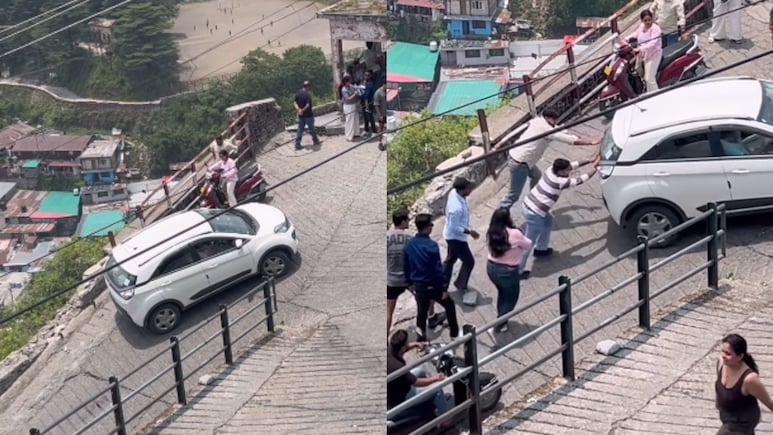
In the video, a Tata Nexon is seen navigating a steep uphill hairpin in Landour. The driver initially has the right trajectory, but a scooter rider suddenly cuts across her path, forcing a complete halt mid-corner. On a mountain road, that is the worst-case scenario.
The Physics of Losing Momentum
When you stop a heavy compact SUV on a severe incline, gravity immediately takes over. Getting the vehicle moving again from a dead halt requires a flawless balance of throttle and clutch. If the revs drop, you stall. If you panic and dump the clutch, you spin the front wheels.
In the video, the driver struggles to find that bite point, resulting in the Nexon failing to climb further. Ultimately, it takes a group of bystanders physically pushing the SUV from behind to get it over the crest. This high-stress situation is exactly what hill-hold assist was engineered to prevent.
What Is A Hill-Hold Assist & How Does It Work?
If you drive a manual or an AMT (Automated Manual Transmission) in the hills, rollback anxiety is real. When you lift your foot off the brake to press the accelerator, there is a split-second window where the car is in free-fall backward.
Here is what the tech does:
When the car's gyroscope sensors detect a steep gradient, hill-hold assist automatically holds the brake pressure for two to three seconds after you take your foot off the brake pedal.
This gives the driver a relaxed, panic-free window to shift their foot to the accelerator, build up the RPMs, and smoothly release the clutch to launch the car forward. Zero rollback. Zero tire spin. Zero burned clutches.
The Old-School Fix: The Handbrake Start
While newer iterations and higher variants of the Tata Nexon come equipped with Hill-Hold Control, millions of cars on Indian roads do not have this luxury. If you find yourself in the same situation as the driver in Landour without electronic assists, you must rely on the traditional handbrake start.
- Engage the handbrake fully while stopped.
- Put the car in first gear and slowly release the clutch while feeding the throttle.
- Once you feel the rear of the car squat (the engine fighting the brakes), disengage the handbrake smoothly.
Driving in the hills demands anticipation. If a scooter or a stray dog forces you to stop on a 30-degree hairpin, knowing how to manage your vehicle's weight transfer is just as important as the tech packed inside it.
Track Latest News Live on NDTV.com and get news updates from India and around the world
