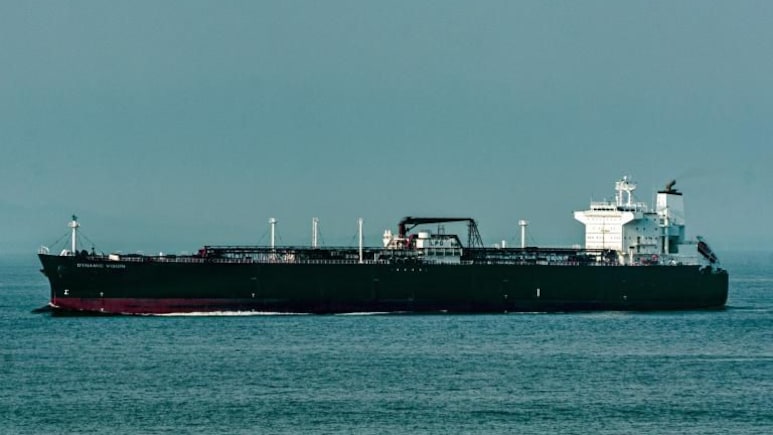
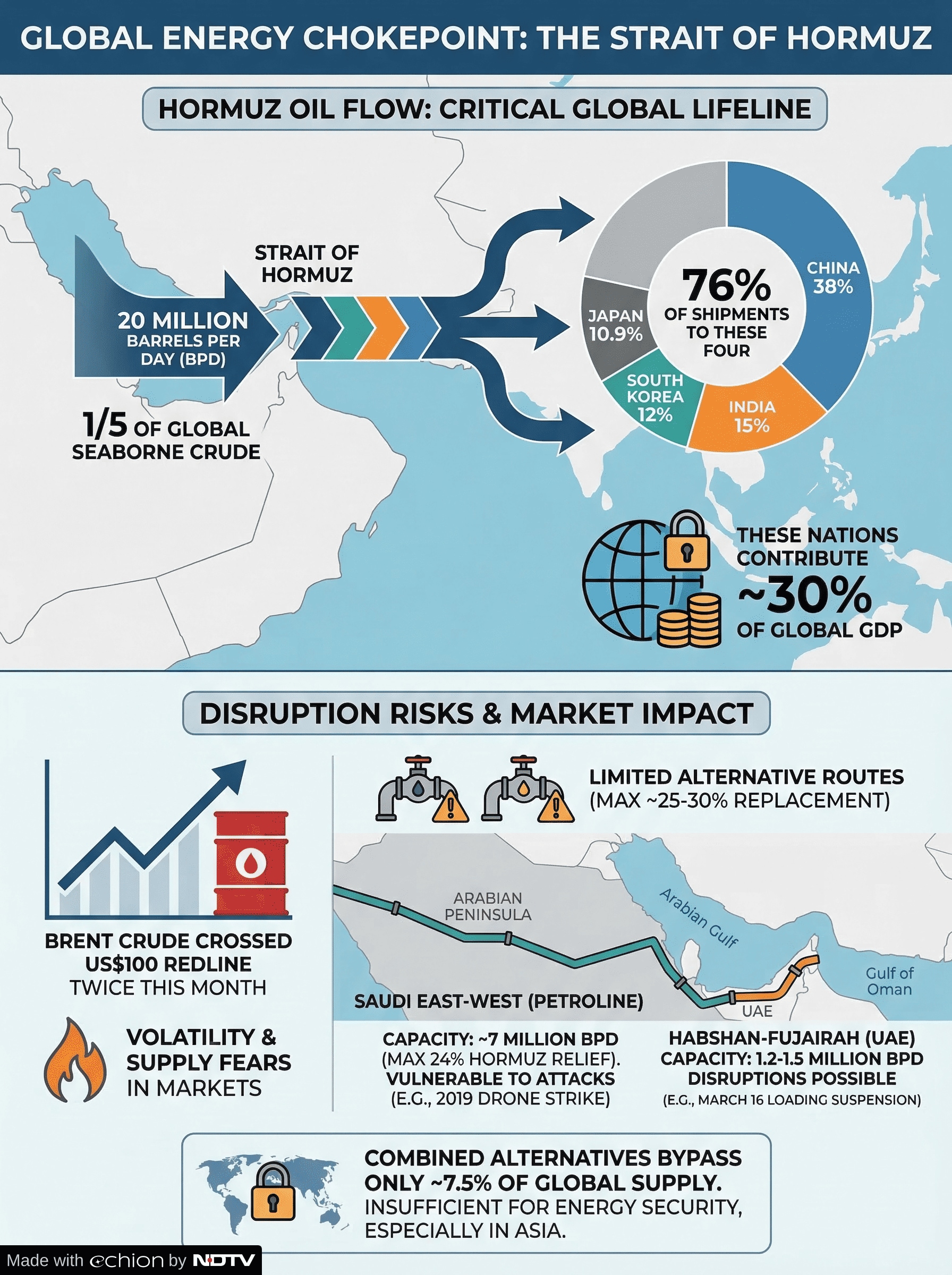
An estimated 20 million barrels of oil – a fifth of the world's seaborne crude – ships through the Strait of Hormuz daily, and nearly half that, i.e., around 8.2 million barrels, is bound for India and China, two countries with vast and energy-hungry populations and economies.
India typically collects around 12 to 15 per cent of Hormuz-shipped oil. China dominates by pocketing around 38 per cent while South Korea and Japan pick up around 12 and 11 per cent, respectively. India's Hormuz supply is equivalent to about 40 per cent of crude imports pre-crisis, but it has now diversified to 70 per cent non-Hormuz supplies, the Petroleum Ministry said.
Together these four buy up to 76 per cent of total oil shipments through the Hormuz and contribute around 30 per cent of global GDP. That latter number means the world simply cannot afford to risk energy supply to these nations.
But disruption as a result of the US and Israel war on Iran has fed unwelcome volatility into the system, leading to supply fears in Indian markets and forcing oil prices upwards; benchmark Brent crude has crossed the US$100 redline twice this month.
Alternative routes - specifically Saudi and UAE pipelines - exist but these cannot replace more than 25 or 30 per cent of the Hormuz' 20 million bpd, even in the short-term, underlining the strait's importance to global energy supply stability.
Post the US and Israel attacks, and Iran's blockade, there has been a pivot to Saudi East-West and Habshan-Fujairah pipelines, but these face operational constraints, including limited carrying capacities, and are as vulnerable to strikes.
Saudi and UAE pipelines offer marginal relief for Hormuz oil chokehold.
The Saudi pipeline runs from oil fields in the country's east to export terminals on its west coast, along the Red Sea.
On paper, this is an ideal workaround – it avoids the Hormuz completely.
Nearly 750km long, the pipeline, also called Petroline was built for exactly this purpose – to skip the Hormuz and bypass Iranian and Iraqi military attacks on merchant vessels in 1981-88. But its full operational capacity is around seven million barrels per day only, meaning it can relieve no more than 24 per cent of the pressure on the Hormuz supply channel.
And, as the shutdown post a 2019 Houthi drone attack showed, operations can be impacted.
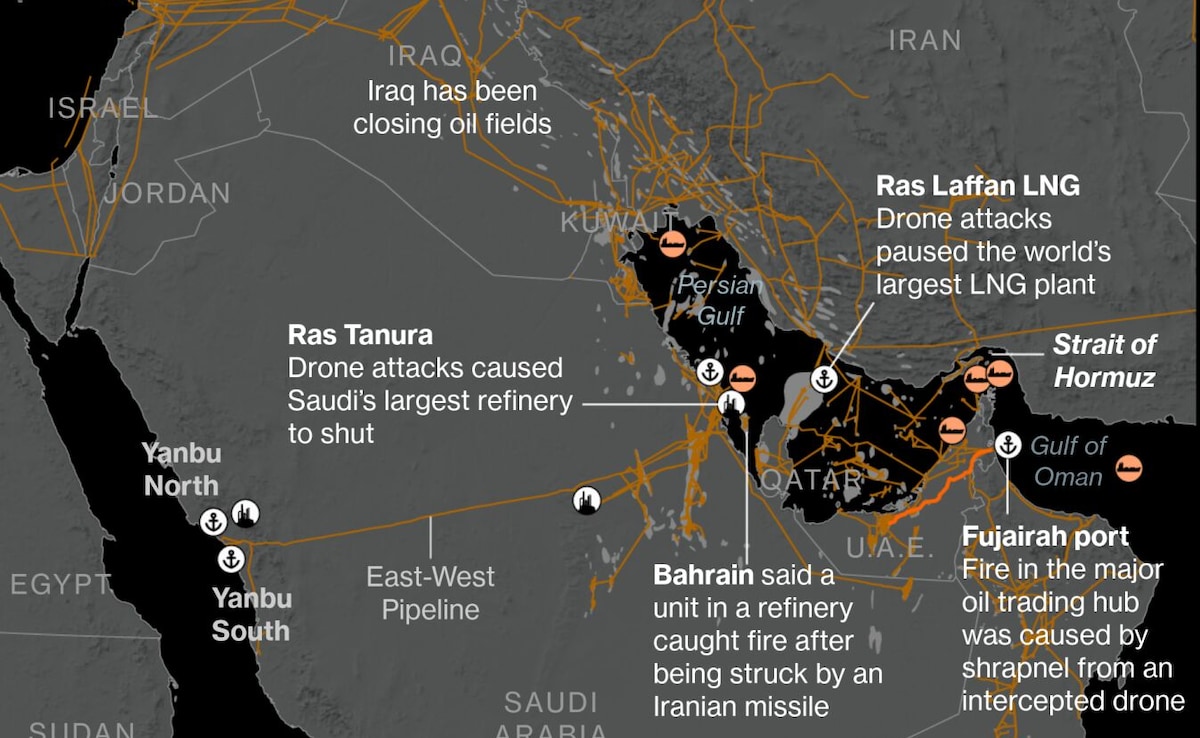
Energy disruptions in the Middle East. Photo: Bloomberg
The Habshan-Fujairah pipeline in the UAE is another overland route. It connects the Habshan oil field in Abu Dhabi to the Fujairah Port on the Gulf of Oman, which lies past Iran's blockade.
But it, even less so than the Petroline, cannot replicate Hormuz shipping volumes.
The Fujairah pipeline can carry between 1.2 and 1.5 million bpd, and even that volume faces disruptions; loading ops at Fujairah Port were suspended March 16 after a drone strike.
| Route/Pipeline | Approx. capacity | % of Hormuz flow |
| Strait of Hormuz | 20 to 21 million barrels per day | - |
| Saudi East-West | 5 million bpd | 24 per cent |
| UAE Habshan-Fujairah | 1.2 to 1.5 million bpd | 7 per cent |
| Others | Less than 1 million bpd | Less than 5 per cent |
| Total bypass | 6 to 7 million bpd | 29 per cent |
Between them an estimated 7.5 per cent of the world's crude supply skips the Hormuz chokepoint, but it is nowhere near enough to keep fuel-hungry wolves at bay in Asia.
Other overland routes to marine terminals – transiting through Iraq, for example – can carry even less, underlining the region's fragile oil export infrastructure, which then adds to price surges.
It also means the Middle East oil supply is now being forced westwards, and that Tehran's gamble on Hormuz pressure is translating into a strategic pain point for Trump and the US.
Track Latest News Live on NDTV.com and get news updates from India and around the world


