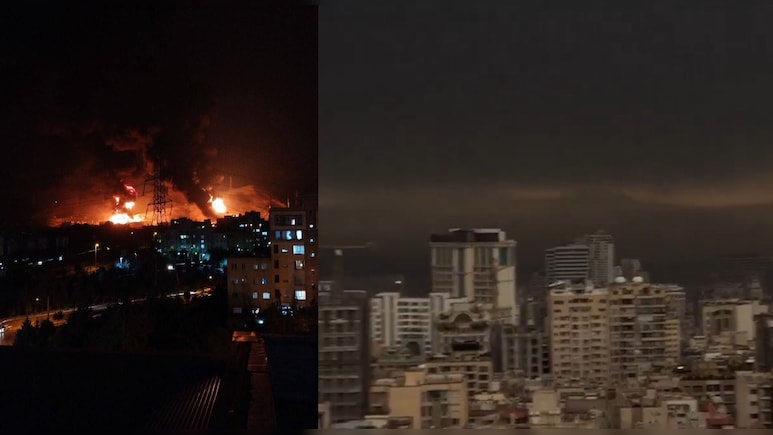
Residents in Iran's capital Tehran reported oil-tainted rain and thick black smoke on Sunday (March 8) after Israeli airstrikes hit several fuel storage and oil facilities around the city overnight.
Images and videos from the city showed dark clouds hanging over Tehran, while residents said rain carried an oily residue that stained buildings, vehicles and roads. The city's governor urged residents to wear masks as concerns rose about air pollution.
This is Ghaem Maqam Farahani Street in Tehran, Iran today.
— Weather Monitor (@WeatherMonitors) March 8, 2026
Oil fell with the rain, not normal rain that helps people, crops, trees, animals, and nature. This is an ecological disaster. pic.twitter.com/nmKETu59as
Iranian state media said multiple oil facilities were targeted in the strikes. These included the Aghdasieh oil warehouse in northeast Tehran, the Shahran oil depot north of the city, an oil refinery in southern Tehran, and an oil depot in Karaj in neighbouring Alborz province.
The Israeli military confirmed the strikes, saying it had targeted fuel storage complexes belonging to Iran's Islamic Revolutionary Guard Corps (IRGC), which it said were used to distribute fuel to military entities.
🎯STRUCK: Several Fuel Storage Complexes Belonging to the IRGC in Tehran
— Israel Defense Forces (@IDF) March 7, 2026
Guided by IDF intelligence, the IAF struck these complexes, where the Iranian terrorist regime would distribute fuel to multiple military entities in Iran.
The strike significantly deepens the damage to… pic.twitter.com/T1csYf4PCp
According to Iran's FARS news agency, four oil storage facilities and oil transfer centres in Tehran and Alborz were hit in the strikes carried out on Saturday. Four tanker drivers present at one of the sites were reported killed.
The fires triggered by the attacks burned for hours, sending large plumes of black smoke into the air. The smoke later formed heavy clouds that produced rainfall carrying oily residue across parts of the capital, home to nearly 10 million people.
Iran's Red Crescent Society warned that the rain could contain toxic hydrocarbon compounds as well as sulfur and nitrogen oxides. These substances can cause acid rain and may pose health risks, including breathing difficulties and skin irritation.
The organisation advised residents to remain indoors, cover openings in their homes with damp cloth and remove any clothes contaminated by the rainwater. It also recommended washing vehicles and building exteriors to prevent toxic residue from turning into airborne dust later.
Israeli Strikes In Lebanon
Israeli forces also carried out strikes in southern Lebanon targeting Iranian-backed forces. Lebanon's health minister said the attacks had killed 394 people so far, including 83 children.
The strikes come despite a ceasefire reached in November 2024.
Iran Hits Desalination Plant In Bahrain
Elsewhere in the region, Iran was reported to have targeted a desalination plant in Bahrain, causing material damage. The strike reportedly involved drones and missiles.
Bahrain has been repeatedly targeted since the conflict escalated because it hosts the US Navy's Fifth Fleet. However, this was the first reported attack on a desalination facility.
The development followed US strikes on Iran's Qeshm Island in the Strait of Hormuz, where an Iranian desalination plant is located. Iran's foreign minister Abbas Araghchi said the attack disrupted water supplies to nearly 30 villages and warned that the United States had set a dangerous precedent.
Conflict Widens Across Middle East
The current escalation began on February 28, 2026, when the United States and Israel launched a joint attack on Iranian nuclear, military and leadership sites.
Iran responded with missiles and drones targeting Israeli and American interests across the Middle East, including embassies and military bases in Gulf countries. Some strikes have also hit civilian locations such as hotels, airports and residential buildings.
Iran's Red Crescent Society said about 10,000 civilian structures across the country -- including homes, schools and medical facilities -- have been damaged since the attacks began.
The fighting has also disrupted global energy markets. The Strait of Hormuz, a key route for global oil shipments, has faced disruptions during the conflict, pushing oil prices to their highest levels since the Covid-19 pandemic.
Track Latest News Live on NDTV.com and get news updates from India and around the world


