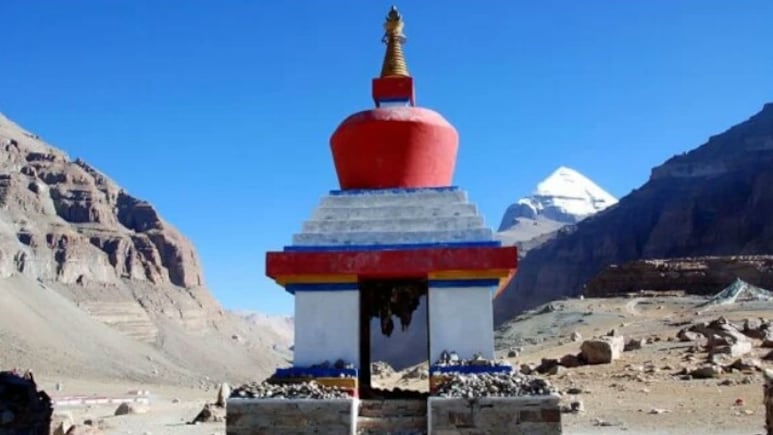
Few places in the world evoke as much mystery and reverence as Mount Kailash. Believed to be the abode of Lord Shiva, the sacred peak draws thousands of devotees from across the world every year despite its remote location. Along the journey to the revered Kailash Mansarovar lies Yam Dwar, a symbolic gateway that pilgrims cross as they begin one of Hinduism's most sacred pilgrimages.
Yam Dwar, or the “Gateway to the God and Death," is located at Tarboche in the Ngari Prefecture of Tibet at an altitude of 4,750 metres and lies about 15 km north of the base camp town of Darchen. Marking the starting point of the Mount Kailash Parikrama, this place holds immense spiritual significance.
Also Read: Why This Year's Kailash Mansarovar Yatra, A Once-In-12-Years Pilgrimage, Is So Special
The Gate Of Yama
Like the name suggests, Yam Dwar represents the gate of Yama, the deity of death. As per beliefs, Yamraj himself guards this home of Lord Shiva. Passing through the place symbolises spiritual rebirth and the abandonment of worldly attachment. While central to Hinduism, the place holds equal weight for Buddhists, Jains, and Bon followers.
Tibetans believe that Kailash is the home of 'Demchok', a supreme meditational deity in Vajrayana Buddhism. Therefore, every year, they establish a new prayer flagpole in Tarboche. The colourful Tibetan flags have a deep meaning and are arranged in the specific colour sequence, which is “blue, white, red, green, and yellow”.
They arrange flags from left to right. The blue-coloured flag represents the sky, the white colour is of air, the red is of fire, the green colour is of water, and the yellow flag is of earth. Therefore, all these flags together represent the balance establishing life on Earth.
As per Hindu mythology, after completing the Yam Dwar circumambulation, the individual will get a place in heaven. As per belief, when someone passes through this door, Yamraj's record-keeper, Chitragupta, removes all evil deeds of the person from the ‘Book of Judgement.'
Also Read: Kailash Mansarovar Yatra Pilgrims Stranded In Nepal, Ministry Of External Affairs Issues Advisory
About Mount Kailash Parikrama

This sacred 52-kilometre circumambulation of the revered mountain in Tibet takes 2-3 days to complete. It holds immense religious significance for Hindus, Buddhists, Jains and followers of the Bon faith. Hindus believe that completing one parikrama washes away the sins of a lifetime, while 108 circumambulations are said to lead to liberation. The journey takes pilgrims through rugged terrain and the high-altitude Dolma La Pass, making it both physically demanding and spiritually transformative.
Track Latest News Live on NDTV.com and get news updates from India and around the world


