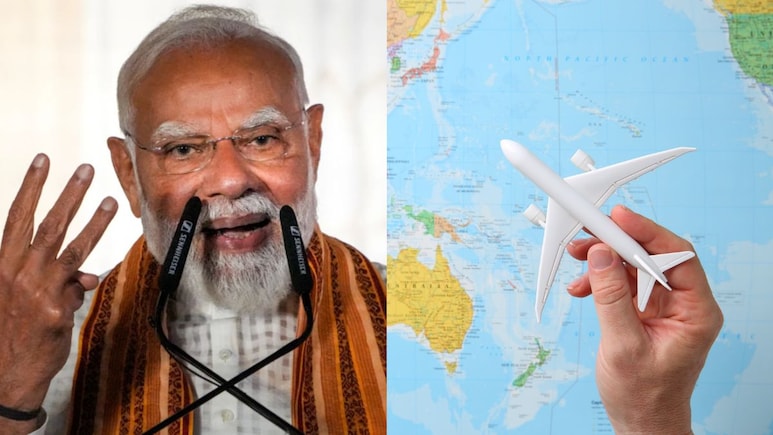
Prime Minister Narendra Modi's recent appeal to citizens to reconsider international holidays and destination weddings has brought travel choices into the spotlight, linking them directly with the country's economic stability.
At a time when global uncertainties, particularly the ongoing conflict in West Asia, have pushed up crude oil prices and exerted pressure on the Indian rupee, the government is urging people to make mindful travel decisions.
The message is clear: prioritise domestic tourism and reduce non-essential foreign spending to help conserve India's foreign exchange reserves.
Here is a detailed breakdown on how your foreign trip affects the economy and what it means for you.
Rise In International Trips Recorded In 2025
According to the Ministry of Tourism's Annual Tourism Snapshot Report, 3.27 crore Indians travelled abroad in 2025. Leisure travel accounted for 43.5 per cent of these trips, with 1.43 crore Indians travelling overseas purely for holidays. At the same time, growth in foreign exchange earnings from tourism declined by 6.62 per cent in 2025 compared to the previous year.
Experts note that such trends can intensify pressure on the rupee, especially when outbound travel significantly outweighs inbound flows.
Why The Government Is Urging Caution
PM Modi's appeal comes against the backdrop of rising geopolitical tensions, which have disrupted global supply chains and driven up oil prices.
According to RBI data, India's forex reserves, which were close to $728 billion in February 2026, slipped to around $691 billion in April amid global volatility.
According to IMF projections, the country's current account deficit (CAD) could widen to $84.5 billion in 2026, roughly 2 per cent of GDP, indicating that more money is flowing out of the country than coming in.
Also Read: PM Modi's WFH Appeal Sparks Debate: Is Corporate India Ready Again?
What Role Does Your International Trip Play In Forex Reserves?
Outbound tourism leads to a forex outflow. When Indians travel abroad:
- Travellers convert rupees into foreign currencies
- Money is spent overseas on flights, hotels, shopping and services
- This results in foreign exchange leaving India
In simple terms: More Indians travelling abroad = more dollars going out = pressure on forex reserves
Tourism is effectively a foreign exchange channel:
- Inbound tourism = forex inflow (positive for reserves)
- Outbound tourism = forex outflow (pressure on reserves)
That's why, during periods of economic stress or currency pressure, governments often urge citizens to travel domestically and limit non-essential foreign spending.
Impact On Current Account Deficit (CAD)
Tourism directly affects the current account deficit, which tracks the flow of money in and out of the country.
If outbound travel spending is higher than inbound earnings, it widens the CAD. A widening CAD means more foreign currency is leaving the country than entering it.
Effect On The Rupee
Tourism also influences the value of the Indian rupee. Higher outbound travel means increased demand for foreign currency. This demand weakens the rupee against major currencies.
Why Is The Government Focusing On Domestic Tourism?
Encouraging domestic tourism helps in two ways:
- Reduces forex outflow (people spend within India)
- Boosts the local economy without impacting reserves negatively
"Domestic tourism is not just a leisure activity anymore; it is also an important economic multiplier. The focus should not be on discouraging travel, but on encouraging Indians to rediscover and invest in India's own diverse destinations, hospitality, weddings, and experiences," says Jyoti Mayal, Chairperson, Travel & Hospitality Skill Council, adding, "At a time when India's import bill - particularly crude oil imports - is already increasing due to global uncertainty, reducing avoidable dollar outflows becomes economically significant."
Are Indian Destinations Equipped To Absorb A Surge In Demand?
"Due to an increase in domestic holidaymakers and wedding traffic throughout the entire country, some of the most popular destinations in India will become more crowded during peak travel seasons," notes Ravi Gosain, President, Indian Association of Tour Operators (IATO), adding, "However, many tier two cities and other emerging tourism destinations will now have the opportunity to attract domestic tourists from within the country and surrounding regions."
Rohit Kohli, Joint Managing Director, Creative Travel family of brands, says that the popular destinations in India may struggle under overtourism, hence better infrastructure is required during the peak season.
As for the wedding industry, Nikhil Mahajan, Director of Kestone Utsav, says, "Industry reports suggest that close to 90% of destination weddings hosted by Indians are now taking place within India, highlighting the growing preference for premium domestic venues and culturally rooted celebrations."
Mahajan adds, "PM Modi's appeal to celebrate weddings in India could further accelerate this trend. India today offers world-class hospitality infrastructure, luxury resorts, heritage palaces, beach destinations, and unique experiential venues across Rajasthan, Goa, Kerala, Uttarakhand, and the Northeast. Beyond tourism, domestic destination weddings significantly contribute to local economies, employment generation, hospitality, decor, travel, and event management sectors."
Weaker Rupee And Rising Airfares Make International Travel Costlier
For travellers, currency depreciation has a direct impact on budgets. When the rupee weakens, the cost of every dollar-denominated expense rises.
For instance, when the exchange rate was around ₹83 per US dollar, a $1,000 trip would cost approximately ₹83,000. At ₹95 to the dollar, that same trip costs ₹ 95,000, an increase of ₹12,000 without any change in itinerary.
This effect multiplies across all travel expenses. Hotels, flights, visa fees, travel insurance, local transport, food and shopping, most of which are priced in foreign currency, become significantly more expensive when converted into rupees.
As per reports, overseas travel has become up to 20 per cent more expensive in recent months, especially for long-haul destinations such as the US and Europe.
Currency is only part of the story. Rising crude oil prices have pushed up aviation fuel costs, leading to higher airfares.
This combined impact - higher fuel prices, weaker currency and global disruptions - has made every element of international travel more expensive.
Govind Gaur, Founder and CEO, WanderOn, says, "We are already seeing increased demand for premium domestic vacations, experiential group travel, road trips, adventure travel, and destination celebrations within India. Destinations like Kashmir, Himachal Pradesh, Uttarakhand, Meghalaya, Kerala, and North Eastern States have witnessed growing traveller interest from young consumers seeking experiential domestic vacations."
Also Read: Why PM Asked Households To Cut Use Of Cooking Oil And What's The Alternative
Will Lesser Outbound Travel Impact Business For Indian Airlines?
Ravi Gosain adds, "In the near-to-medium term, Indian airlines that focus heavily on international routes may experience less demand, especially for leisure travel and destination weddings outside of India. However, as travellers consider domestic tourism, this will somewhat mitigate the downturn of international travel, as travellers may look to explore Indian vacation destinations versus foreign vacation destinations. The aviation industry in India has shown great resilience to changing travel patterns and should continue to see strong domestic demand."
What Does It All Mean For You As A Traveller?
PM Modi's appeal is not just about travel choices; it reflects a broader economic strategy during a period of global uncertainty. By encouraging citizens to cut back on non-essential foreign spending, the government aims to stabilise forex reserves and ease pressure on the rupee.
At the same time, rising travel costs may naturally deter some international trips, potentially reinforcing this shift.
The long-term impact of this appeal on travel behaviour is yet to become clear. However, for now, it has sparked a wider conversation about the economic impact of travel and the growing importance of balancing aspiration with economic realities.
Track Latest News Live on NDTV.com and get news updates from India and around the world


