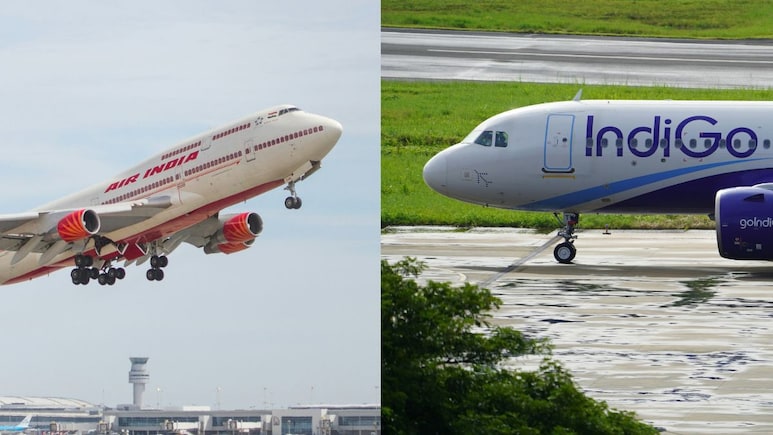
In what comes as a significant shift for India's rapidly expanding aviation sector, the Centre has stepped in to address one of the most persistent irritants for flyers: paying extra just to choose a seat.
Under new passenger-focused norms issued by the Union Ministry of Civil Aviation through the Directorate General of Civil Aviation (DGCA), Indian airlines have now been asked to ensure that at least 60 per cent of seats on any flight are available free of seat selection charges.
For anyone who has booked a flight in the past few years, this move lands as a long-awaited intervention. Seat selection fees, often tucked away in the final stages of booking, have been a sore point, with passengers arguing that what is marketed as a base fare rarely reflects the actual cost of travel.
What This Means When You Actually Try Booking A Ticket
To understand how this plays out in real terms, we tried booking a flight ourselves. The route was Delhi to Kolkata on an Air India flight scheduled for Sunday, 5 April 2026 at 06:40.
The base pricing looked straightforward enough. For one passenger, the total fare came to Rs 6,018, with Rs 1,287 listed under taxes, fees, and charges, and an additional convenience fee of Rs 399. So far, so expected.
But the moment you move to seat selection, the pricing begins to tell a different story.
On this particular aircraft, an Airbus A320neo with around 174 seats, a large chunk of seats were marked as chargeable. Window seats in the front rows were priced at Rs 1,300. Exit row seats, often marketed as premium due to extra legroom, ranged between Rs 650 and Rs 750. Even seats further back, like a standard window in row 23, came at Rs 386.
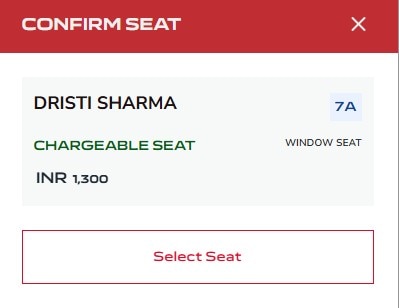
The front row window seat was priced at Rs 1,300. Photo: Air India/Author
Another window seat in row 12 was priced at Rs 551.
What stood out was not just the pricing, but the availability. Out of roughly 174 seats, only about 14 (that's less than 10% seats) were available for free selection. That is a tiny fraction, and it aligns with what many passengers have been complaining about: that "free" seats are either scarce, poorly located, or practically inaccessible during booking.
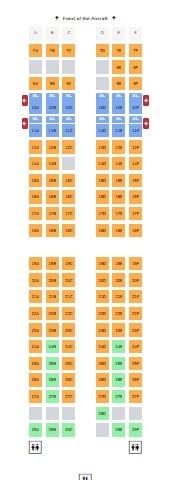
Out of roughly 174 seats, only about 14 were available for free (the green boxes). Photo: Air India/Author
Aircraft configurations also explain why seat selection has quietly become such a revenue stream. Most narrow-body aircraft used on domestic routes, like the Airbus A320neo or A321neo, typically have between 138 and 232 economy seats, with little to no premium economy sections.
Even Boeing 737-800 variants, depending on the airline, carry around 156 to 162 passengers, sometimes with a small premium cabin of just 8 seats. In such layouts, a vast majority of seats fall within the economy section, allowing airlines to segment them by location and charge differently for window, aisle, exit rows, or front sections. When only a small fraction of these are left unpriced, it effectively pushes most passengers towards paid options.
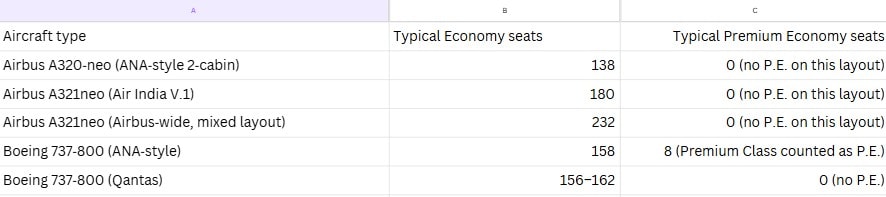
A rough, airline‑specific reference table of typical Economy and Premium Economy seats by aircraft type. Photo: Author
This is exactly the imbalance the government is now trying to correct by mandating that a majority of seats must be free to choose from.
Why This Matters
Spend a few minutes on X, and a clear pattern emerges. The frustration is not just about paying extra, but about how unavoidable it often feels.
One user, Shubh Agrawal, called out on March 7, 2026, what he described as a "dark UI pattern", saying that during web check-in, free seats appear unavailable and passengers are nudged towards paid options. "You either have to pay for a seat... or it simply prompts you with 'select a seat now' without offering a free seat option," he wrote, questioning how such practices were even allowed.
"When you try to check in for a flight, they indicate that all free seats are sold out and only allow you to check in early if you pay for a seat. In the past, you could be assigned a random seat, but that option is no longer available. Now, you either have to pay for a seat, or if you choose to proceed without paying, it simply prompts you with "Hey, select a seat now," without offering a free seat option. It's disappointing to see this kind of behaviour from a company, and I honestly don't understand how it's legal," the tweet says.
It's quite frustrating how @IndiGo6E employs this dark UI pattern . When you try to check in for a flight, they indicate that all free seats are sold out and only allow you to check in early if you pay for a seat.
— Shubh Agrawal (@ShubhAgrawal26) March 6, 2026
In the past, you could be assigned a random seat, but that option… pic.twitter.com/cqEee54X3q
Another user, Aanchal Agrawal, shared a different experience, where paying extra did not guarantee a better seat. She complained that the seat she paid for had a broken tray table, and the overall in-flight experience left her more frustrated than reassured.
Guys never compliment @IndiGo6E because it jinx it. On a seat that was paid for separately, the tray table was broken, and so was my head after a fellow passenger dropped luggage on me from the overhead compartment. Right on my head, severely hurting me and indigo didn't even… https://t.co/fc5p56x2Z0
— Aanchal Agrawal (@awwwnchal) September 21, 2025
And these are not isolated incidents. Across threads, passengers have flagged everything from paying Rs 1,000 for a window seat that turned out to be broken, to booking so-called premium seats that lacked basic features like a proper window or space. There are also repeated complaints about airlines changing pre-booked seats without prior notice, sometimes pushing passengers from front rows to the back of the aircraft.
For families, the issue becomes even more stressful. Many have shared screenshots showing how members on the same booking are scattered across rows, unless they pay extra. Travelling with young children in such cases turns into a negotiation exercise mid-flight, with passengers requesting strangers to swap seats, and not always successfully.
The DGCA has now also asked airlines to ensure that passengers travelling on the same PNR are seated together, preferably in adjacent seats. This addresses a long-standing issue where families, including those with young children, are often split across rows unless they pay extra.
Before this directive, it was not uncommon to see passengers negotiating swaps mid-flight, or worse, arguments breaking out before take-off. The new rule attempts to bring some sanity to that chaos.
The Numbers Also Show The Same
If it felt like everyone around you was complaining about seat fees, that is because they were.
A March 2024 survey by LocalCircles, which gathered over 41,000 responses across 339 districts, found that 44 per cent of respondents had to pay extra just to get a seat at the time of booking.
The charges ranged from Rs 200 to Rs 2,000 per seat, sometimes accounting for 5 to 40 per cent of the airfare. In some cases, families reported spending more on seat selection than on the ticket itself just to sit together.
The survey also suggested that nearly 80 per cent of seats on some airlines required additional payment, and about 65 per cent of flyers had paid seat selection fees at least once in the past year.
What Experts Are Saying
Here is where expectations need a reality check.
According to Dr Vandana Singh, Chairperson, Aviation Cargo at the Federation of Aviation Industry in India (FAII), the move is a positive step, but not a straightforward cost-cutting one.
"The Centre's move to eliminate seat selection fees on 60% of seats is a welcome step towards enhancing transparency and passenger fairness in air travel. This decision is likely to bring a marginal sense of relief to flyers, especially those who were previously paying additional charges for standard seat selection," she says.
However, she also points out that airlines rely heavily on ancillary revenue streams, including seat selection fees.
"It is important to understand that this does not necessarily translate into a direct reduction in overall ticket prices. Airlines operate on dynamic pricing models, and ancillary revenues such as seat selection fees form a significant part of their income streams," she tells NDTV.
In simple terms, if airlines lose revenue from one stream, they may adjust elsewhere. That could mean slightly higher base fares or increased charges on other add-ons.
"In the short term, passengers may perceive better value, as a previously paid service is now partially absorbed. In the long run, the overall ticket cost is unlikely to see a substantial drop, but the move certainly improves pricing transparency and simplifies the booking experience," she adds.
A Broader Push To Clean Up The Flying Experience
The seat selection rule is just one part of a larger effort by the government to improve passenger experience.
Airlines have also been asked to clearly display passenger rights related to delays, cancellations and denied boarding across websites, apps and airport counters. There is a push for more transparent policies around carrying sports equipment, musical instruments and pets, areas that have often seen inconsistent rules and high charges.
The DGCA has now also asked airlines to ensure that passengers travelling on the same PNR are seated together. Photo: Pexels
Additionally, the government is working on accessibility, asking airlines to communicate passenger rights in regional languages.
This comes at a time when India is the third-largest domestic aviation market globally, with airports handling over 5 lakh passengers daily.
There are also softer interventions, such as UDAN Cafes offering affordable food at airports, Flybrary initiatives for free reading access, and free WiFi becoming more common.
But Remember...
The new 60 per cent rule does not mean flight tickets will suddenly become cheaper. But it does mean that a service many passengers felt was unfairly monetised will now be more accessible.
If implemented properly, it could remove a layer of friction from the booking process, reduce last-minute surprises, and make travelling with family less stressful.
Track Latest News Live on NDTV.com and get news updates from India and around the world


