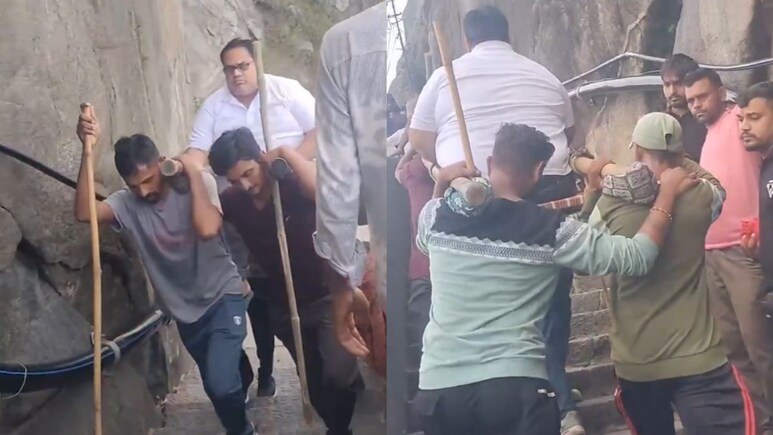
A video from Gujarat's sacred Mount Girnar has gone massively viral. It has sparked an emotional debate across social media, leaving people divided over one simple but uncomfortable question: Should tourists pay money to humans to carry them up a mountain? The clip, shared widely on X (formerly Twitter), shows four men carrying a pilgrim in a traditional palki as they slowly climb the endless stone staircase leading to the holy Dattatreya Peak. The journey involves more than 10,000 steep steps, making it one of India's most physically demanding pilgrimages.
Also Read: What The Cameras Missed At Students' Protest March In Delhi
Viral Video From Mount Girnar Sparks Heated Debate On Human-Carried Palkis
En La India, turistas adinerados pagan a residentes locales para que carguen con ellos con una camilla de mano para subir los escarpados escalones de piedra del monte Girnar, que tiene más de 10.000 peldaños.
— Daniel Mayakovski (@DaniMayakovski) July 20, 2026
El capitalismo en una imagen, te dirán que es el turista quién crea… pic.twitter.com/8AJdGEtiZM
The viral clip shows four porters lifting a man seated comfortably in a traditional palki. The men can be seen steadily climbing the steep staircase while also using wooden sticks to keep their balance. The video was reportedly filmed at Mount Girnar in Junagadh, Gujarat. Every year, thousands of devotees travel here to visit the revered Dattatreya Peak.
To reach the shrine, pilgrims have to climb around 10,000 stone steps, and the journey can take several hours. It is considered to be one of the most revered pilgrimages for Jains. The mountain is also home to several Hindu temples like Amba Mata temple and Mahakali Mandir.
The video caught global attention after it was shared by X user Daniel Mayakovski, who wrote, “In India, wealthy tourists pay local residents to carry them on a hand-carried litter up the steep stone steps of Mount Girnar, which has more than 10,000 steps. Capitalism in an image, they'll tell you it's the tourist who creates wealth, and they should be thankful to him.”
While the viral post described the passenger as a wealthy tourist, many people familiar with Mount Girnar explained that palki services are mainly meant for elderly devotees, people with disabilities, or anyone who is physically unable to complete the difficult climb.
However, people also pointed out that some physically fit visitors choose the service simply because they do not want to climb thousands of steps themselves. That is exactly what has made the video so controversial.
Also Read: "America Kya Kehta Tha?" Meme Star Gautam Singh Joins NEET-UG Protest In Delhi
The Internet Is Deeply Divided
The comment section quickly turned into a heated debate. Many people questioned whether it is morally right for one person to be carried by four others up a mountain. One user wrote, “If you need four men and bamboo sticks to reach God, maybe just send a prayer from home instead.”
Another commented, “If God is fair, all the blessings will go to the carriers, not the carried.” Some viewers said the video perfectly captured the gap between the rich and the poor, arguing that money allows some people to avoid physical hardship by paying others to endure it instead.
Another user compared it to hiring economically weaker people to perform physically demanding domestic work, saying the idea was not very different.
However, not everyone believed the practice should be criticised. Many users argued that these porters are skilled workers who choose this profession because it provides a steady income for their families. One comment read, “These people are paid to do the job they do. Unless someone is forcing them, why is there so much outrage?”
Another person pointed out that in places like Kedarnath, many porters have protested against proposed ropeway projects because they fear losing their livelihood.
The viral video has opened up conversations about economic inequality, poverty, privilege and the difficult choices many people make to earn a living.
Track Latest News Live on NDTV.com and get news updates from India and around the world


