





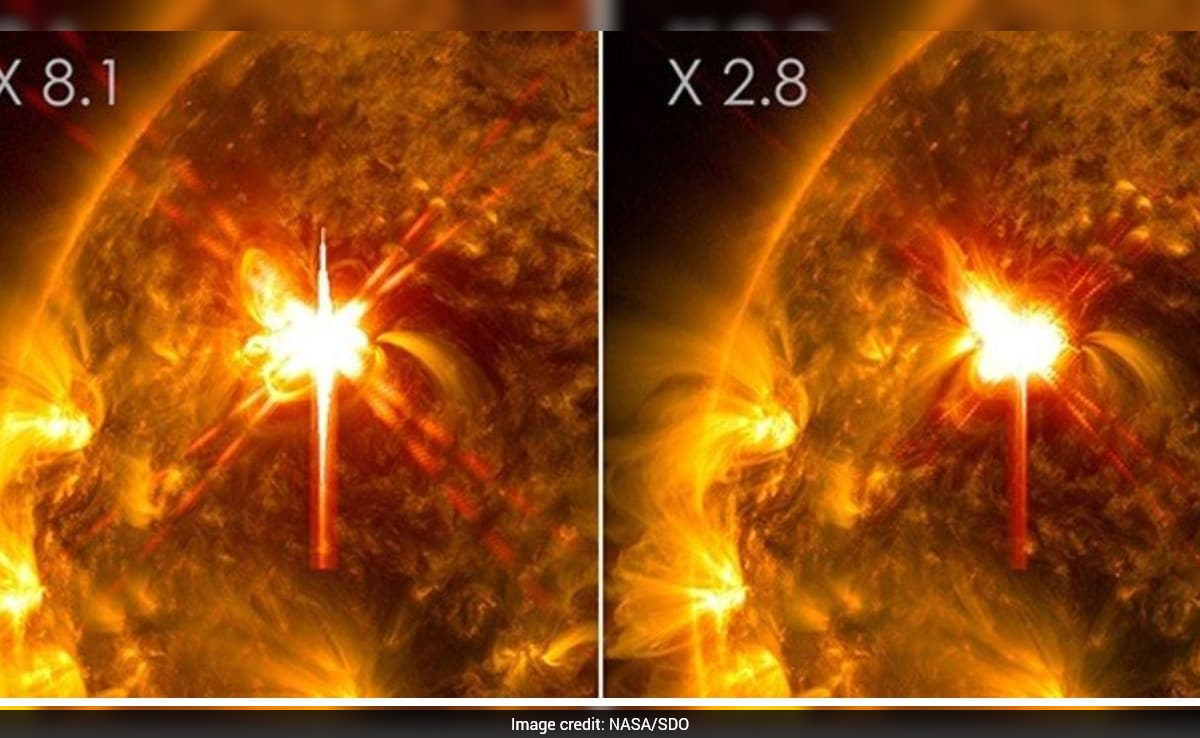
The Sun has unleashed four powerful solar flares, including an X8.1-class flare, the strongest of 2026, NASA confirmed on Monday (Feb 2). These powerful solar flares have sparked concerns about potential disruptions to communication systems, power grids and satellite operations. All these events were captured by NASA's Solar Dynamics Observatory, which watches our star.
"The Sun emitted three strong solar flares on Feb. 1, peaking at 7:33 a.m. ET, 6:37 p.m. ET, and 7:36 p.m. ET. The Sun emitted a fourth strong solar flare on Feb. 2, peaking at 3:14 a.m. ET," NASA revealed the timings.
Also read | Discovery Of Ancient Beach On Mars Provides Clues To Planet's Past Life
According to the space agency, the first flare is classified as an X1.0 flare, the second as an X8.1, the third as an X2.8, and the fourth flare is classified as an X1.6.
The most powerful one was the second, classified as an X8.1. A report by Scientific American claimed that the Sun on Sunday "unleashed several strong and bright solar flares, including one of the most powerful eruptions seen in decades."
Meanwhile, SpaceWeatherLive.com reported that it was the brightest flare since October 2024 and among the top 20 since 1996.
An X8.1 Solar Flare Occurred from Region 4366. pic.twitter.com/q8PuvOsUL5
— NOAA Space Weather Prediction Center (@NWSSWPC) February 2, 2026
Impact of solar flares on humans
Solar flares do not pose a direct physical danger to humans on Earth because of the planet's magnetic field and atmosphere, which shield us from harmful radiation.
But according to NOAA's Space Weather Prediction Center, "Immediate, wider area of strong degradation or signal loss in high frequency (HF) communication bands over much of the sunlit side of Earth."
"Users of HF radio signals may experience loss of contact or major disruptions for a number of minutes to a couple of hours in the affected areas."
Strong geomagnetic storms can damage high-voltage transformers, potentially causing blackouts. They can also cause radio blackouts and disruptions to satellite communications, GPS and navigation systems.
Track Latest News Live on NDTV.com and get news updates from India and around the world

