





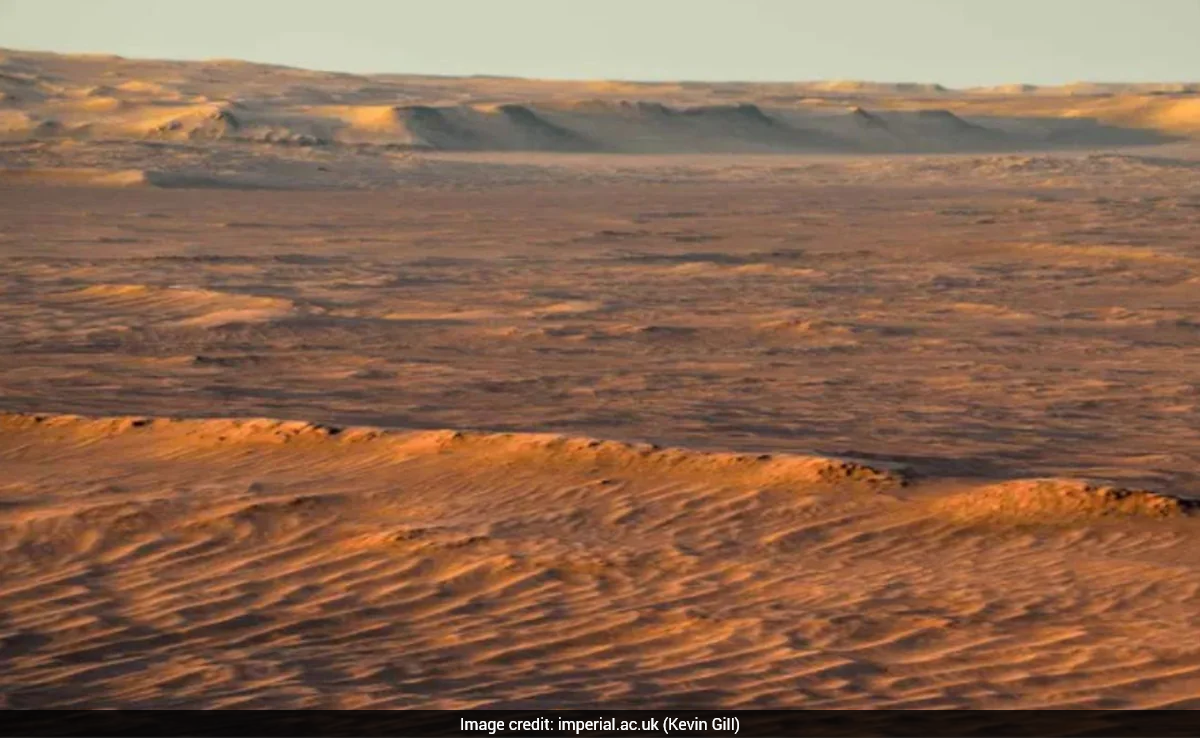
NASA's Perseverance rover has uncovered evidence of an ancient beach that once hosted a vast lake around 3.5 billion years ago. As scientists continue their probe to find possible clues of past life on the Red Planet, these findings suggest that Mars may have had a more hospitable environment, with water playing a significant role in shaping the planet's surface.
The Imperial College London led the study, and the findings were published in the Journal of Geophysical Research: Planets.
The discovery was made in the "Margin unit" of Jezero crater, with researchers identifying wave-formed beaches and rocks altered by subsurface water.
As per the study, the rounded sand-sized grains of olivine and carbonate indicate that the area was once a shoreline. The local bedrock appears eroded, said to be by waves.
Also read | Meteor Or Space Debris? Video Shows Mysterious Light Illuminating Wellington Skyline
"Shorelines are habitable environments on Earth, and the carbonate minerals that form here can naturally seal in and preserve information about the ancient environment," Alex Jones, a PhD researcher in the Department of Earth Science and Engineering (ESE) at Imperial, who is also the lead author, said as quoted in the release.
"Our findings therefore, have exciting implications for Mars's past climate and habitability, while providing new insights into a geologic unit which has long had a debated origin."
The findings extend the timeline for potential habitability at the site, suggesting that calm lake conditions existed earlier than previously thought. It also supports the idea that Mars may have had a more Earth-like climate in the past, with liquid water and a stable environment
Also read | Rare Phenomenon Or Fake? Viral 'Paraselene' Moon Video Has Internet Guessing
"This transformation, which builds on recently published work we also contributed to, indicates that water circulated below the surface of the Margin unit, altering the rock over vast timescales," another author of the study, Professor Sanjeev Gupta of Imperial's Department of Earth Science and Engineering, said as quoted.
"On Earth, this kind of subsurface hydrothermal environment is known to support microbial life."
Perseverance rover
The Perseverance rover has been exploring Jezero crater since 2021 and collecting core samples of Martian rock and regolith for potential pickup by a future mission for detailed study here on Earth. The latest findings are part of an international study led by Imperial College London.
Track Latest News Live on NDTV.com and get news updates from India and around the world

