





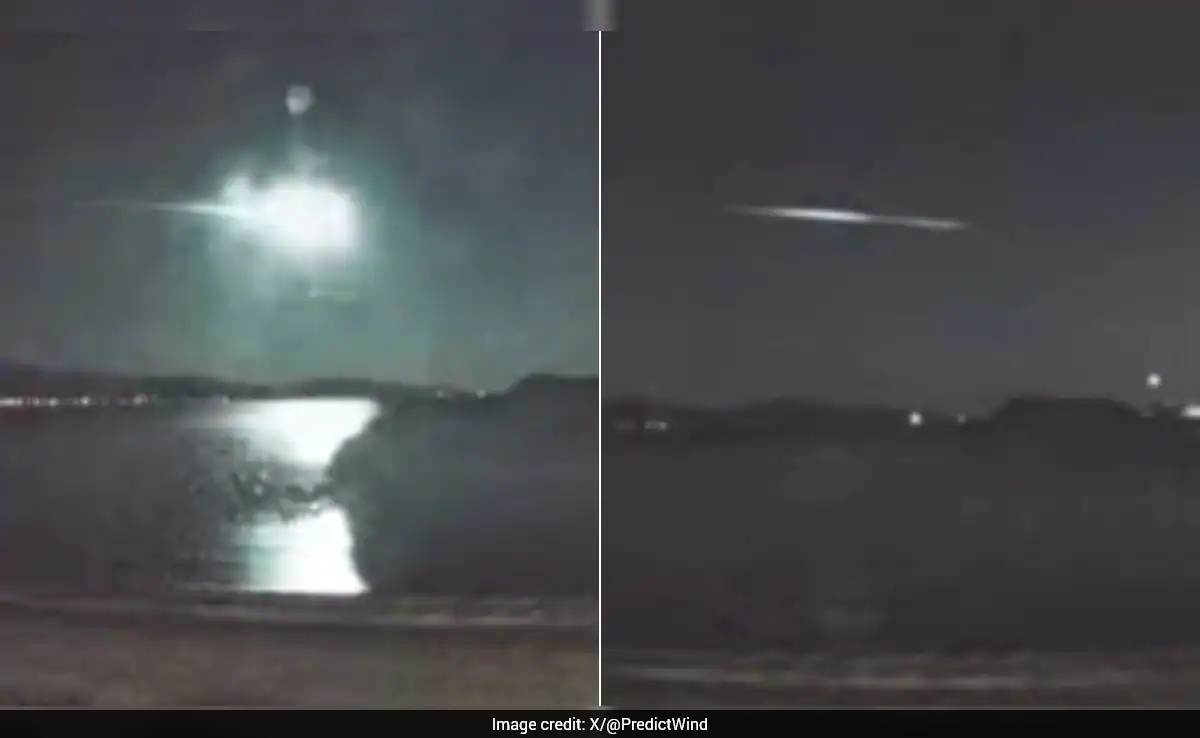
A bright streak of light was spotted over New Zealand's capital city, Wellington, on January 30 at around 11:30 pm (local time), BBC reported. The mysterious teal light was captured by the PredictWind webcam at the Heretaunga Boating Club, showing the luminous trail reflected on the water's surface below.
PredictWind is the world's leading marine forecaster, and while sharing the video, it wrote in the caption: "Look up a meteorite lights up Wellington's sky, caught live on the PredictWind webcam at Heretaunga Boating Club on 30 Jan 2026."
Also read | Rare Phenomenon Or Fake? Viral 'Paraselene' Moon Video Has Internet Guessing
Watch the video here:
The social media users were in awe, and some residents claim that they also spotted the light. "I live in Petone, and it lit up my room," one person said on a Lower Hutt Facebook group as quoted by RNZ.
"I saw it in Titahi Bay," another person said as quoted. "From my point of view, it looked like a green line shooting across the sky," another said, while someone further south said they "saw it just before Seddon on the South Island."
A user wrote on Reddit: "Watched from my window in Ngaio. Most fantastic streak of blue/teal. Would have burnt up in the atmosphere."
Also read | "Mere Paas Canva Hai": Street Vendor's "Savage" Reply To Woman's Offer Of Signage Designing Goes Viral
What's behind the mysterious light?
The glowing light could be either a meteor entering Earth's atmosphere or fragments of space debris burning up upon re-entry. Such events have become increasingly common due to the global increase in satellite launches, contributing to more frequent sightings of space debris. So far, there's no confirmation of the light that flashed over Wellington.
The report further noted that according to the Fireballs Aotearoa, a meteor camera network, such events might have happened on that night, with the first fireball could be seen over Manawatu-Whanganui at 10:00 pm (local time), and the second over Wellington at 11.30 pm (local time).
"A fireball is what we would call in common language, a shooting star, or a meteor is the correct term, and a fireball is a large meteor," Steve Wyn-Harris from Fireballs Aotearoa said as quoted in the report.
"Most shooting stars that we see are small grains of sand, coming into the upper atmosphere and burning up. But sometimes a big rock comes in, and when it does, that becomes a big meteor - or a fireball."
Meanwhile, a MetService spokesperson said as quoted that their weather monitoring radars didn't pick anything.
Track Latest News Live on NDTV.com and get news updates from India and around the world

