





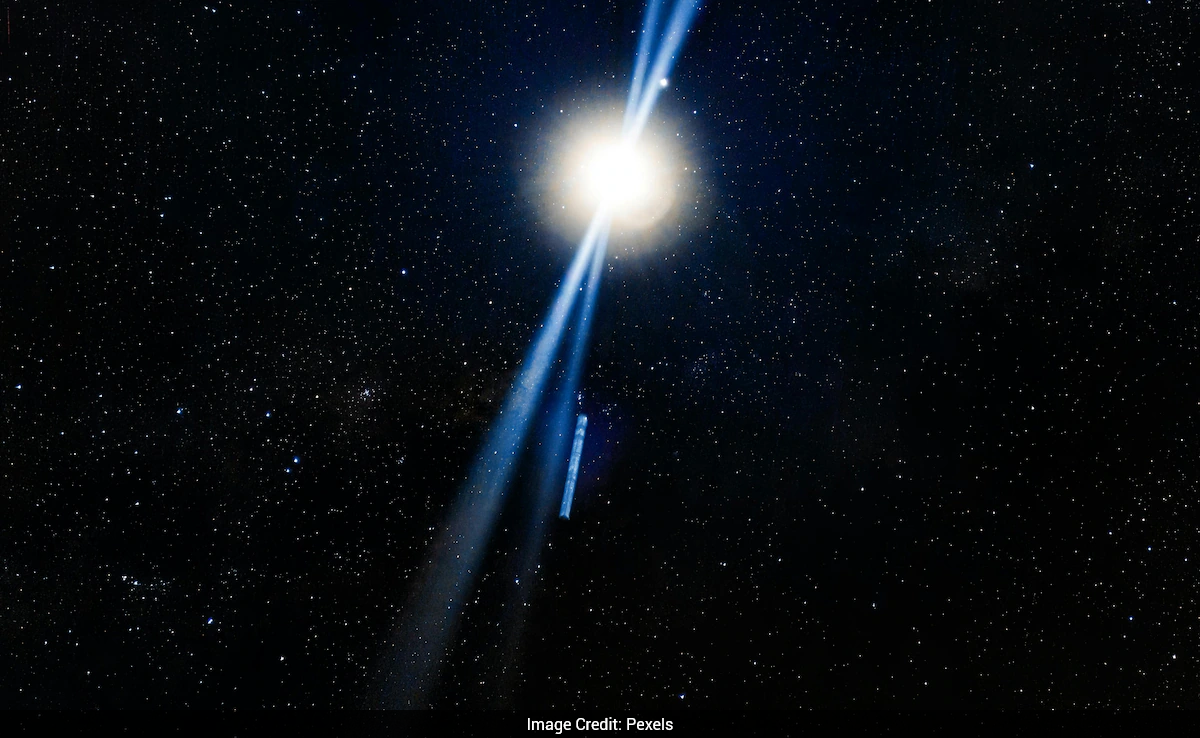
For nearly a decade, scientists have been trying to understand a set of strange blue flashes coming from deep space. These rare and powerful bursts of light have puzzled astronomers since they were first observed in 2018, reported Daily Mail.
Only 14 of these unusual events have been recorded so far, making them some of the rarest known in astronomy. Scientists call them Luminous Fast Blue Optical Transients (LFBOTs), and they are known to shine much faster and up to 100 times brighter than other known cosmic explosions.
LFBOTs appear and disappear very quickly. They reach their brightest point in just a few days and then fade away, unlike most stellar explosions that last for weeks or even months. Another unusual feature is their constant blue colour, which suggests that they remain extremely hot throughout their short lifespan.
Dr Anya Nugent, lead author of a new study from Harvard & Smithsonian, said that this makes them unlike anything scientists have observed before. She explained that their origins are likely just as unusual and violent as their appearance.
In their pre-print study, Dr Nugent and her team studied the types of galaxies where these flashes have been seen. They looked at star formation rates, galaxy mass, and the presence of metallic elements to understand how these events might occur.
Their findings suggest that LFBOTs could be caused by collisions between extremely dense objects, such as black holes or neutron stars, and a special type of star known as a Wolf-Rayet star.
Wolf-Rayet stars begin as part of a binary system, where two large stars orbit each other. Over time, one star pulls material from the other. If conditions are right, the donor star loses its outer hydrogen layer but is not completely destroyed, leaving behind a bright helium core known as a Wolf-Rayet star.
Meanwhile, the star gaining material becomes so massive that it collapses under its own weight. This collapse leads to a supernova explosion, leaving behind either a black hole or a neutron star.
The black hole continues to pull material from its companion star. Over hundreds of thousands of years, it eventually moves into the core of the Wolf-Rayet star and destroys it, triggering an LFBOT.
Professor Brian Metzger of Columbia University explained that when the compact object plunges into the Wolf-Rayet star, it can rapidly gather stellar material and release a huge amount of gravitational energy. He added that some of this energy drives powerful outflows or jets, which then collide with surrounding material and produce a very hot and bright flash of light in a short time.
Scientists believe Wolf-Rayet stars are strong candidates for producing LFBOTs for several reasons. The light from these flashes does not show signs of hydrogen, which matches stars that have already lost their hydrogen layers.
These stars are also very massive and dense, allowing black holes to feed quickly and generate intense bursts of light. Professor Metzger further explained that they can have dense material around them from earlier mass loss, which gives the explosion something to collide with and helps produce the observed emission.
The study offers a possible explanation for one of the universe's most mysterious phenomena, though further observations will be needed to confirm the theory.
Track Latest News Live on NDTV.com and get news updates from India and around the world

