





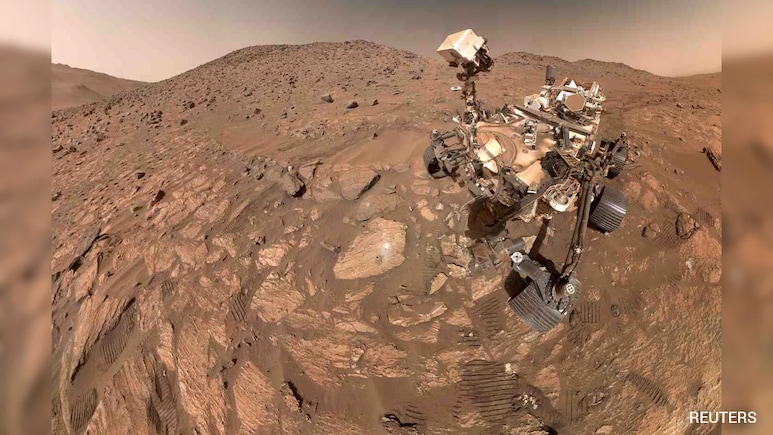
- Perseverance rover found tiny corundum crystals, first on Mars, New Scientist reported
- Corundum minerals were embedded in Martian pebbles analysed by SuperCam instrument
- Corundum likely formed by meteorite impacts due to Mars' lack of plate tectonics
NASA's Perseverance rover has made a surprising discovery on Mars, finding tiny crystals of corundum, New Scientist reported. The minerals that form rubies and sapphires were embedded in Martian pebbles. This marks the first time such gems have been spotted on the Red Planet. The hints of the mineral were first spotted by Ann Ollila and her colleagues at Los Alamos National Laboratory in New Mexico. The discovery was made using the SuperCam instrument on the Perseverance rover, which analysed rocks like Hampden River, Coffee Cove, and Smiths Harbour.
The researchers have presented the findings at the Lunar and Planetary Science Conference in Texas on March 16.
The results showed tiny grains of corundum, less than 0.2 millimetres across, which shone brightly when hit with a laser.
Unlike Earth, Mars doesn't have plate tectonics, so the corundum likely formed when meteorites smashed into the ground, heating and compressing the dust.
Also read | Ex-US Officer Claims UFOs Shut Down Nuclear Missiles At US Base
"I was very surprised"
"[Corundum] usually is associated, on Earth, with tectonism. It's a very specific environment - you have to have a very silica-poor environment, very aluminium-rich," as quoted, Ollila said in her presentation.
"I was very surprised," Allan Treiman of the Lunar and Planetary Institute in Texas said during the conference session. Notably, he was not part of Ollila's team.
"In retrospect, one might not have been, because there are aluminium-rich outcrops elsewhere on the planet and there are impacts, but I thought it was very shocking to see this."
Also read | Astronomers Detect Massive 'Cosmic Laser' 8 Billion Light-Years Away
"I would love to be able to pick one of those up and analyse it and see if it looks red - it's pretty disappointing that all you can see is this white pebble," Ollila said, further adding that when they were hit with the SuperCam laser, they shone brightly.
This discovery provides new insights into Mars' geological history and suggests the planet has remained chemically and thermally active more recently than previously believed.
Track Latest News Live on NDTV.com and get news updates from India and around the world

