





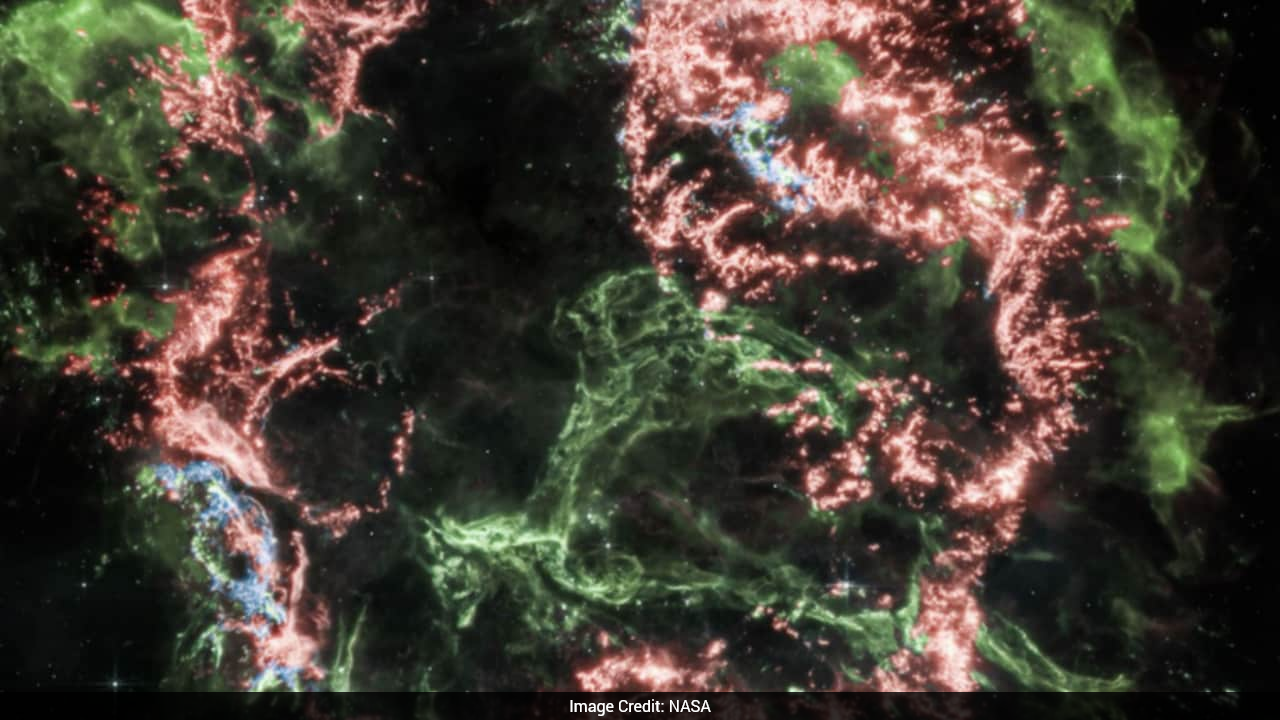
NASA's James Webb Space Telescope has captured a detailed view of Cassiopeia A (Cas A), a supernova remnant formed after a massive star exploded. The new observations have revealed important details about the star's structure and suggest that major changes may have taken place inside it just hours before the explosion, according to NASA.
The findings, published in The Astrophysical Journal Letters, offer new information about how stars change before they explode and how their remains help create future stars and planets.
Supernova remnants are clouds of gas and dust left behind after massive stars explode. These materials can later help form new stars and planets.
Using its mid-infrared observation technology, Webb studied the dust and gas in Cas A. Researchers found evidence of a process called a shell merger, in which different layers inside a star mix with each other before an explosion.
Stars develop through different stages. They begin as large clouds of hydrogen gas and cosmic dust. Gravity pulls these clouds together, forming young stars. As they grow, hydrogen changes into helium through a process called nuclear fusion.
When the hydrogen in a star's core runs out, the core contracts and becomes hotter. Helium then begins to fuse into heavier elements. This process continues as the star develops, creating different layers of elements inside it.
Before a massive star explodes, the different layers inside it can move and mix. This process can change the star's structure and the elements found in its remains.
Tea Temim, the lead author of the study and a research scientist at Columbia University, explained that material inside these layers moves around and can cause them to merge shortly before the explosion.
She said that when layers where oxygen and carbon burn come together, they can significantly change the star's structure and the chemical elements found after the explosion.
To identify the regions for detailed study, researchers also used information from NASA's retired Spitzer Space Telescope. Spitzer identified three areas that Webb later observed in greater detail.
Two of these areas were inside a region where an inward-moving shock wave meets material thrown outward by the explosion. Webb found that one area mainly contained silica dust, while the other was dominated by carbon dust.
The third area, known as the Green Monster, contained large amounts of complex magnesium silicates. This material came from the star before it exploded, unlike the other two areas, which contained material thrown out during the explosion.
Webb also mapped the dust composition across the entire supernova remnant. Researchers combined these observations with X-ray data from NASA's Chandra X-ray Observatory and Japan's XRISM mission.
The observations showed that the mixing of the star's layers had started very close to the time of the explosion.
Dan Milisavljevic, an associate professor at Purdue University and co-author of the study, said that Webb's ability to study individual dust clumps has helped researchers understand the chemical composition of the material.
He explained that this information allows scientists to connect the remains of an explosion to the original star's structure, even hundreds of years later. It also provides clues about what may have happened in the hours before the star's core collapsed.
The researchers said that understanding this process is important because supernova explosions release elements into space that can help form future generations of stars and planets.
The new dust map also shows signs of the shell merger across much of Cas A. This method could help other astronomers study the internal structure of stars by examining the remains of their explosions.
Track Latest News Live on NDTV.com and get news updates from India and around the world

