





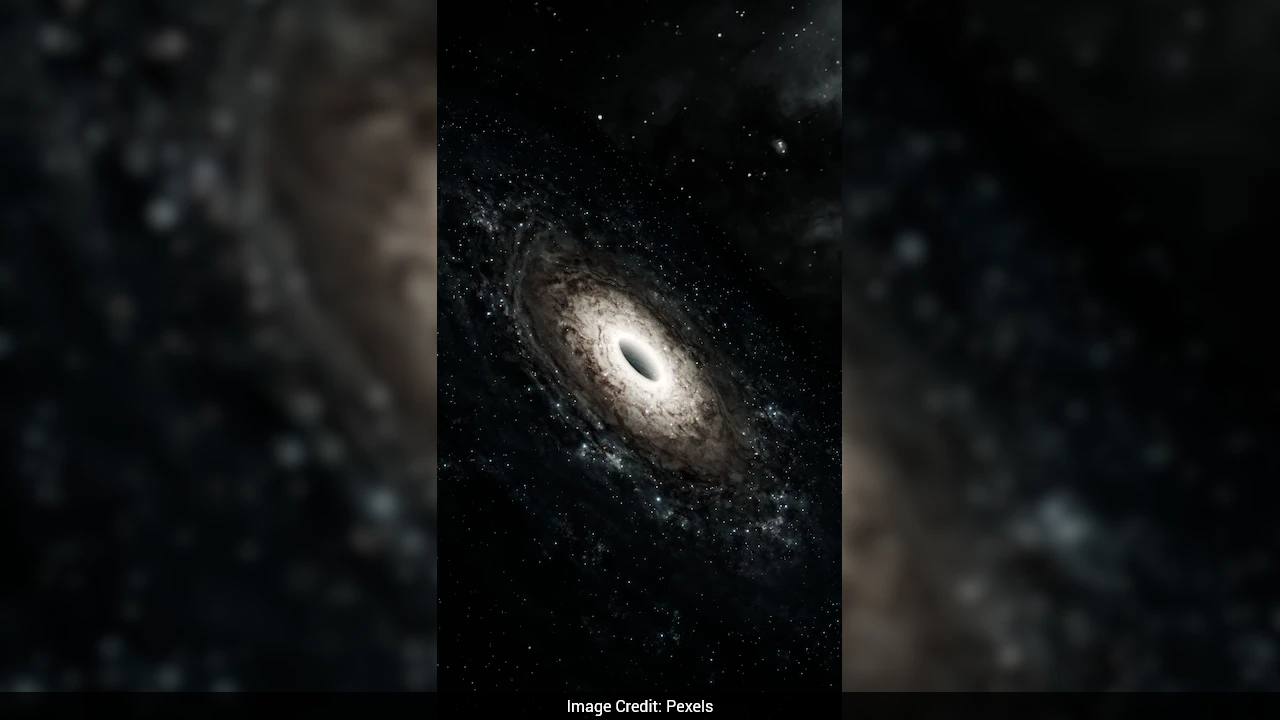
The James Webb Space Telescope has given astronomers a new view of how giant black holes at the centres of galaxies collect material and grow. The observations could help scientists understand how supermassive black holes, which can have masses millions or even billions of times greater than the Sun, became so large so quickly after the Big Bang, reported Space.com.
All large galaxies have supermassive black holes at their centres, but they do not all behave the same way. Some are quiet and consume very little gas and dust, while others actively feed on surrounding material and power bright regions called active galactic nuclei.
-

-
 Paris Setback, Asian Games Glory: Lovlina Borgohain's New Perspective
 -
 To PM Modi's "Failed Product" Jab At Rahul Gandhi, A Shashi Tharoor Counter
 -
 NDTV World Summit 2026: AI, Chips, Warfare And The Future Of The World | Key Conversations
 -
 Kriti Sanon On Situationships, Open Relationships And Being Old-School
 -
 'AI Scares Me': Kriti Sanon On Personality Rights And Need For Laws
 -
 'AI Scares Me': Kriti Sanon On Personality Rights And Need For Laws
 -
 'This Time I Wanted Gold': Savita Punia Reflects On Historic Asiad Success
 -
 Favourite Bollywood Actor To 5-Year Plan, Kriti Sanon Interviews AI Actor Tilly Norwood
 -
 Neeru Dhanda Carried Homemade Churma To Asiad, Returned With Two Gold Medals
 -
 Inside The Mind Of Archer Kumkum Mohod, Who Dared To Challenge South Korea
These feeding black holes can also send jets of matter from their poles. The jets can push gas and dust, which are needed for forming stars, out of their host galaxies. This can stop star formation and affect the growth of galaxies.
However, astronomers have found supermassive black holes in the early universe that existed less than 1 billion years after the Big Bang. This creates a mystery because the process of consuming matter and merging with other black holes should take at least 1 billion years to create such massive objects.
Scientists have suggested that black holes may follow a cycle of feeding and fasting. According to this explanation, black holes push away gas as they grow, but the material later cools and falls back toward the black hole, allowing another period of growth.
As the gas cools, it can form thin structures called streamers or filaments. These filaments can be a few hundred light-years wide but stretch thousands of light-years long. They can fall back toward the center of the galaxy and create a swirling disk around the black hole, providing more material for feeding and restarting powerful jets.
This process creates a self-regulating cycle where black holes feed, push away material and later receive more gas.
However, the connection between these filaments and supermassive black holes has been difficult to confirm.
To study this process, the James Webb Space Telescope observed a nearby active galactic nucleus located at the center of the galaxy NGC 4696 in the Centaurus Cluster, about 145 million light-years from Earth.
The Hubble Space Telescope had earlier studied this galaxy and found a strange hook-shaped swirl of gas near its central supermassive black hole.
The James Webb Space Telescope created a detailed map of the gas moving through the centre of the galaxy. The observations showed that the hook-shaped feature is about 800 light-years wide and contains gas moving at speeds of around 1.3 million miles per hour, or 600 kilometers per second.
The researchers also found that the gas swirl appears to be connected to a large filament of material moving toward the central supermassive black hole.
The team compared the James Webb Space Telescope observations with computer simulations and found that gas falling inward through filaments could create a shape similar to the one seen in NGC 4696.
The team's research was published in the Astrophysical Journal Letters.
Track Latest News Live on NDTV.com and get news updates from India and around the world

