





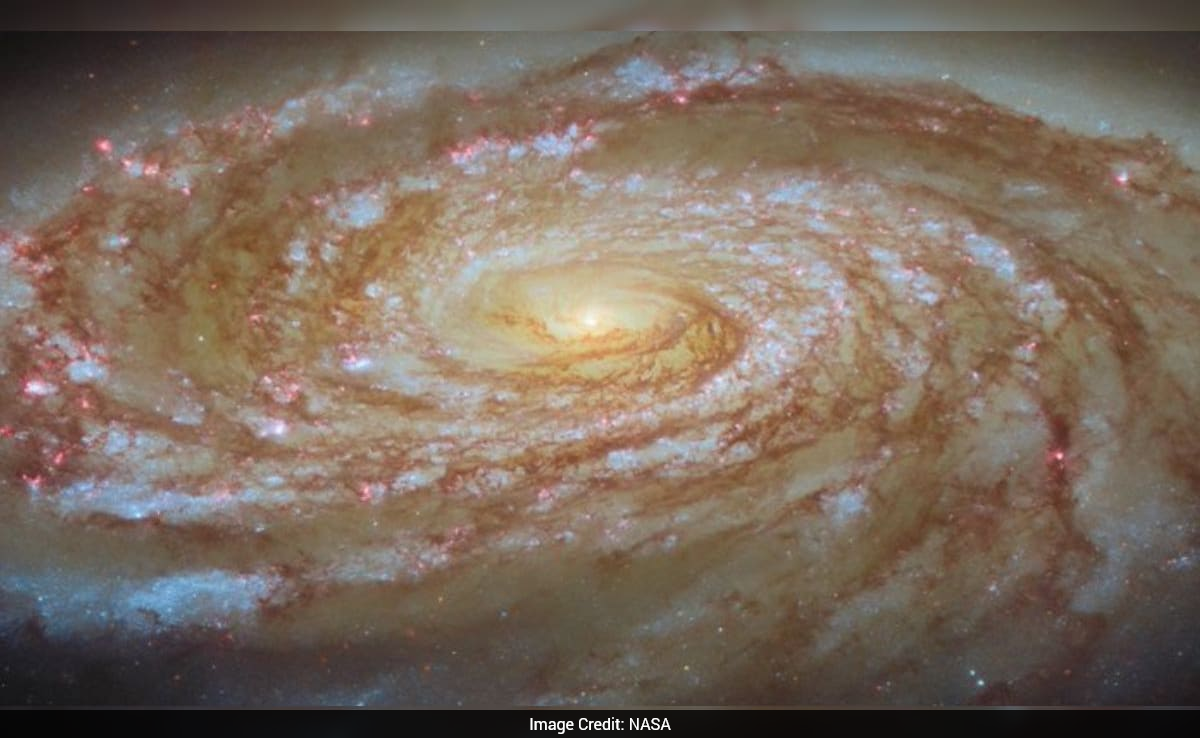
A newly released image from the NASA's Hubble Space Telescope highlights Messier 88 (M88), an active spiral galaxy located approximately 63 million light-years from Earth in the constellation Coma Berenices, also known as Berenice's Hair, reported NASA.
M88, also known as NGC 4501, is classified as an active galaxy because its center contains a supermassive black hole that is consuming gas and dust. Astronomers estimate that the black hole is around 100 million times more massive than the Sun. The black hole is also believed to be driving streams of gas outward from the galaxy's core.
At the center of M88 is a population of old, reddish stars that gives the galaxy a warm glow. Extending outward are several tightly wound and symmetrical spiral arms. These arms are marked by pink and blue star clusters as well as dense clouds of dust.
The galaxy is viewed from an angle that makes it appear elongated, with its spiral arms spreading outward in a fan-like pattern.
M88 is a member of the Virgo Cluster, a vast collection of more than a thousand galaxies bound together by gravity. Within the cluster, galaxies are constantly moving as they orbit around the cluster's center of gravity.
Astronomers say M88 is currently on a long journey that will eventually take it closer to the cluster's center. This path is expected to bring the galaxy into the innermost regions of the Virgo Cluster.
Scientists estimate that in about 200 million to 300 million years, M88 will make its closest approach to Messier 87, the massive elliptical galaxy that sits at the center of the Virgo Cluster.
As M88 moves closer, it is expected to experience a process known as ram pressure stripping. This occurs when gas within a galaxy is swept away as the galaxy moves through the gas that exists between galaxies in a cluster.
Researchers have already observed signs of this process in M88. The galaxy's gas disk appears shortened and compressed at its leading edge, causing gas and dust to accumulate there.
Astronomers have found that M88 contains significantly less cold gas than expected for a galaxy of its size, particularly in its outer regions. Since cold gas serves as the raw material for creating new stars, this shortage is considered evidence that the galaxy is already being affected by its journey through the Virgo Cluster.
Scientists say these changes are likely to influence M88's ability to form stars in the future and will ultimately alter the course of its evolution.
Track Latest News Live on NDTV.com and get news updates from India and around the world

