





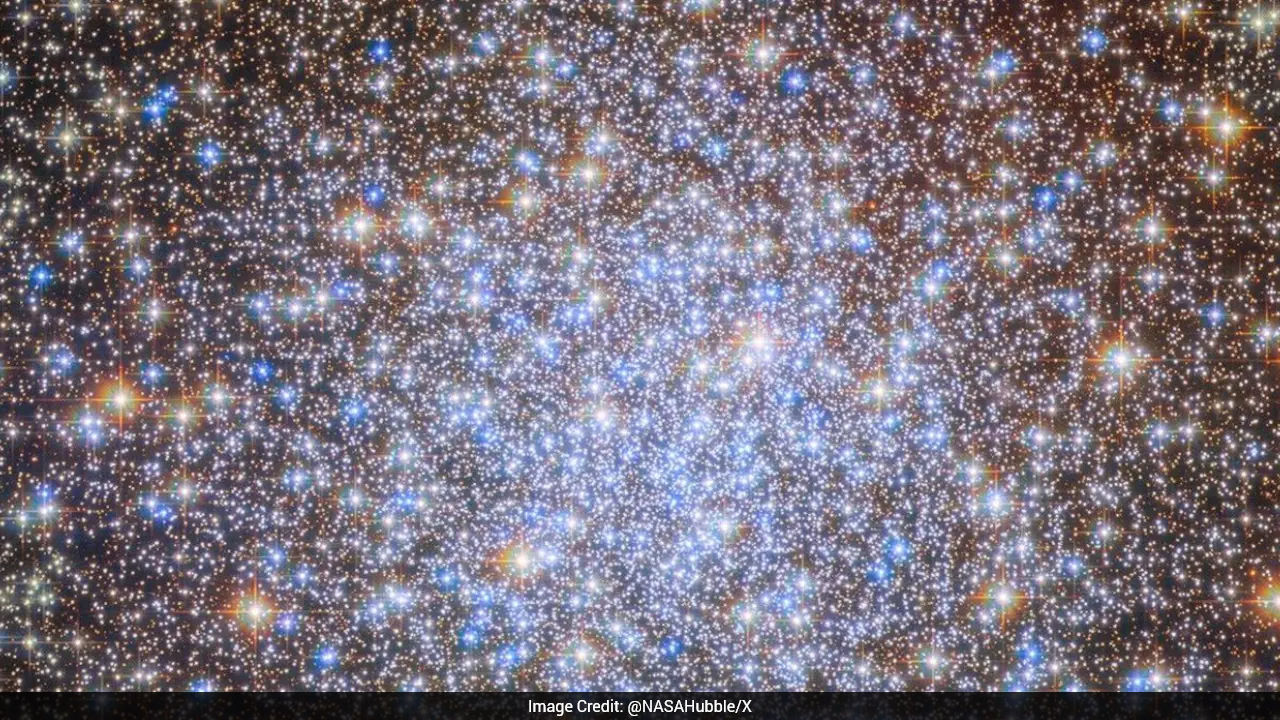
Deep in our galaxy, ancient groups of stars continue to reveal new secrets about the universe. One such star system has been captured in a stunning image by the NASA Hubble Space Telescope, showing a glowing cluster filled with thousands of stars, reported NASA.
The image features a globular cluster, which is a collection of tens of thousands to millions of stars that are tightly bound together by gravity. There are more than 150 globular clusters in our galaxy, although some may still be hidden from view by dust or crowded star fields.
The cluster shown in the image is NGC 6723, also known as the Chandelier Cluster. It is located 27,000 light-years away in the constellation Sagittarius, and it shines like a chandelier filled with countless lights, where each light is actually a star.
These globular clusters contain some of the oldest stars in the Milky Way galaxy. They are often more than 10 billion years old, and some may be nearly as old as the universe itself. Scientists believe they were among the first structures formed in the galaxy, even before the thin disk where the Sun now orbits, although the exact way they formed is still not fully known.
Earlier, astronomers believed that all stars in a globular cluster formed at the same time and had the same chemical makeup. However, new observations from telescopes like Hubble show that these star groups have more complex histories than once thought.
Hubble first observed NGC 6723 as part of a detailed survey of globular clusters in the Milky Way galaxy. In this program, researchers used Hubble to study 65 globular clusters in visible and near-infrared light. The data helped scientists study the ages of these clusters and understand how heavier stars move toward the center while lighter stars drift toward the outer regions. The survey has been highly valuable and has led to hundreds of scientific research papers.
Track Latest News Live on NDTV.com and get news updates from India and around the world

