





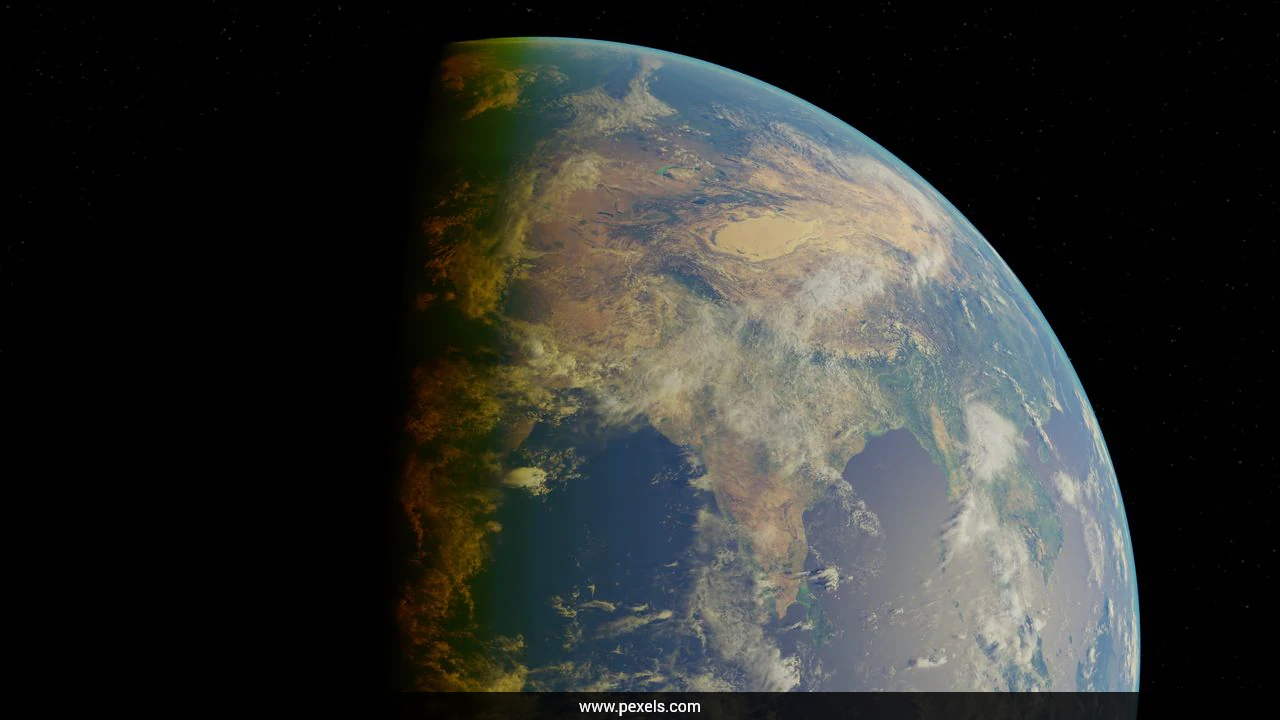
Earth is the only planet known to support life, but scientists believe there could be other worlds in the universe that offer even better conditions for living organisms. These planets, known as "superhabitable worlds", could have warmer climates, more water and environments where life might survive and evolve for billions of years longer than on Earth.
According to a report by The New York Times, researchers are exploring the possibility that planets slightly larger than Earth, particularly those orbiting certain types of stars, could be more suitable for life than our own planet.
What Are Superhabitable Planets?
Scientists describe superhabitable planets as worlds that could provide better conditions for life to develop and thrive. Such planets could be around 20 to 30 per cent wider than Earth and have approximately twice its mass.
Their stronger gravity could help them retain thicker atmospheres, potentially creating warmer and more stable climates. A larger iron core might also generate a stronger magnetic field, offering greater protection against harmful radiation from space.
Researchers believe these planets could have vast shallow seas, lakes and islands, providing ideal conditions for different forms of life.
On Earth, tropical islands and shallow waters support some of the richest ecosystems. Scientists suggest that planets with similar environments spread across much larger areas could potentially support even greater biodiversity.
However, these conditions remain theoretical, and no superhabitable planet has yet been confirmed.
Why Orange Stars Could Be Better Than Our Sun
One of the most interesting findings involves a type of star called a K-dwarf.
These stars are smaller, cooler and more orange in colour than our Sun. They also burn their fuel much more slowly, allowing them to shine steadily for tens of billions of years.
This could give life on nearby planets much longer to develop and evolve.
Astrobiologist Iva Vilovic experimented in a Berlin laboratory using artificial light designed to imitate a K-dwarf star.
She grew garden cress under this orange-coloured light and found that the plants grew faster and taller than those exposed to simulated sunlight.
The findings suggest that photosynthesis, the process through which plants turn light into energy, could work effectively on planets orbiting K-dwarf stars.
Speaking to The New York Times, Vilovic, who now works at the Leibniz Institute for Astrophysics in Germany, said light from these stars should receive serious attention in the search for extraterrestrial life.
Why Scientists Think Earth May Not Be Ideal
The idea that other planets could be more habitable than Earth gained attention in the 2010s.
Astronomers René Heller and John Armstrong explored the possibility that Earth might not represent the best possible environment for life.
In 2014, they published a scientific paper proposing the concept of superhabitable worlds.
Their argument was that astronomers should not focus only on finding planets identical to Earth.
Although Earth supports an enormous variety of living organisms, its ability to sustain life depends on a delicate balance of conditions.
Scientists believe that if Earth were slightly closer to the Sun, its oceans might not have formed as they did.
The planet also faces a long-term threat from the Sun, which is gradually becoming brighter.
Researchers estimate that Earth could become too hot to support complex life, including plants and animals, in roughly 500 million years.
By comparison, planets orbiting K-dwarf stars could remain suitable for life for much longer because these stars evolve more slowly than the Sun.
This extended period could allow organisms to develop greater complexity and diversity.
Could These Planets Have Alien Life?
Scientists believe superhabitable planets could potentially support rich ecosystems, including organisms similar to plants and animals.
Some researchers imagine worlds covered with shallow oceans, tropical islands and thriving marine environments.
However, there is currently no evidence that such ecosystems exist beyond Earth.
Even if a planet has favourable conditions, it does not necessarily mean life has developed there.
Researchers are therefore focusing on identifying planets with suitable temperatures, liquid water and atmospheres that might contain signs of biological activity.
How Scientists Plan To Find These Worlds
Astronomers are preparing to use powerful space telescopes to search for potentially superhabitable planets.
The European Space Agency's PLATO (PLAnetary Transits and Oscillations of stars) mission, scheduled for launch in 2027, is expected to help scientists identify planets that could support life, including larger rocky worlds orbiting K-dwarf stars.
Heller, who is involved in the mission, believes it could discover several promising candidates.
However, finding these planets would only be the first step.
Scientists would then need to examine their atmospheres to understand whether they contain gases that might indicate biological activity.
The James Webb Space Telescope could help study some of these worlds, while the Extremely Large Telescope being built in Chile is expected to provide more detailed observations.
NASA's planned Habitable Worlds Observatory, expected in the 2040s, could further improve the search for signs of life on distant planets.
According to The New York Times, these future missions could help astronomers determine whether planets with conditions potentially better than Earth's actually exist.
Could Life Be More Common Than We Think?
The possibility of superhabitable worlds raises an important question: how common might life be in the universe?
If some planets have more stable climates, suitable environments and billions of additional years for evolution, scientists believe they could offer favourable opportunities for complex life to develop.
Vilovic has expressed optimism about the possibility of life elsewhere, particularly on planets with conditions that could be more suitable than Earth's.
For now, the idea remains a scientific hypothesis rather than a confirmed discovery.
Earth is still the only planet where life has been found, but future space missions could help scientists discover whether even more life-friendly worlds are waiting to be explored.
Track Latest News Live on NDTV.com and get news updates from India and around the world

