





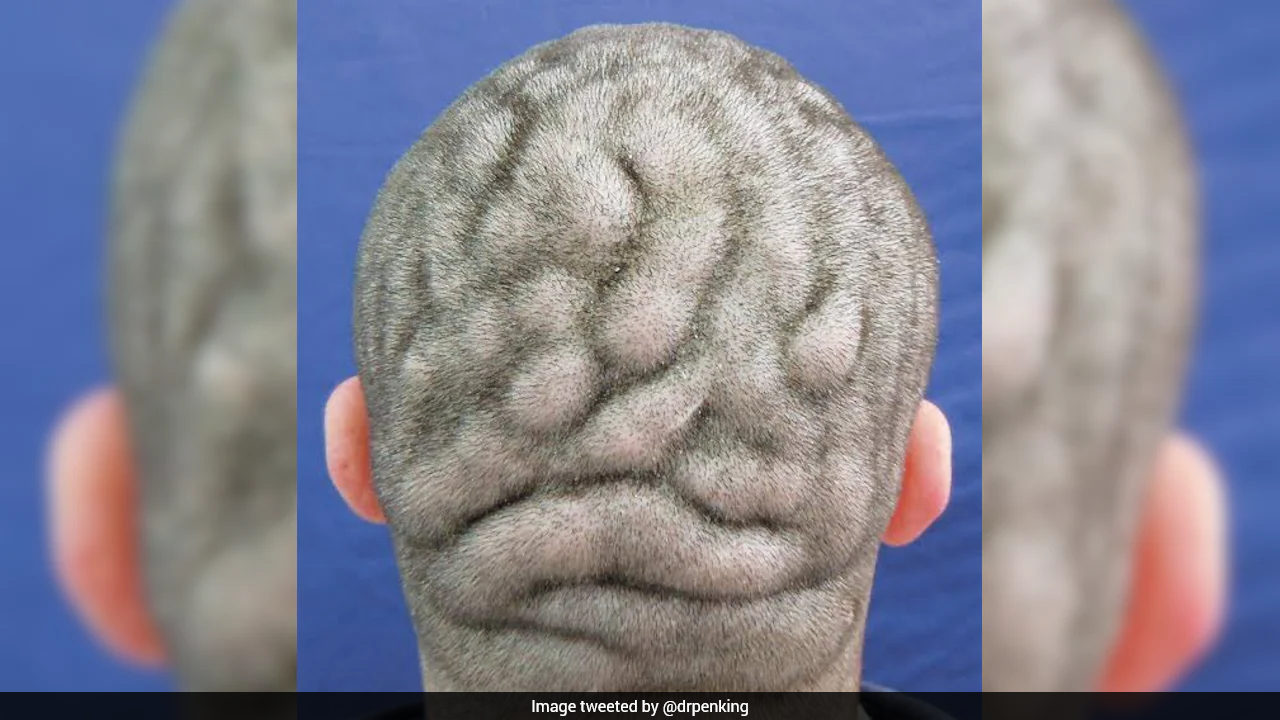
A 23-year-old man from central China's Hunan province has finally found relief from a rare scalp condition that caused his head to develop deep folds resembling the surface of a human brain. The man, identified only by his surname, Li, underwent a complex reconstructive procedure at Zhongnan Hospital of Wuhan University in Hubei province after years of failed treatment attempts, the South China Morning Post reported.
Li first noticed his scalp hardening several years ago. As the condition progressed, the skin on his head became thicker and formed large, uneven folds. By the time he was 14, the abnormal growth had spread across nearly half of his scalp, severely affecting his appearance and taking a toll on his confidence.
He sought treatment at several hospitals over the years. An early skin expansion procedure failed, leaving behind extensive scarring. Because there was very little healthy scalp tissue left, other hospitals declined to operate, saying the surgery would be too risky.
Rare diagnosis
Li eventually consulted Dr Zhou Wei and his team at the Plastic Surgery Department of Zhongnan Hospital after learning about their experience with similar cases.
Doctors diagnosed him with cutis verticis gyrata, a rare condition in which the scalp becomes unusually thick and forms deep folds. The disorder is not believed to be congenital, and its exact cause remains unknown. It mainly affects a person's appearance rather than causing other underlying health problems.
An 11-month treatment plan
Given the complexity of Li's case, the surgical team designed a two-stage reconstruction plan. They used his existing scar lines to preserve as much healthy scalp as possible.
In July last year, doctors implanted tissue expanders beneath two areas of his scalp. Over the next 11 months, they gradually injected fluid into the expanders, slowly stretching the healthy skin to create enough tissue for reconstruction.
Once a sufficient healthy scalp had developed, surgeons carried out a three-hour operation to remove the abnormal tissue and repair the affected area.
The surgery was successful, and Li's scalp now has a normal appearance. Doctors said his scalp is able to grow hair normally, marking the end of a long journey that had caused him years of physical and emotional distress.
Track Latest News Live on NDTV.com and get news updates from India and around the world

