




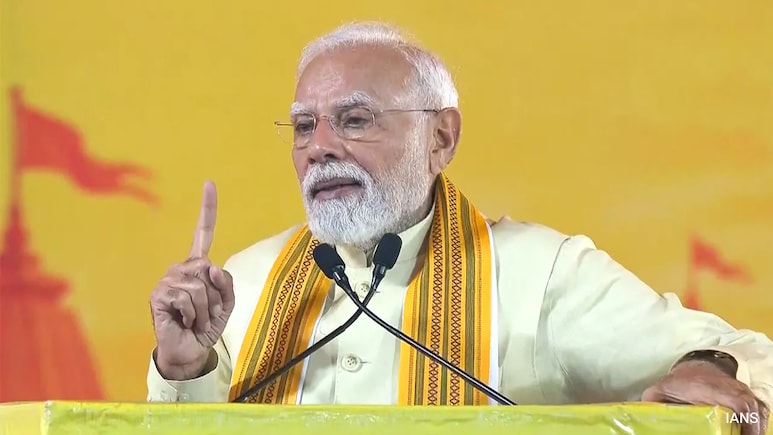
Politicians are extremely tenacious. Their footwork can sometimes be so sublime that a change in tactics is hard to decipher. It's being highlighted yet again by how, in a climate of setbacks, Delhi's ruling party seems to have discovered a chance for a comeback. The political narrative since July has been unfavourable for the BJP. A satirical platform mobilised masses and claimed the scalp of a central minister, forcing none less than PM Narendra Modi to launch an outreach to a voting group that stood up and said they cannot be ignored.
For much of October, India's political narrative was dominated by the Opposition led by a consistent Rahul Gandhi. The government faced a high opposition-unity index and serious questions delivered not through press conferences but via an agitation. The national capital echoed with war cries like "vote chori" and "Gyanesh, it's done bro!", with the Chief Election Commissioner Gyanesh Kumar's resignation on the demand charter.
-

-
 Andrew Ng On AI At Scale: Building The Intelligence Economy | NDTV World Summit 2026
-
 NDTV World Summit 2026: Behind The Scenes As Ayush And Vedika Preview Two-Day Mega Event
-
 Who Is Rajiv Mehta? Lilavati Hospital Trustee To Speak At NDTV World Summit 2026
-
 Ex-CIA Director To Decode 'War In Times Of AI' At NDTV World Summit
-
 From Call Centre To Billion-Dollar Disruptor: Nikhil Kamath At NDTV World Summit
-
 'Every 5 Years, You'll See A New India': Swami Sarvapriyananda Ahead Of NDTV World Summit
-
 Alain Ebobisse, Africa50 CEO, To Attend NDTV World Summit 2026. All About Him
-
 Kriti Sanon At NDTV World Summit: A Look At Her Career And Business Ventures
-
 Ex-CIA Director To Decode 'War In Times Of AI' At NDTV World Summit
-
 Who Is Vikram Rai, CEO, South Asia GE Aerospace, Set To Attend The NDTV World Summit 2026
With 12 years of incumbency weighing heavily, the saffron party had its back to the proverbial wall like never before. Till a few days ago, the BJP and the government it leads were openly contesting "vote chori" but were feeble in response on the CEC issue.
On Dussehra, through speeches, two of the most influential men in Delhi's ruling matrix -- Prime Minister Narendra Modi and the BJP's ideological mentor, RSS chief Mohan Bhagwat -- like Hansel and Gretel from a famous German fairy tale, dropped a trail of breadcrumbs for their voters to find their way back home.
It can be said that the Opposition's "vote chori" charge now has "regime loot" as the BJP's counter in the works.
One speech was delivered by PM Modi at a Ravana effigy-burning event in Delhi. Bhagwat spoke in Nagpur.
Both had elements that form a congruent narrative.
PM Modi said that "inspired by Lord Rama", India is moving towards being "viksit" and "atmanirbhar", developed and self-reliant. That part was familiar.
Then he warned, "There are people who hate our cultural heritage. And the enemies of Maa Bharti (Mother India) need to be defeated."
At the Nagpur headquarters of the RSS, Mohan Bhagwat performed the customary 'shastra puja' (ritualistic worship of weapons). It's inspired by a mention in the Hindu epic Mahabharata that the Pandavas during their exile had hidden their weapons on a Shami tree, and they recovered them on Vijaydashami.
"India's rise has made our country the prime target," Bhagwat said.
"A storm is coming from the West. There are people who hold conclaves to find how to dismantle India and the union. They get support. Lure of power drives ambitious leaders," he added.
He went on to say, "Problems persist, and agitations happen. But agitations should aim at solutions. It should not lead to ill-will in society. Movements demanding regime change have not necessarily improved conditions."
A 'Foreign' Bogey, A Loaded Past
The two speeches indicate a two-pronged attack.
The first thrust is via the "foreign hand" bogey. It's not new. In post-Independence India, this argument figured for the first time in Kerala in 1959. Then it became one of the alibis for Indira Gandhi to impose the Emergency in 1975. Amid mounting corruption allegations surrounding the Bofors defence deal, Rajiv Gandhi accused an "invisible foreign hand" of trying to destabilise India. Manmohan Singh as Prime Minister attributed grassroots protests against nuclear plants to foreign-funded NGOs. An American hand was alleged behind the Anna Hazare-led anti-corruption movement in 2011 by Congress leaders. Since 2014, the BJP and government voices have repeatedly blamed an "international toolkit" for every major domestic disruption or protest.
But this time there's something different too: the BJP has videos of anarchy on the streets of Paris to point out and say, "See, this is what they want to unleash in India."
The Bangladesh Mention
The cycle started with the Opposition mounting pressure, holding potent protests, and petitioning the Supreme Court on the CEC issue. Then came a 39-second undated video in which All India Students' Association ( AISA, the CPI-ML student wing) head Neha Bora was heard saying, "Gen-Z movement in Bangladesh showed us the way."
The BJP grabbed the video with glee. Bora had become a prominent anti-government face after she walked with Rahul Gandhi and Priyanka Gandhi Vadra in their 'Supreme Court chalo' march with thousands of supporters.
Later, at a press conference, she was seen sitting next to lawyer-activist and one-time AAP founder Prashant Bhushan when he said, "We all want a regime change," and questioned what was wrong with that demand.
The BJP instantly put together Prashant Bhushan's "regime change", Neha bora's "inspired by Bangladesh", and her constant showcasing by Rahul Gandhi to construct a narrative: that the opponents of the Modi government are plotting a Bangladesh- and Nepal-like violent and destructive change of regime.
In July, the anti-NEET paper leak protests led by the Cockroach Janta Party (CJP) were different. The BJP felt threatened not just because the crescendo was rising or the Opposition was uniting on the issue. Most victims of exam paper leaks came from the upper castes, the BJP's core vote bank. That's why the BJP backtracked.
But the call for a regime change on the lines of Bangladesh is something the BJP thinks it can exploit.
In Bangladesh, the July 2024 movement began as a peaceful student protest against government job quotas. It rapidly evolved into a national uprising that forced Prime Minister Sheikh Hasina to resign and flee. Islamist groups capitalised on the security vacuum and unleashed communal violence against minority Hindus.
The Us-vs-Them Play
The narrative being built now indirectly says that "assisted by the foreign hand", a regime-change attempt will end up hurting the majority. This fits the BJP's cultural nationalism agenda. With polarising issues like Ram Temple fading away, the issue can be pushed to create an us-versus-them narrative. The party will amplify the regime-change charge to frame ongoing protests -- triggered by electoral roll revisions -- as a foreign-backed conspiracy to destabilise India.
Top leaders of the party, including president Nitin Nabin, have already alleged "a hidden agenda to destabilise the country in collusion with external forces".
Defence Minister Rajnath Singh has accused Opposition parties of attempting to instigate youth-led unrest similar to developments in Bangladesh, branding the movement as "an effort to spread anarchy".
The Opposition's discomfort is visible. Congress leaders, including P Chidambaram and Shashi Tharoor, have rejected the regime-change charge as a defensive distraction by a government rattled by democratic dissent.
A bitter critic of the BJP, actor and activist Prakash Raj had to come out and say that the people of India will bring down the regime in Delhi "by voting only". "We are not Nepal. We are not Bangladesh," he added.
But the charge has provided the BJP a minor toehold that may not alter the political landscape but provide its core Hindutva voter something to chew on.
Dismantling An Unconventional Threat
The second push is to neutralise the threat posed by the CJP. At the Vijaydashami event in Nagpur, RSS chief Bhagwat didn't brush aside the discontent among the youth. He admitted that there are problems and protests were inevitable. But he appealed, "Agitations should aim at solutions. It should not lead to ill-will in society. We should not allow cheap publicity to overcome our intellect and wisdom."
The idea is to cut off the support the CJP can get by claiming that forces seeking to damage India are out to exploit social differences and encourage feelings of victimhood. This seems to be the part of the game plan unfolding since October 10, when the CJP had issued a call for a protest at Jantar Mantar on the CEC issue.
While Opposition marches were permitted, the police in Delhi executed a complete clampdown on CJP's attempts to become a stakeholder in the anti-CEC protests. The CJP succeeded in July only because of the mass support it received. But on October 10, Delhi Police thwarted any attempt to build a congregation. The agitation was thrown into disarray with the arrest of the top CJP leaders from the aircraft they had landed in at Delhi airport. More than 7,000 supporters were detained.
Since then, founder Abhijeet Dipke is out of detention with a signed promise not to disturb peace. Two top CJP activists, Saurav Das and Ashutosh Ranka, are in custody. The protests for their release are feeble and few.
The CJP's July high is already history. The unconventional outfit is finding that governments have a large bag of tricks, and that it needs to go back to the drawing board to counter it.
Footnote: The "vote chori" vs "regime loot" game plan comes with no guarantees for the BJP. Indians know that their nation is structurally different from Bangladesh, Nepal, or Pakistan. They may judge the "foreign hand" as a distraction. But the Opposition, especially the Congress, also needs to be cautious. To expand the protest umbrella, it should stay away from fringe players, opportunists, and those seeking disruption. Indian voters have an acute understanding of democracy. They may be living with chaos but are averse to anarchy.

