






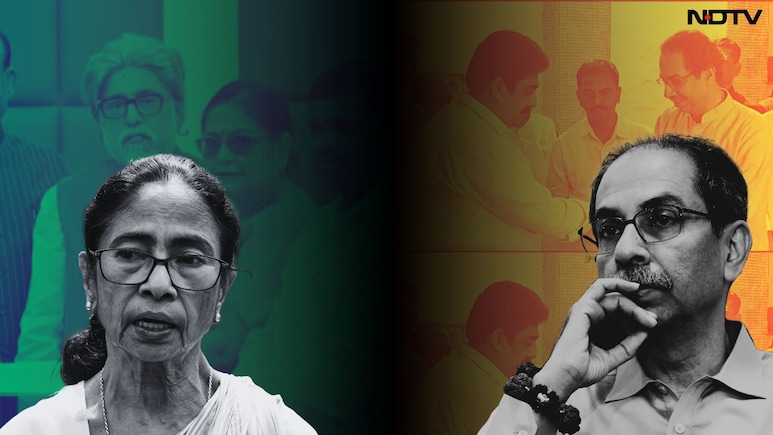
The parallel defection dramas playing out in West Bengal and Maharashtra should worry us as voters. They not only serve as a grim reminder of the growing crisis in an electoral democracy but also make a mockery of our choices in the polling booth.
Defections are not new. But the rate at which political parties have been splitting and regrouping in recent years -- as MPs and MLAs scurry around like headless chickens looking for new sanctuaries -- turns the spotlight on the anti-defection law. There are too many loopholes in the law, having been mutilated to further the interests of a self-seeking political class.
Beyond the law, however, shenanigans of resort politics and horse trading that accompany every defection episode pose a deeper and more fundamental question: should defections be allowed at all? Can we, in all conscience, as a democracy that is supposed to reflect the will of the people, sanctify the movement of MPs or MLAs from one party to a rival party after showering it with abuse the other day?
Opinion: With Trinamool Exodus, Bengal's Political Culture Enters New Phase
Consider the sordid saga unfolding in West Bengal. Within days of the defeat of Mamata Banerjee and her Trinamool Congress, 20 of her 28 MPs elected to the Lok Sabha just two years ago under her name and on her party symbol are preparing to jump ship.
The BJP doesn't want them in the party, but is ready to accommodate them in the NDA. The defection formula that has been worked out for them is a master class in creative interpretation of a supposedly law. The MPs will merge into a little-known party born in 2023, the Nationalist Citizens Party of India. It is registered with the Election Commission as an 'unrecognized' party, does not have a symbol of its own, and has fought only one election, the Tripura assembly polls in 2023, in which it bagged just 0.03 percent of the votes.
The NCPI neither contested the 2024 Lok Sabha elections nor the recent assembly polls in West Bengal, despite being registered in Howrah. With the merger of 20 Trinamool rebels, the party will transform overnight from anonymity into one of the largest blocs in the Lok Sabha. This is unprecedented in parliamentary history.
On the other side of the country in Maharashtra, Uddhav Thackeray's Shiv Sena is splintering. Two years after they fought a bitter battle with Eknath Shinde's faction in 2024 to determine which Sena is the real inheritor of Balasaheb Thackeray's mantle, six of Thackeray's nine MPs are in the process of crossing the floor to merge with the rival Sena.
The danger to electoral democracy from unprincipled about-turns is two-fold. One is the debasement of the mandate MPs and MLAs receive. Every defection invalidates the choice of voters. We vote for one party only to wake up one morning and find that our elected representative has decided to shift to a party we did not vote for. This is not just betrayal. It is the erasure of our choices as voters.
The other is the breakdown of the party system. Political parties are fundamental building blocks of our parliamentary model of democracy. When leaders sent by recognized parties to Parliament or state assemblies switch horses midstream for personal gains or whatever other reasons they offer to justify their decision, they pave the way for institutional erosion.
Opinion: Heir Not-So-Apparent: The New Reality Of Indian Politics
In West Bengal, Mamata Banerjee's Trinamool received 41% of the popular vote and won 80 seats. Today, 60 MLAs are poised to flee. If the Trinamool is reduced to nothing but a rump, that vote share becomes a meaningless number as the party faces extinction, not through the ballot but because of the narrow interests of a few.
The irony is that the anti-defection law was passed in Parliament in 1985 through a constitutional amendment. The purpose was to protect and stabilize the party system which had become vulnerable to erosion through defections.
Studies have shown that between 1967 and 1983, there were more than 2,700 defections in state assemblies, leading to chaos as parties disintegrated overnight and many simply disappeared from the political map.
The most famous defection was that of a Haryana MLA named Gaya Singh in 1967. He switched parties three times in two weeks, leading to the coinage of the notorious phrase 'Aaya Ram Gaya Ram'.
By 2003, it was evident that the anti-defection law needed further tightening. It was amended again that year to ban a 'split' and only recognize a 'merger'. In other words, rebel MPs or MLAs could break away from the mother party if they merged into another party. In a bid to make the law more stringent, the amendment raised the number required for a merger from one-third of the party's strength in the House to two-thirds.
It is obvious that even this hasn't stemmed the malaise of defections. They continue unabated as the lust for power and other benefits make politics increasingly transactional.
Perhaps, the time has finally come to consider banning defections altogether. Any elected representative wanting to switch parties is free to do so but he or she must first resign and seek re-election. Maybe that will make MPs and MLAs think twice before jumping ship.
Opinion: Rise And Fall Of Trinamool's Once-Unchallenged Yuvraj
The problem is this: who will bell the cat? Can the party that rules at the Centre be expected to initiate a path-breaking reform of this nature? The short answer is no because history tells us that the biggest beneficiary of defections is the ruling party. Of the 2,700 defections that took place between 1967 and 1983, 1,900 of them were to the Congress, which enjoyed unbridled power for most of those years.
And now, since coming to power in 2014, it is the BJP that has emerged as the chief gainer of defections, according to a study by the Association for Democratic Reforms.
The ball then rolls into the court of voters. They will have to show their disapproval by rejecting defectors at election time.
(The author is a senior journalist)
Disclaimer: These are the personal opinions of the author

