






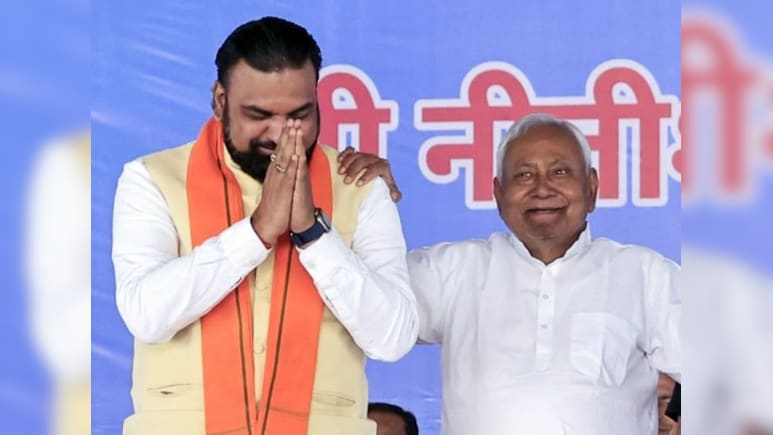
Politics is not a straightforward subject where every question has a clear and fixed answer. Here, equations change constantly and a state of flux is the only certain aspect of circumstances. Bihar is the test case.
For nearly 21 years, attempts were made to defeat Nitish Kumar and dislodge him from the Chief Minister's post. Now, the man stepping into his shoes is one who had once vowed to send the 75-year-old packing.
Since coming to power in 2005, Kumar has managed to hang on to the top post no matter which side of the political divide he has been on -- the NDA or the opposition Grand Alliance.
But this time, he has willingly given up the seat, sparking a massive change in the political dynamics in the state.
The state's top job has never gone to the BJP. This is the first time a leader from the BJP is set to become the Chief Minister.
Despite being the single largest party in the state for a considerable period, the BJP has been patient - part of the reason being Kumar's stature in the state as "Mr Good Governance (Sushan babu)" and the solid support from women he enjoys after the implementation of liquor ban.
His unexpected move also comes in the wake of multiple reports about his ill health. Leaders of the ruling alliance, though, said he was offered a Rajya Sabha seat and decided to fill up a gap in his resume.
Who Stepped Into Nitish Kumar's Shoes
The other thing most people did not anticipate even a few years ago was that the mantle of Chief Ministership would fall on Samrat Choudhary.
Back when Kumar had broken off from the NDA to join the Mahagathbandhan, Samrat Choudhary had taken a solemn vow: He would not don his "pagdi (turban)" - a symbol of honor and resolve - until he had successfully ousted Nitish Kumar from the Chief Minister's office. When Kumar returned to the NDA fold and once again occupied the top post, Choudhary, after a point, had to accept the role of his deputy.
Why Samrat Choudhary Was Chosen
Samrat Choudhary is an experienced leader with a strong organisational foundation. Within the party, he is regarded as an influential and prominent figure. So when Nitish Kumar severed ties with the BJP to form government in alliance with Lalu Prasad Yadav's Rashtriya Janata Dal, the BJP strategically projected Samrat Choudhary as the political counterweight to him.
A significant factor behind the decision is also the social equation within the state.
In Bihar, after the Yadav community (approximately 14 per cent) the combined population of the Kurmi, Kushwaha, and Dhanuk communities is estimated to be around 10 per cent.
Among these groups, the Kushwaha (Koeri) community is considered to have a relatively larger numerical strength.
Following Nitish Kumar's return to NDA in January 2024, Samrat Choudhary and Vijay Sinha were appointed as Deputy Chief Ministers - but the former was accorded greater prominence due to the dominance of OBC politics.
The BJP strategy being to stand on its own feet and implement its own political agenda, Choudhary was quietly projected as the face for the top post in the run-up to the stepping down of Nitish Kumar.
Exit Nitish Kumar
Although Nitish Kumar's resignation from the Chief Minister's post may sound simple, persuading such a seasoned political strategist to take such a step is considered a monumental feat. There was no row or overt dissent against Kumar. No political manoeuvre was needed either. Nitish Kumar not just resigned but also facilitated a smooth and seamless transfer of power to the BJP.
The Web of Social Equations
Caste-based equilibrium holds immense significance in the politics of Bihar. Since 1990, the dominance of OBC politics has grown steadily. Emphasising "social engineering," the BJP, too, has actively promoted OBC leaders and skilfully managed these social equations through coalition politics.
It was under this very strategy that an alliance was forged with Nitish Kumar in the past - the aim was to dislodge Lalu Prasad Yadav from power. Subsequently, it was conclusively proved that without Nitish Kumar, no coalition could either win an election or successfully form a government in Bihar. Whichever alliance Kumar joined, the coalition emerged victorious and formed the government.
Now, amid this political flux, neither Kumar nor the BJP is willing to take the risk of letting the Chief Ministership move away from the Kurmi/Kushwaha caste bloc and into the fold of another caste group.
It was with precisely this consideration in mind that Samrat Choudhary was projected as the candidate for the Chief Minister's post.
In Bihar, the combined population of the Backward Classes and the Extremely Backward Classes stands at approximately 63 per cent. Dalits comprise around 19.65 per cent of the population, while the other castes account for 15.52 per cent.
Eye on Uttar Pradesh Elections
The political landscape of Bihar and Uttar Pradesh bears a striking resemblance, as caste and religious cards play a prime role in the election in both states.
The political equation in Bihar - characterised by a dynamic of Yadavs versus Kurmis and Kushwahas - is, by and large, mirrored in Uttar Pradesh as well. Political shifts in Bihar could potentially ripple through the politics of Uttar Pradesh, where assembly elections are due next year.
Uttar Pradesh, too, is home to a substantial population of Kurmis and Kushwahas (including sub-groups such as Mauryas, Shakhyas, Sainis, Patels, Gangwars, Katiyars, Vermas, etc.). During the 2024 Lok Sabha elections, there was considerable discussion regarding a sense of resentment among certain segments of these communities.
The Bihar equation was finalised taking note of all these factors.

