






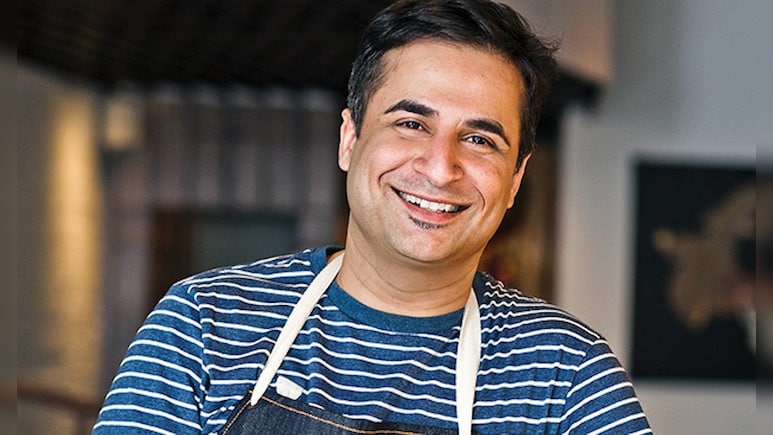
In his new memoir, Tell My Mother I Like Boys, Michelin-starred chef Suvir Saran trades the precision of a professional kitchen for something far riskier: emotional nakedness. The result is a book that reads less like a celebrity memoir and more like a long, unflinching exhale, the kind you can only take once you have lived through enough fire, enough reinvention, enough heartbreak to stop being afraid of your own truth.
Saran begins at the beginning, not with triumph, but with hesitation. He describes his birth as an "unsummoned third", a child kept almost by accident, raised in a Delhi where plurality was an instinct rather than a slogan. These early chapters are among the book's strongest: the rituals with his grandfather, the mixed faith prayer room, the quiet resilience of his mother. Saran approaches memory the way a chef approaches flavour: he lets it simmer, he layers it, he gives it time. And he refuses to simplify anything just because it is painful.
Cooking As Memory
The first act of the memoir, his childhood in Delhi, Nagpur, and back to Delhi, is told with striking sensory detail. Food is everywhere: laddoos being shaped in Panditji's kitchen, the bittersweet ritual of feeding birds as a form of remembrance, the scent of Nagpur oranges, the eggplant pickle from an upstairs neighbour that will later travel with him across continents. But this is not a "chef memoir" in the conventional sense. Cooking is not treated as destiny; it is treated as memory, inheritance, and sometimes refuge. Saran writes of kitchens the way some people write of prayer halls.
What gives the memoir its edge, however, is not nostalgia but confrontation. Saran does not gloss over cruelty, particularly the cruelty children inflict on each other. His descriptions of teasing, shame, and internal panic are direct without being self-pitying. The passages about being dressed up by cousins, the confusion that followed, and the quiet fear of not fitting into the masculine mould expected of him remain some of the most affecting sections of the book. He writes about queerness as a lifelong negotiation, a truth he understood long before he had the language for it.
The memoir's second act, Manhattan, is where the book shifts gears. The city is painted as both tormentor and liberator. Saran writes candidly about ambition, love, betrayal, infidelity, illness, and the brutal loneliness of a life that looks glamorous from the outside. The Michelin star is mentioned, of course, but never glamorised. If anything, Saran questions the very culture that once applauded him. He admits mistakes, he admits vanity, he admits selfishness. That honesty is precisely what strengthens the book.
Readers expecting a glossy narrative about culinary success might be startled by how much space Saran devotes to his emotional interior life: relationships that shaped him, relationships that broke him, and the grief that followed him across continents. His reflections on caregiving - both the caregiving he received from friends, and the caregiving he had to offer in times of loss - are some of the memoir's most assured lines.
Confession, Observation
But the memoir's deepest emotional anchor is his mother. Every few chapters, the narrative returns to her, her pragmatism, her quiet endurance, her refusal to flinch even when the world around her did. In one of the book's early chapters, he recalls her comforting him after he fails a dictation test, turning pain into possibility with nothing more than tenderness and chhola bhatura. These recurring portraits of his mother are crafted with restraint, not sentimentality. She is not idealised; she is honoured.
The writing style is surprisingly literary. At times, almost too lyrical, but Saran generally knows when to pull back. His voice moves between the confessional and the observational with a natural ease, and the book's emotional honesty feels earned rather than performed. There are a few moments where the metaphors crowd each other, but the narrative never loses clarity.
The last quarter, his fall, his illness, and his return to India, is the book's emotional core. When he writes about coming home "not in triumph but in tremor", the line lands with the weight of lived experience. And when he writes of India healing him, holding him, and giving him a second life, it is not a nationalistic flourish; it is gratitude, raw and grounded.
Tell My Mother I Like Boys is not a typical chef memoir. It is not a coming-out manifesto. It is not a voyeuristic celebrity tell-all. It is something far more intimate: a life examined honestly. A narrative built on vulnerability rather than victory laps. A story that refuses to tidy up the messiness of identity, love, culture, and family.
It is also a reminder that some of the most compelling memoirs come from people who have lived several lives in one, and are finally ready to tell the truth about all of them.
Saran does exactly that.
It is a brave book. A generous book. And a deeply human one.
Disclaimer: These are the personal opinions of the author

