






I went to Dhar on a Friday as a reporter with a to-do list: battery checks, mic levels, call-time reminders, and the unspoken rule that you must stand steady even when the ground inside you shifts.
But some places refuse to let you remain just a reporter. Some moments slip past the vigilant press badge and rekindle memories from childhood when you prayed with the innocent belief that the goddess would listen if you asked enough.
The Bhojshala Temple-Kamal Maula Mosque complex stands in Dhar like a sentence contested for centuries. For the Hindus, it is Bhojshala, the temple of the Goddess of Learning, Saraswati. And for the Muslims, it is a shrine to Kamal Maula. The dispute lives in courts, petitions, maps, survey numbers and orders. Official history has been filed and refiled here. But what I'm writing is not official history. This is what I witnessed and carried back.
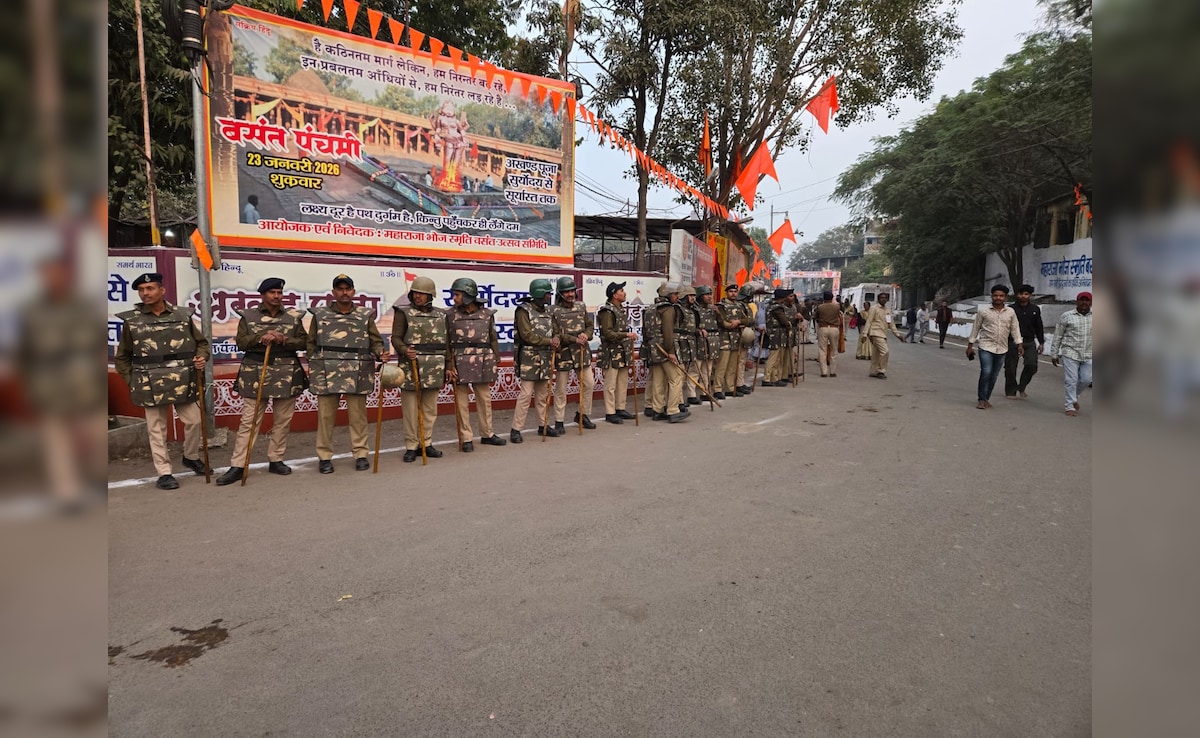
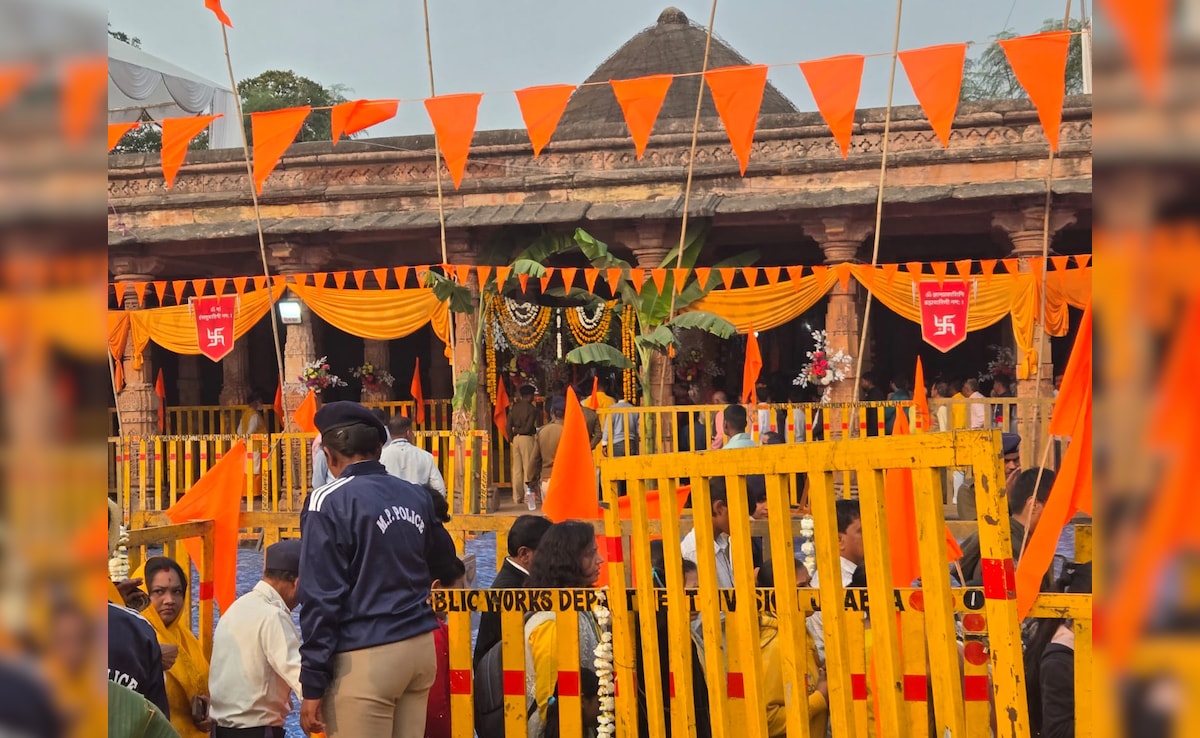
Heavy force was deployed to prevent any untoward situation
6:00 am: How The Day Began
At six, Dhar had the kind of quiet that feels earned. The air was cold enough to make your nostrils sting, and to keep people honest. The road to the complex had barricades planted like punctuation marks. Police boots scraped on stone as constables shifted their weight.
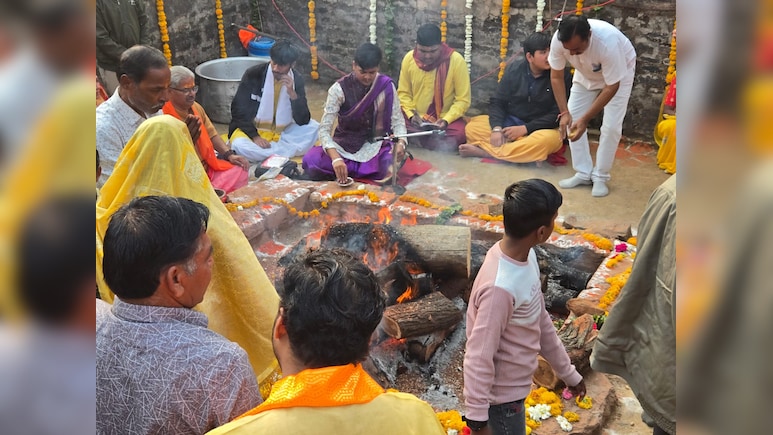
Inside, Havan preparations were underway. Wood was stacked in symmetry. Brass vessels waited for their big moment.
A priest murmured instructions. I offered my prayers too. Even with story angles flickering in my mind like camera frames, I bowed at a threshold that has held faith for centuries.
The idol of the 'Vagdevi' is not here, they say. It sits in a museum in London. Governments have claimed they will bring her back. But faith does not wait for governments. Devotees here worship a cutout image, a flat cardboard standing in for a thousand years of reverence.
8:00 am: The Mood Begins to Change
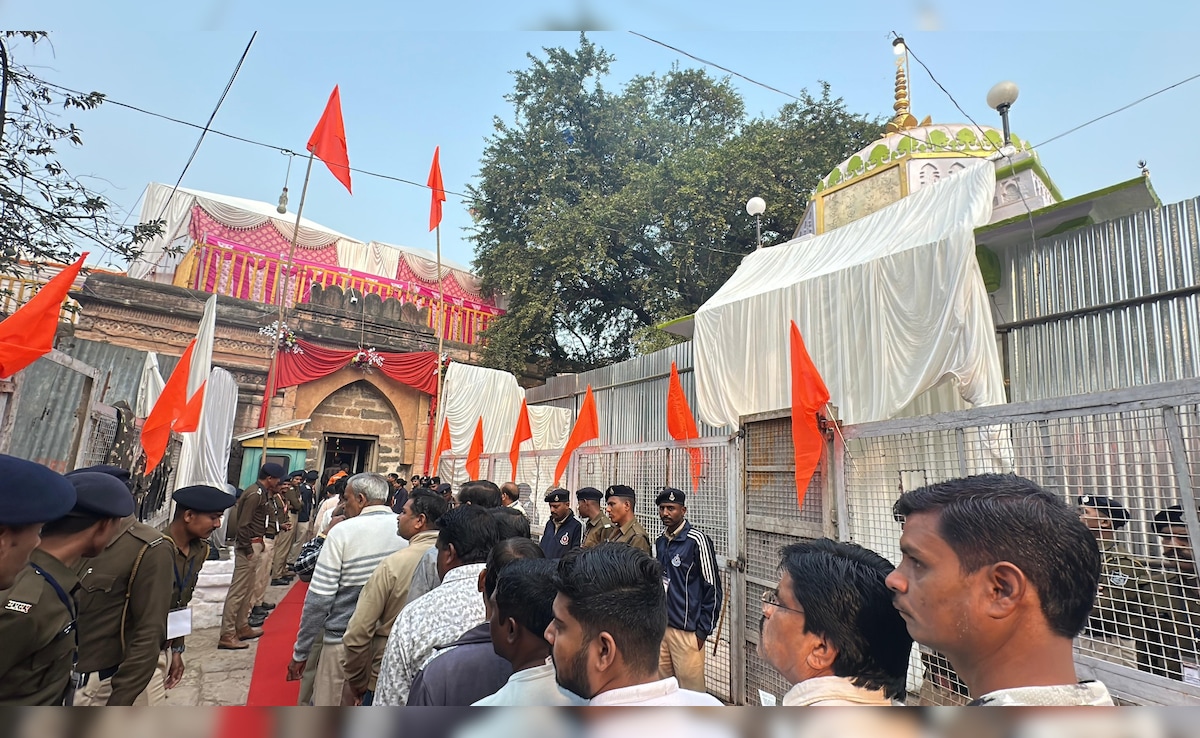
By eight, the complex had started filling up. The air was warmer, the volunteers moved fast, their instructions cutting through the crowd. The police presence was more visible: helmets, shields, walkie-talkies crackling with coded phrases.
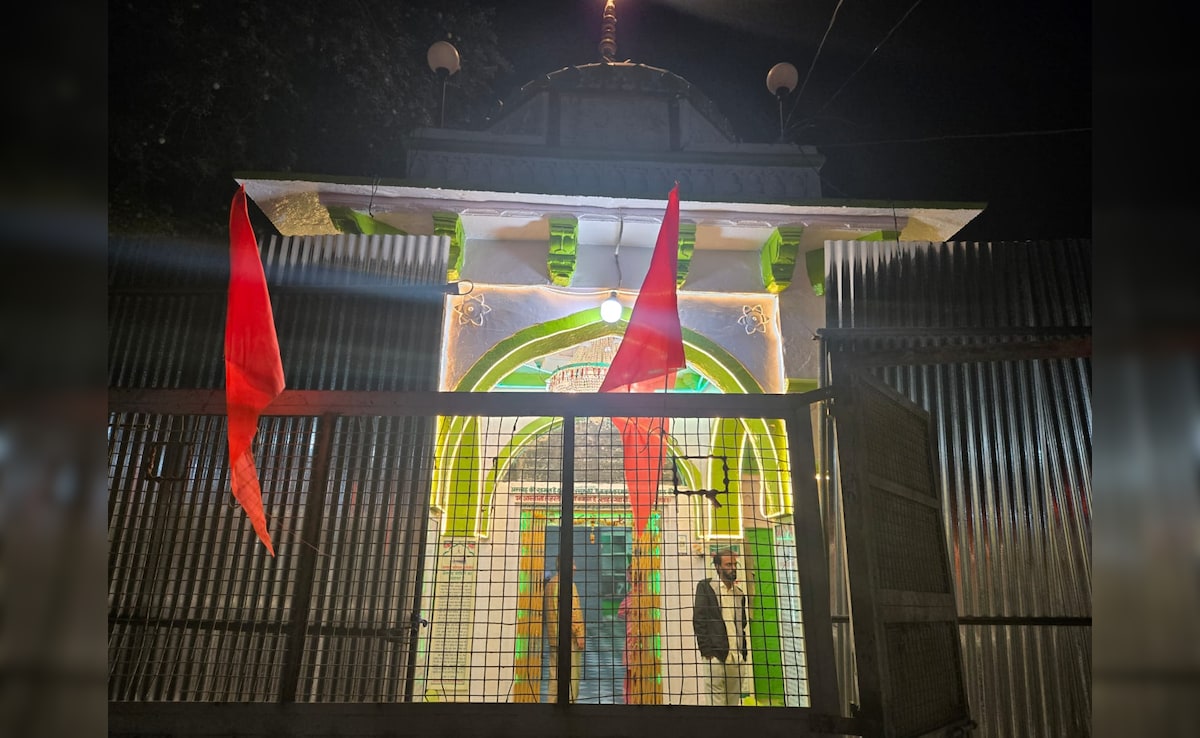
And then my eyes caught something. The adjacent Kamal Maula dargah, visible the evening before, was now covered with tin sheets and white cloth, as if someone had tried to tuck history away.
Maybe it was for security, a precautionary move.
I stood there watching the cloth ripple, and a thought crossed my mind... some things are not removed. They are made 'unseen'.
Then the chants began. "Jai Shri Ram".
On Basant Panchami, in the courtyard of Goddess Saraswati, the chants did not sound like a prayer, but a declaration. And then my childhood came before my eyes, a sepia-tinted, warm photograph that now seems unreal.
The Saraswati Puja of Our Childhood
We didn't eat berries before Saraswati Puja. That was the 'rule', sacred as any scripture in our small universe. We waited with a kind of childish discipline that felt like devotion.
Unlike other Pujas, Saraswati Puja was a DIY project. Boys would turn organisers. We would borrow sarees from our mothers, sarees soft from daily use, smelling of mothers and of home. These would then be tied to bamboo poles, and a pandal would be put together. No one questioned if this was enough; the Goddess of Learning does not stand on ceremony, she wants you to study hard, we were told.
But even Saraswati Puja needs some assistance from her sibling, Lakshmi. The fundraising would be aggressive. Boys armed with receipt books would hit neighbourhoods, arguing with uncles and aunties over what would be a decent contribution. Promises of 'bhog' and 'prasad' would be made during these negotiations, and there would always be generous benefactors who would make a large contribution to support the 'baccha party'.
These groups of boys would be seen visiting decorators, idolmakers and priests, determined not to be taken for a ride. Parents mostly watched from a distance. Their role was to visit the pandal in the evening and witness how the little ones had done.
As groups of boys organised these pujas, their religion, caste, and social status did not matter. What mattered more was timing. Saraswati Puja would come right before the final examinations. The year had been spent fooling around, and now these boys wanted the benevolent Mother's blessings to see them through. Each was praying for a different subject; someone wanted to top the class, while the other would be happy with passing marks.
That was Basant Panchami to me. A children's festival. A student's festival, and a quiet conversation with the Goddess of Learning.
Dhar's Posters And Maces
Dhar that day was plastered with posters that were a far cry from the Saraswati Puja I grew up with. I felt a kind of grief, the kind one feels on visiting their childhood home redesigned by strangers.
Saraswati is not merely the goddess of bookish education, she is the goddess of wise speech. She teaches that words can become weapons as well as medicine, so restraint and compassion must guide what we speak. Her message is simple and timeless: knowledge without arrogance, speech without bitterness, art without distortion.
At Dhar that day, I saw some young men swing gadas (maces), a surprising sight on Saraswati Puja. I asked, "What is the purpose of a mace in the worship of Goddess Saraswati? Why not bring pens and books?" They responded, "All gods and goddesses are one."
Yes, truth is one. But worship is not meant to be uniform. Sanatan Dharma, at its core, is the broad acceptance of different forms.
Creation is Brahma, preservation is Vishnu, transformation is Mahesh, knowledge is Saraswati, power and protection take the form of Durga, and prosperity is Lakshmi. This is not conflict, it's a way of reading life. The student turns to Saraswati, the warrior to Durga or Hanuman, the householder to Lakshmi-Narayan, the renunciate to Shiva. Even the calendar follows this rhythm... Basant Panchami for renewal and knowledge, Navratri for awakened strength, Mahashivratri for austerity and inner realisation, Diwali for light and abundance. I went back to reporting, but something inside me had begun to ache.
The Gate, And The Questions
Four gates had been built for Hindu devotees. A smaller gate sat near the police post: narrow, tightly controlled. Most of us in the media assumed Muslim worshippers would be brought in through that passage for prayers between 1 and 3 pm. We gathered there.
Between 2 and 2:30 pm, the air changed again. A group of about 250-300 people arrived. Mostly young. Some in black jackets, black sunglasses. They carried framed pictures of Vagdevi, held high like proof. And they insisted on entering through the same gate.
The police line tightened. The crackle of walkie-talkies became frantic. The crowd pressed forward. Anger rose. There was pushing and shoving.
And then the news came... Muslim worshippers were taken inside in a police van for prayers.
I thought: can we not welcome fifteen or twenty of our brothers into a complex where even the Supreme Court has permitted them to pray? Couldn't they have been given security? Would harmony have suffered if devotion from both faiths had unfolded simultaneously?
The Puja and the Namaz done, faith returned to litigation.
I kept searching for the fragrance of berries, for the childhood peace that made Saraswati Puja feel like an intimate conversation with the universe. But I couldn't find it.
I returned with footage, statements, and a story for the day. But I returned with something else: a question about what happens to prayer when it must travel in a police van? And what happens to Saraswati when maces replace pens?
Basant Panchami still comes. But the children who built pandals from their mothers' sarees, who didn't care to care about caste or religion and only believed the Goddess would see them through the exam, are now lost.
(The author is Executive Editor, NDTV)
Disclaimer: These are the personal opinions of the author

