





The results of the Legislative Council elections for 28 seats across Uttar Pradesh, Bihar, Maharashtra and Karnataka have set off a fresh war of words between the BJP and the Congress. The Prime Minister used the outcome to take a swipe at the Congress, mocking its "SIR/Vote Chori" campaign and pointing out that the party struggled even in a ballot-paper election, never mind with EVMs. The Congress, which has long demanded a return to ballot papers, hit back by noting that the BJP lost seats in the Prime Minister's own Varanasi and in Nagpur, the headquarters of the RSS.
Beyond the rhetoric, the numbers tell a more layered story than either side admits.
Who Actually Votes in These Elections?
Before reading anything into the results, it is important to understand what kind of contest this is. MLC polls in graduates' and teachers' constituencies are hyper-local affairs. Not every citizen can vote. Only graduates and teachers are eligible, and they must register themselves, since an ordinary voter ID card is not enough. The registration process is cumbersome, so turnout is low and margins tend to be tight.
Only six states have a Legislative Council: Uttar Pradesh, Maharashtra, Karnataka, Bihar, Andhra Pradesh and Telangana. These bodies have a fixed six-year term, with one-third of members retiring every two years, much like the Rajya Sabha.
The low turnout makes these elections a test of political management rather than a broad popular referendum. The party or candidate who registers the most voters usually wins. Over the years, muscle and money power have also grown in importance. Incumbent governments typically hold the edge because they command resources and administrative machinery.
The Big Picture
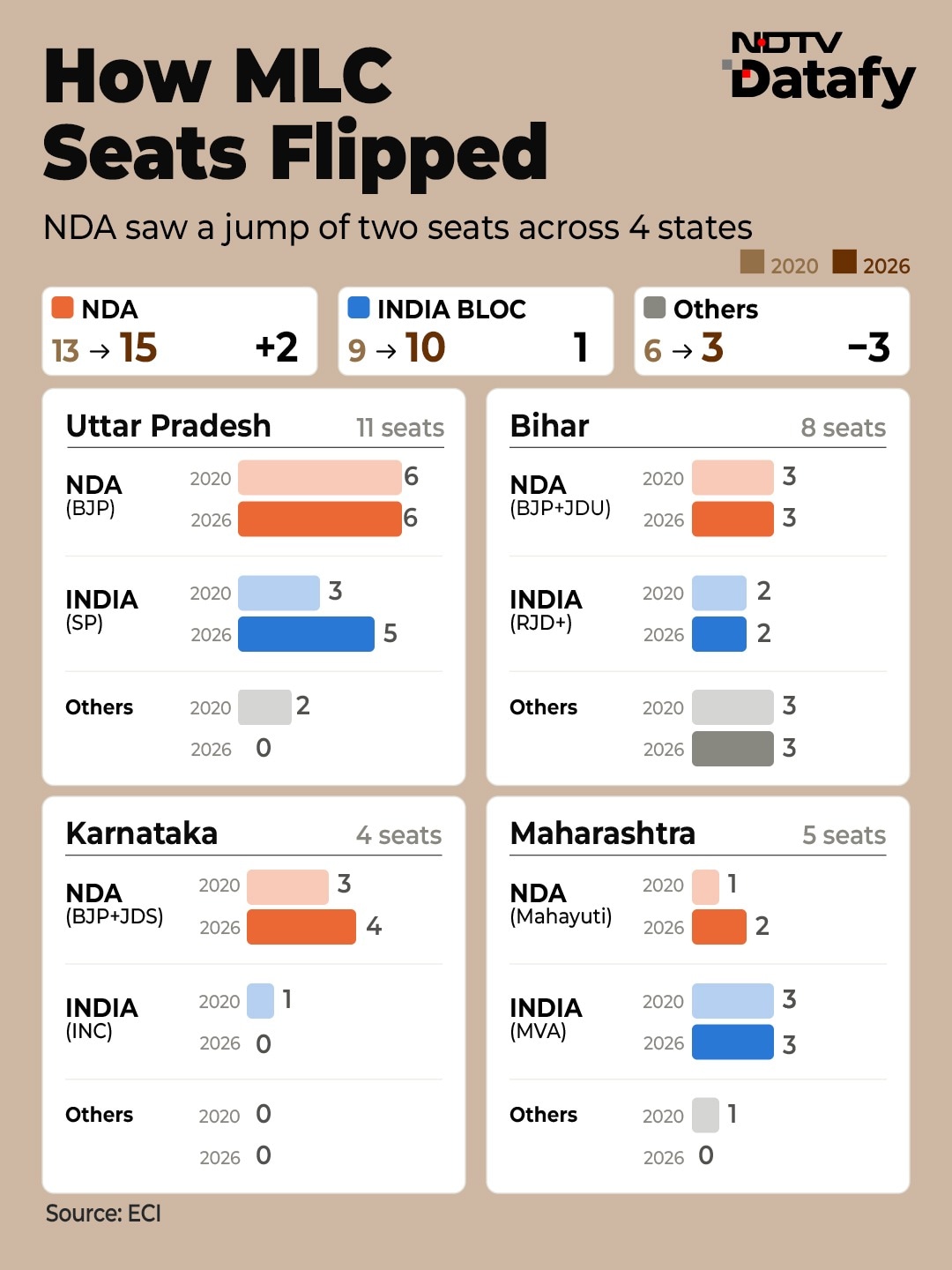
Across the 28 seats that went to polls, the BJP-led NDA moved from 12 to 16 seats, a gain of 4 seats. The BJP's own tally rose from 10 to 13, while its allies went from 2 to 3.
The INDIA bloc's overall total is unchanged, but the balance within it shifted sharply. The Congress fell from four seats to just one, while its allies rose from five to eight, with the Samajwadi Party, RJD and NCP (SP) among the gainers. "Others" lost four seats, exactly the number the NDA gained. In other words, the NDA's advance came largely from absorbing independents and smaller players rather than from defeating the opposition bloc head-on.
State by State
Uttar Pradesh. The NDA retained six of 11 seats, a clear majority. But the SP and its allies did even better in relative terms, gaining two seats, and the three independent or other seats disappeared, split between the two main camps. The SP's wins in Varanasi and Lucknow, the constituencies of the Prime Minister and Defence Minister Rajnath Singh respectively, carry symbolic weight. With Chief Minister Yogi Adityanath holding ground and Akhilesh Yadav showing a strong performance, the result offers a preview of the intense contest expected in the 2027 state elections. The losses also hint at friction between the central and state units of the BJP.
Bihar. The NDA reached four of eight seats, a tie rather than a majority, and the INDIA bloc lost one seat. The three "others" seats held steady, making Bihar the one state where they kept their ground. Prashant Kishor's Jan Suraj Party made its debut here, building on the momentum from its Bankipur by-poll win. For new Chief Minister Samrat Choudhary, who is still settling in, the message is mixed. For the opposition, the sign that voters are exploring options beyond the INDIA bloc is worrying.
Karnataka. This was the NDA's strongest showing, with all four seats going its way and the Congress left with none. It is a notable setback for a Congress party in power in the state, and an early setback for Chief Minister D.K. Shivakumar after the transfer of power from Siddaramaiah, which has exposed infighting in the Congress camp.
Maharashtra. This is the only state where the INDIA bloc (MVA) still leads, by 3 to 2. The MVA held its three seats while the NDA gained one at the expense of "others." The Congress retained the Nagpur seat, a symbolic win in the RSS heartland. For the ruling Mahayuti, the result points to poor coordination among allies, with the BJP blaming the Shinde Sena for lack of support. The rift between the two has been visible since Devendra Fadnavis took over the chief minister's chair from Eknath Shinde. The NCP seems to have weakened after Ajit Pawar's death, while Sharad Pawar's party picked up two seats.
The Congress Problem
The most striking trend is the Congress's decline within its own alliance. Falling from four seats to one, while regional partners grew from five to eight, makes the party the weak link of the INDIA bloc. It failed to retain even its 2020 tally.
This raises uncomfortable questions. Is there a disconnect between sentiment on social and traditional media and the mood on the ground? Is the "SIR/Vote Chori" campaign actually resonating with voters? Discontent against the government, where it exists, does not convert into votes automatically. The party needs a stronger organisation and better poll management, particularly the unglamorous work of getting supporters to come out and vote.
The BJP's Homework
The NDA has reason for satisfaction. Gaining four seats after six years, at a time when it is seen to be on the back foot amid protests and opposition attacks, is a real achievement, and the advance was broad-based, with a gain in every state.
Yet the losses in Varanasi, Lucknow and Nagpur call for introspection. These are graduate and teacher constituencies, where voters are educated and many are young. They may be using the ballot to register unhappiness over jobs and the economy. The BJP also needs to sort out rifts with its allies and within its own ranks before the crucial UP polls.
Key Takeaways
The NDA's gain is real but narrow. It rose in every state, yet only Karnataka was a clean sweep and only UP gave it a clear majority.
The INDIA bloc is stable only because of UP. The SP's two-seat gain offset losses in Bihar and Karnataka.
Bipolarity is deepening. Independents and smaller parties were squeezed in UP and Maharashtra, which account for the entire four-seat decline in "others."
Incumbency was not a guarantee. The incumbent-led camps held up in Bihar and UP, but the ruling Mahayuti in Maharashtra and the Congress in Karnataka both stumbled.
Management beats mood. In low-turnout electorates, organisation and voter registration matter more than headlines.
Congress is the weak link in INDIA bloc. It fell from 4 seats to 1, while regional allies grew from 5 to 8
MLC results are a poor predictor of general elections, given the narrow and self-selected electorate. But as a measure of party machinery, alliance health and the mood among educated voters, they are a useful early signal. With UP heading to the polls next year, both camps have plenty to think about.
(Amitabh Tiwari is a political strategist and commentator. In his earlier avatar, he was a corporate and investment banker)
Disclaimer: These are the personal opinions of the author

