





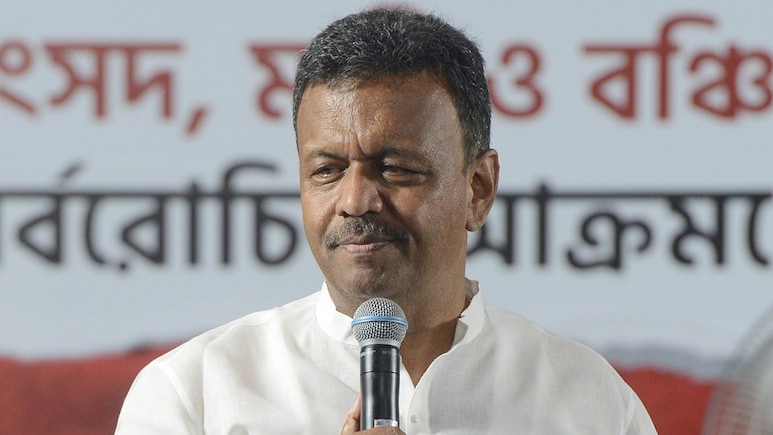
Firhad "Bobbi" Hakim, one of Mamata Banerjee's closest associates and among the most influential Muslim leaders in the Trinamool Congress, met Leader of the Opposition Ritobrata Banerjee at his office on June 8. According to the report, the meeting lasted nearly seventy minutes and immediately triggered speculation about a deeper crack emerging inside 30B Harish Chatterjee Street, Mamata Banerjee's political residence and symbolic power centre.
The timing of the meeting made it even more politically significant.
Firhad Hakim had only recently resigned from the post of Mayor of the Kolkata Municipal Corporation, reportedly with Mamata Banerjee's consent. Initially, Mamata was not comfortable with the idea of his resignation. However, Babi Hakim eventually convinced her. At that time, his public argument was that it had become increasingly difficult for him to function under the new administrative setup after the rise of the BJP government under Suvendu Adhikari.
But the bigger political question now is different: why did he meet Ritobrata Banerjee privately, and what exactly was discussed during those seventy minutes?
Ritobrata's camp wasted no time in fuelling speculation. Leaders from his group openly claimed that Babi Hakim was already politically aligned with them and that only a formal declaration remained. One senior figure associated with the rebel faction even informed sections of the Bengal media that Hakim's transition was now "only a matter of time."
This development carries weight because Firhad Hakim was not just another senior TMC leader. For years, he was widely seen as Mamata Banerjee's most trusted face within Bengal's Muslim community. He handled sensitive minority issues, maintained political communication with influential Muslim groups, and was often perceived as a protector of Muslim interests inside the TMC framework.
That is precisely why the developments after the 2026 West Bengal Assembly election are being viewed as politically historic. For the first time in the 15-year history of Trinamool Congress rule, several influential Muslim leaders and legislators have either distanced themselves from the party, openly revolted, or aligned themselves with anti-TMC political formations.
Among them are:
- Niyamat Seikh from Hariharpara
- Mohammad Nur Alam from Samserganj
- Sabina Yasmin from Sujapur, who was also a minister in Mamata Banerjee's cabinet
- Akhruzzaman from Raghunathganj
- Gulshan Malik from Mothabari
- Javed Khan, one of Kolkata Corporation's most prominent Muslim leaders and MLA from Kasba
- Kajal Sheikh from Birbhum
And the list does not end there.
Later, during the political churn surrounding the Lok Sabha MPs who revolted against the party line, several Muslim leaders were again found among the dissident bloc. Those names included the following:
- Khalilur Rahman from Jangipur
- Yusuf Pathan from Gaiyespur
- Abu Taher from Murshidabad
- Sajeda Ahmed from Fulbaria
All of them belong to the Muslim community. This marks a major psychological and political shift in Bengal politics. For years, there existed a strong perception that Muslim leaders and voters would never move toward the BJP or align themselves with forces opposing Mamata Banerjee. That mental barrier now appears to be weakening.
The significance of this development is not limited to party defections alone.
One side of the story is the internal rebellion within the Trinamool Congress. The Kolkata Municipal Corporation slipping out of the party's unquestioned control and rebel MLAs and MPs extending support to the NDA are themselves major political developments. But an even bigger ideological transformation may now be unfolding beneath the surface.
For decades, the BJP was treated as politically "untouchable" by large sections of Bengal's Muslim population. Now, with Muslim leaders themselves crossing over or opening communication channels with BJP-backed political platforms, a new question is emerging in Bengal politics: Is the Muslim community's attitude toward the BJP gradually changing? And if that is happening, can the BJP's own strategy toward Muslims also evolve in the coming years?
This debate has gained further importance because, during the 2026 West Bengal Assembly election, the BJP did not field a single Muslim candidate. Similar political experiments had previously been attempted in states like Uttar Pradesh as well. Several BJP leaders had publicly argued that if Muslim voters were not supporting the BJP electorally, then the party had little reason to field Muslim candidates merely for symbolic representation.
At the same time, doubts and dissatisfaction regarding the functioning of minority institutions and commissions in West Bengal have also been growing among sections of the Muslim community. There is frustration in certain pockets over representation, governance, development, and political patronage.
Against this backdrop, the movement of Muslim leaders away from the TMC cannot be dismissed as isolated incidents anymore. The larger question now is whether this is merely a temporary rebellion born out of post-election instability or whether Bengal is witnessing the beginning of a deeper political realignment within its minority vote base, a vote base that had remained firmly loyal to Mamata Banerjee and the Trinamool Congress for more than a decade. That answer is still unfolding.
(The author is Contributing Editor, NDTV)
Disclaimer: These are the personal opinions of the author
Track Latest News Live on NDTV.com and get news updates from India and around the world

