






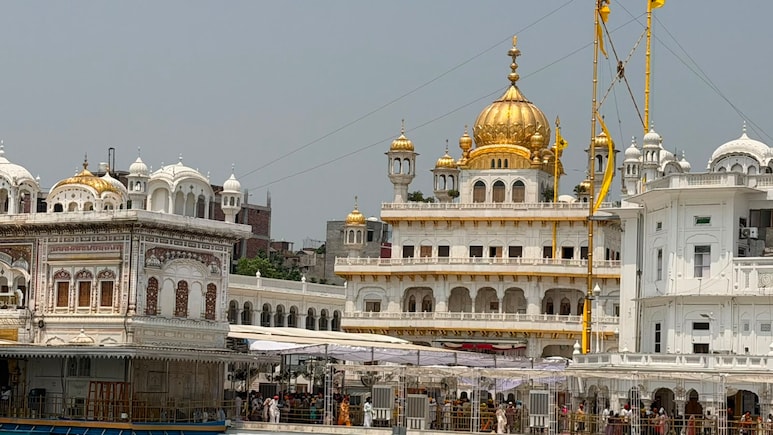
A sacred Sikh space in the Deccan has become the setting for a question Punjab can no longer avoid. What happens when religious identity, grievance and violence begin appearing too closely together?
The motive behind the attack on Sukhbir Singh Badal remains under investigation. But the incident raises questions about the direction of Sikh public discourse. I was in Nanded in June, walking through a city where Sikh history feels inseparable from the cultural world around it.
Takht Sachkhand Sri Hazur Sahib is a holy centre of enormous importance, associated with Guru Gobind Singh's final days in 1708 and the continuing Sikh presence in the Deccan.
That experience challenged the neat categories through which many of us in Delhi have understood Sikhi.
Sikhs in the Deccan have absorbed the cultural landscape around them without surrendering their own identity.
Then, back in London, came the news that Sukhbir Singh Badal had been attacked inside a gurdwara in Nanded by Jaspal Singh, identified by police as a Nihang.
Badal reportedly suffered a penetrating wound to his hand and underwent surgery.
A Faith That Leaves Room For Mercy
The question is larger than Badal.
He carries political baggage. The sacrilege incidents of 2015, during the Akali-BJP government, caused a wound that cannot be dismissed in religious life.
The controversies around the handling of those cases and the religious pardon granted to Sirsa Dera chief Ram Rahim by the then Jathedar of the Akal Takht for an earlier instance of blasphemy, followed by its revocation, remain embedded in Sikh memory.
Badal later sought Panthak and religious forgiveness for wrongdoings committed during his years in power.
Sikhi gives considerable space to confession, correction and forgiveness.
Gurbani places daya at the heart of the Sikh moral imagination.
“Make compassion the cotton, contentment the thread, modesty the knot and truth the twist.”
— Guru Nanak, Ang 471, Sri Guru Granth Sahib
The Guru turns daya into the material from which the sacred thread of the soul is made. Compassion is foundational.
Guru Arjan, the fifth Guru, describes the Divine as:
“The Supreme Being is the treasure of mercy, compassionate and forgiving.”
So what should religious wrongdoing produce?
A demand for accountability, repentance and justice.
The answer cannot be presumed to be violence. And in Nanded, with the motive still unknown, it would be irresponsible to presume that it was.
The Nihangs And A Damaging Headline
There is another uncomfortable part of this story.
The Nihang order has a long and important place in Sikh history, associated with martial service, protection of Sikh institutions and distinctive traditions.
In recent years, however, Nihangs have repeatedly entered public headlines for the wrong reasons.
In England, the murder of 18-year-old Henry Nowak by Vickrum Digwa became entangled in public discussion about Sikh identity, the kirpan and the convicted attacker's association with Nihang traditions. Sikh organisations condemned the murder. The case also generated wider hostility and misinformation around Sikhs in Britain this year.
Now Nanded brings the Nihang identity back into headlines, this time through an attack on the head of the Shiromani Akali Dal inside a gurdwara.
This recurring association with acts of violence in public discourse should concern the Sikh community.
A tradition known for the kirpan, a symbol whose name is traditionally linked to kirpa, or grace, cannot allow a sword used as an attacking weapon to become its most visible public language.
Looking Beyond The Panthak Space
Badal is at his strongest when he acts as a public figure for Punjab in all its diversity.
Last year, when floods ravaged the state, he was on the ground.
During the farmers' agitation, he stood beside farmers.
The SGPC, controlled by the Shiromani Akali Dal, has repeatedly been among the first Sikh institutions to mobilise during major crises.
That is useful public leadership.
He becomes vulnerable when he overreaches into Panthak theatre.
His embrace of the Satluj movie to appease hardline sections brought old questions rushing back: senior police appointments under the Akali-BJP governments, the 2015 sacrilege cases, the Dera pardon and the political decisions surrounding it.
The Panthak space once occupied by the Badal-led Shiromani Akali Dal is increasingly being contested by Amritpal Singh's Waris Punjab De.
Badal would rather serve Punjab better by concentrating on debt, jobs, agriculture, education, healthcare and investment.
Like Uddhav Thackeray, Akhilesh Yadav, Arvind Kejriwal and Rahul Gandhi, he should have registered his presence at Gen Z protests at Jantar Mantar. The SGPC, after all, itself runs medical and higher educational institutions. The stakes are common.
Young Punjabis asking for opportunity and a future are speaking directly to the institutions that claim to represent their aspirations.
That is where the political contest will ultimately be decided.
A Larger Sikh Question
During colonial rule, Sikh author Kahn Singh Nabha (1861-1938) wrote 'Hum Hindu Nahin' to assert Sikh distinctiveness.
Today, perhaps Sikhs need another question. Hum Abrahmic Bhi Nahin.
The point is not theological rivalry. It is a warning against importing a politics of religious offence in which perceived wrongdoing invites personal retaliation, public punishment or vigilante justice.
Sikhi has its own moral vocabulary.
Daya. Khimaa. Santokh. Seva. Kirpa. Bakhshish.
In June, Nanded gave me a glimpse of a Sikh tradition spacious enough to absorb cultural diversities without losing its identity.
Two months later, the attack on Badal presents a very different image from the same sacred landscape.
The motive may eventually explain the attacker's actions. The larger significance lies in how the incident enters Sikh public discourse, especially at a time when violence, religious offence and retribution are increasingly appearing in the same conversation.
Nanded, in that sense, offers both the contrast and the context.
(The writer is a career journalist currently serving as Communications and Advocacy Director at UNITED SIKHS in the UK, a charity registered in England and Wales.)
Disclaimer: These are the personal opinions of the author

