






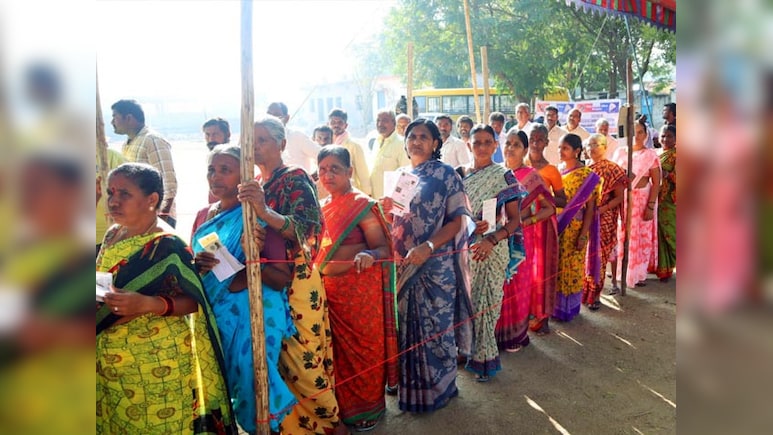
The numbers have not just broken all records, but they are truly staggering. More than 85% in Tamil Nadu and more than 92% virtually in West Bengal, is something no political analyst or pundit or perhaps even the political parties had anticipated. When such massive percentages of people vote in an Assembly election, all bets go out of the window. Of course, the first caveat that must be entered here is that because of the SIR, there has been a significant deletion of the number of voters in all the states where the exercise has been conducted. West Bengal, particularly, has seen close to 90 lakh voters being deleted from the rolls because they were either dead, absent or voting.
In other places, something similar has happened even in Tamil Nadu, with large-scale deletions. So, when the number of voters actually goes down, as it has happened in West Bengal, it is quite natural for the polling percentage to go up statistically. But even with that explanation, it is astounding the manner in which the people of West Bengal and even Tamil Nadu have voted is astonishing. The last time such massive numbers were seen in Tamil Nadu was in 2011, when Jayalalithaa won a thumping victory, and ditto in 2011 in West Bengal, when Mamata Banerjee had broken through the citadel of the Left and captured power in West Bengal.
But beyond that, these kinds of polling percentages are unheard of in India, in any part of India. So what do they signify?
Before we go into that, let us also mention one significant factory. The difference is not huge, but it is still significant. In both West Bengal and Tamil Nadu, the percentage of female voters is approximately 2% higher than that of the male voters, which means, like with many assembly elections held in the recent past, the female voters have outnumbered the male voters when it comes to going to the polling booth and exercising their franchise.
That itself is a very significant and historical event, because traditionally, women voters are expected to mirror the family patriarch's voting choices. Repeated elections in the last five years or so have shown and indicated that it is no longer the case. For instance, look at Bihar, the latest example, where the females defied poll pundits and the so-called 'anti-incumbency' against the NDA regime, which has been more or less in power in the state since 2005. They gave a resounding victory to the Nitish Kumar-led NDA in Bihar. Can we expect something similar in Tamil Nadu, given the scale of voting, and in West Bengal, where the voting percentage is about 92%?
Such calculations aren't easy.
For instance, traditionally, female voters have favoured the AIADMK in Tamil Nadu, while female voters have usually preferred Mamata Banerjee and Trinamool Congress in West Bengal. Will that be repeated this time? That's a tough call to make due to various factors.
Look at Tamil Nadu. The entry of the film star Vijay Joseph with his new party has added uncertainty to the elections. What vote share, particularly among female voters, his party will get is going to determine, to a large extent, the outcome of the polls. If Vijay manages to attract only anti-incumbent votes who are unhappy with the DMK-led government, then he will end up damaging the NDA and handing over a victory to the DMK-led Alliance. But if Vijay manages to pull more than a 20-25% vote share, then all bets are off. With such a three-cornered contest, all possibilities are wide open.
West Bengal is a different kettle of fish altogether, as far as female voters are concerned. The first thing that needs to be said about the state is that, compared to the previous elections, violence has been largely checked because of the strong presence of Central and paramilitary forces. This has resulted in better female turnout in most sensitive areas. Besides that, the BJP has mounted a very, very sustained challenge, thus increasing the turnout level purely on competitive parameters.
The third factor is the unpopularity of the Trinamool Congress at the local level. Though Mamata Banerjee still remains quite popular as the Chief Minister among the female voters of the state, the corruption problem in the state and the lack of decent jobs and infrastructure have led to deep anti-incumbency against her government. It is not a battle between Mamata and the BJP, but one between Mamata's popularity and her government's unpopularity.
Then there is the Hindutva factor, which really does not play a significant role in a state like West Bengal - at least it hasn't traditionally and historically. What role it will play this time is for the pundits to guess. By and large, we have seen women voters defy the traditional caste and religion-based polarisation and vote on issues that matter to them the most, including state-run welfare schemes. But when women's safety and security get mixed up on communal grounds, we end up entering uncharted territories.
Can the BJP really pull off a win? It's a challenging task. But then, who knows? The BJP has often surprised political commentators and pundits. Between the BJP and an upset win, there is just one last bit of the jigsaw puzzle that Modi-Shah strategists need to figure out: it's the female voters of West Bengal. And most critically in the areas, the southern Bengal and the Presidency region going to polls in the second phase, which happens to be the personal turf of Mamata Banerjee. The voters in this region, particularly the female voters, have stood rock solid behind her even during the most brutal years of political prosecution under the Left's rule. It is this region that became the base of 'Poiborton' in the historic 2011 verdict when the Left was uprooted after three long decades. The question is: has that 'Porborton' reached the women of West Bengal in real terms? If yes, then Mamata Didi is safe. If not, then we are looking at some rollercoaster times during the counting of votes on May 4.

