





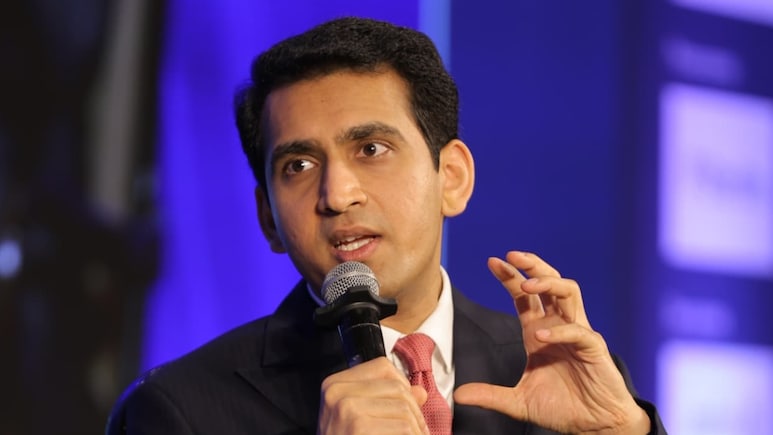
As rising US-Iran tensions rekindle fears of disruption across Middle Eastern energy supply routes, India's reliance on imported fuel is under scrutiny once again. That vulnerability has renewed focus on domestic power buildouts and on Sagar Adani, a 31-year-old executive director at Adani Green Energy who now sits at the centre of one of India's most ambitious energy expansion plans.
Adani joined the Adani Group after graduating from Brown University, beginning his career with hands-on roles at the group's early solar projects, including long stints living on site during plant construction in South India. That grounding shaped how he now talks about energy in public forums.
Speaking at The Economist Resilient Futures Summit, Adani put it plainly: "Access to energy will decide resilience. At the end of the day, it is electricity that turns aspiration into reality."
Today, he helps oversee Adani Green Energy's renewable portfolio and works closely across transmission and thermal power businesses that, together, form the group's broader energy platform.
Adani Green Energy operates close to 20 gigawatts of renewable capacity and plans to scale this to 50 gigawatts by 2030. A key part of that expansion is Khavda in western India - a 30-gigawatt, single-location renewable project that the company calls the largest energy project of any kind anywhere in the world.
Adani's rising profile comes at a time when India's energy choices carry growing global weight. The country is already the world's third-largest energy consumer and is expected to drive a large share of global demand growth over the next two decades. How that demand is met will shape fuel markets and influence climate outcomes.
Few corporate leaders speak to that concern as directly as Sagar Adani. "Whatever happens in West Asia, the answer for India is energy resilience," he said, arguing for a broad mix of power sources. On recent shifts within OPEC and wider regional changes, at the Economist Summit, he offered a view rarely heard in global debates: "Time will tell whether these moves disrupt markets or actually stabilise them. From India's point of view, they could well turn out to be a stabilising force rather than a shock."
The Adani Group has committed $100 billion towards energy transformation across India, covering renewable projects, grids and modern thermal capacity. Adani has credited government support for speeding up renewable manufacturing and project execution, but stressed that delivery matters more than announcements. "The transition won't be decided by intent," he said. "It will be decided by what gets built on the ground."
(Disclaimer: New Delhi Television is a subsidiary of AMG Media Networks Limited, an Adani Group Company.)
Track Latest News Live on NDTV.com and get news updates from India and around the world

