





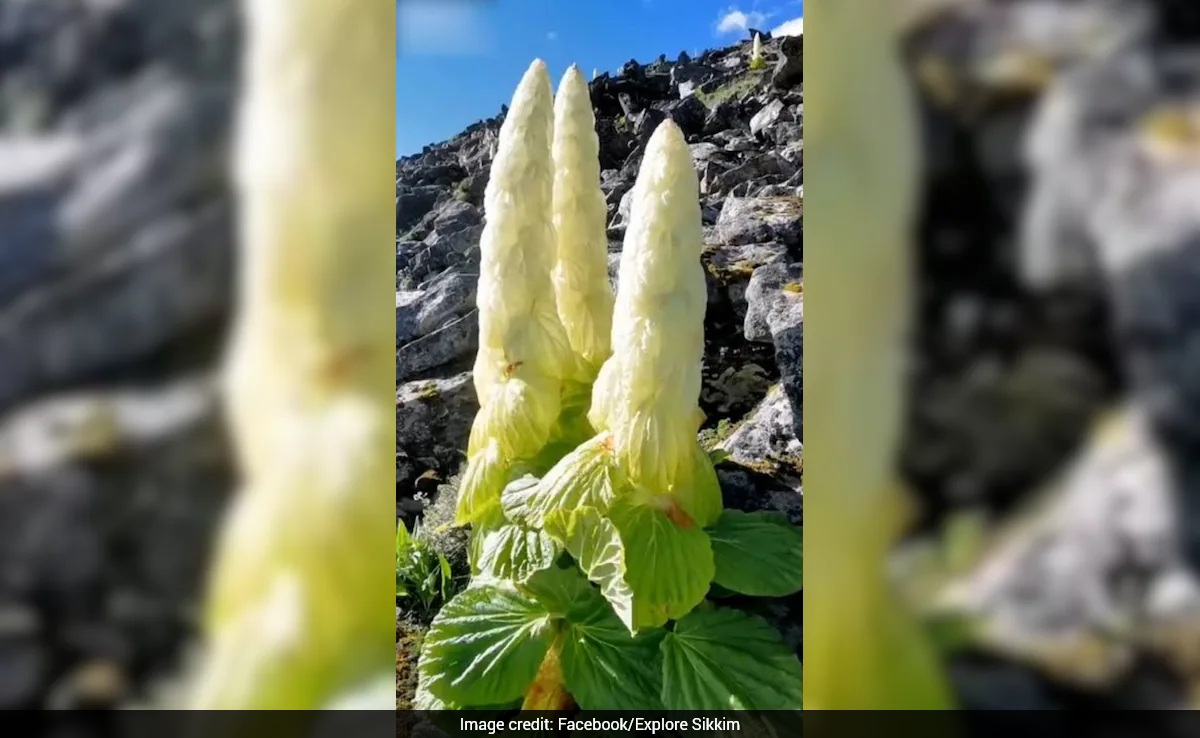
Industrialist Anand Mahindra has drawn attention to one of the Himalayas' most extraordinary plants - the Sikkim Sundari - prompting a conversation online about India's natural heritage. Found in the remote alpine zones of the Eastern Himalayas at altitudes between 4,000 and 4,800 metres, the plant - botanical name Rheum nobile - thrives where few others can. Locally known as Chuka, it is a giant herbaceous species related to rhubarb, distinguished by its towering, translucent bracts that give rise to its evocative nickname, the "Glasshouse Plant" - a natural adaptation that traps light while blocking harmful ultraviolet radiation at high elevations.
Mahindra described the Sikkim Sundari's life cycle as a "masterclass in patience". For years, sometimes decades, the plant remains a modest rosette of leaves, quietly accumulating energy in one of the world's harshest environments. Then, in a single dramatic act, it shoots up to nearly two metres tall, forms a striking, pagoda-like inflorescence, releases its seeds and then dies - a biological strategy known as monocarpy.
I knew nothing about this extraordinary marvel: the ‘Sikkim Sundari'
— anand mahindra (@anandmahindra) December 21, 2025
Thriving at staggering altitudes of 4,000–4,800 meters, this "Glasshouse Plant" stands like a glowing tower against the mountains.
Its life is a masterclass in patience.
It is monocarpic, which means that… pic.twitter.com/keoMSmGcUl
"It's the stuff of poetry, yet my school biology textbooks (from ages ago, of course!) never mentioned it, even while describing flora from halfway across the world. I wonder if current Indian school curricula finally reference this local legend?" the industrialist said in a post on X.
His post started a debate with experts also weighing in.
"This flower is also used in medicine, it proves effective in digestion, swelling, liver and pain," commented Dr Sheetal Yadav, whose X account describes her as a teacher.
"In Malayalam, sundari means "beautiful lady". Sikkim Sundari is sundari indeed," said another user. "It immediately reminded me of Brahma kamal from Uttarakhand, which is of a different shape but is found at similar altitudes, and the colours are also almost identical," a third user said.
According to botanical sources like Flowrrs of India, the plant's translucent, straw-coloured bracts with pink-tinted edges stand like a glowing beacon against rugged mountain slopes, visible from afar across valleys. Beyond its poetic life history, Rheum nobile holds cultural value in local communities and features in traditional uses: its stems are sometimes eaten, and its large, bright yellow roots have roles in local medicine.
Track Latest News Live on NDTV.com and get news updates from India and around the world

